
A studio for bird study

Some Notes on the Gray-crowned Rosy Finch- Leucosticte tephrocotis

by Bryce W. Robinson

IMG_8747

Juvenile “tephrocotis” Gray-crowned Rosy Finch. Brooks Range, Alaska. July

Caitlin Davis recently shared some photos with me of a small group of Gray-crowned Rosy Finches that visited her this fall at the Goshutes in eastern Nevada. The photos showed two different types of Gray-crowned Rosy Finch, one with gray cheeks, the other with brown. The photos reminded me of the flocks I saw while counting migrants there last fall. I remember seeing the two cheek colors, along with a few Black Rosy Finches intermixed in the flocks, which was exciting. My exposure to the birds did not end with the Goshutes. Over the course of the winter I saw a number of birds, and studied the differences in plumage that I observed.
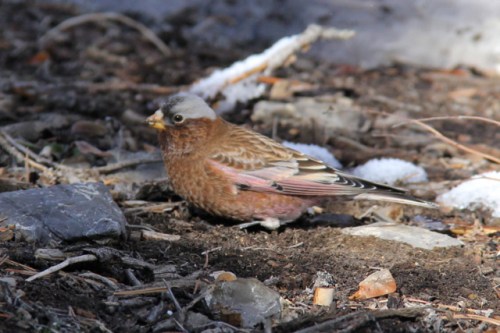
Adult "Tephrocotis" Gray-crowned Rosy Finch. Goshutes Mountains, Nevada. October

Adult “tephrocotis” Gray-crowned Rosy Finch. Goshutes Mountains, Nevada. October

"Hepburns" Gray-crowned Rosy FInch. Goshutes Mountains, Nevada. October.

“Hepburns” Gray-crowned Rosy FInch. Goshutes Mountains, Nevada. October.

The two types of plumage illustrated in Caitlin’s photos are a function of subspecies. There are six recognized subspecies in North America, most easily distinguished by the color of their cheek. Three subspecies have gray cheeks, while the others have brown cheeks. The”Hepburns”, a coastal gray cheeked group ranging from Alaska to northern California, winters in the interior west with another group, a brown cheeked bird, the nominate tephrocotis, an interior subspecies ranging from the Brooks Range of northern Alaska to the Rocky Mountains of the lower 48.
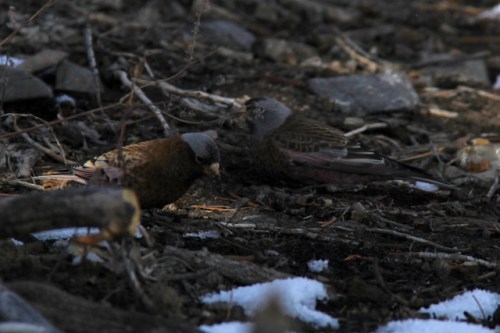
"Tephrocotis" (left) and "Littoralis" or "Hepburns" (right). Goshutes Mountains, Nevada. October.

“tephrocotis” (left) and “littoralis” or “Hepburns” (right). Goshutes Mountains, Nevada. October.

I find it interesting that these birds form these large flocks, intermixed with obviously separate populations. What this speaks to is the nature of flocking in this species. I’d love to track each group, as they break apart with the onset of spring, and then form into their winter groups with the inception of fall.

After the past winter, I found an interest in the small fringillid. I spent a bit of time studying and learning parameters of the subspecies. After making plans to drive to the great north, I realized the potential of seeing the tephrocotis at the northern extent of its range. That thought was ultimately exciting, but even more so was my excitement when I actually found a small group in the Brooks Range of northern Alaska. I was only able to get photos of one cooperative juvenile, regrettably. The adults were very shy, and stayed far from range of my lens.

I plan to locate some flocks this winter, in hopes of studying the birds in the field and getting some additional photographs. What I would like to work out is the ability to sex each individual, and hopefully find a bird in its first basic plumage. I’ve learned some of the characteristics of each sex, now I just need to test those in the field.

After reviewing a photo from last winter, I noticed an aspect of the birds plumage I haven’t read about or heard of. In the photo below, the bird has a great deal of black on the cheeks, rather than brown or grey. This is worth some thought, and one of the reasons I’m anxious to find a large flock and see if there are other instances of variability. Perhaps it is an expression from a lineage closely tied to the Black Rosy Finch. After all, I’ve heard buzz of the possibility of the North American Rosy Finches being once again lumped as a single species. It would be fun to really get to the bottom of how different each population truly is.

"Hepburns" Gray-crowned Rosy Finch, exhibiting a great deal of ashy black on its cheek. West Desert of Utah, January.

“Hepburns” Gray-crowned Rosy Finch, exhibiting a great deal of ashy black on its cheek. West Desert of Utah, January.

Maybe, if I have some luck this winter and really get to know this species, I can illustrate what I’ve learned about how to distinguish individuals to age, sex, and subspecies. And the intellectual journey continues.


Referenced information:

Macdougall-Shackleton, Scott A., Richard E. Johnson and Thomas P. Hahn. 2000. Gray-crowned Rosy-Finch (Leucosticte tephrocotis), The Birds of North America Online (A. Poole, Ed.). Ithaca: Cornell Lab of Ornithology; Retrieved from the Birds of North America Online:http://bna.birds.cornell.edu/bna/species/559 doi:10.2173/bna.559 Accessed 11/10/2013
The Le Conte’s Sparrow: An Idaho State Second, Not Seen Since the Late 1800’s

by Bryce W. Robinson

LCSP1113

I spent the day birding with Jay Carlisle, Heidi Ware, Caitlin Davis, and a number of great folks with the Golden Eagle Audubon Society from Boise, Idaho. We ventured to the area around CJ Strike Reservoir in southern Idaho and found a great diversity of birds with a few highlights.

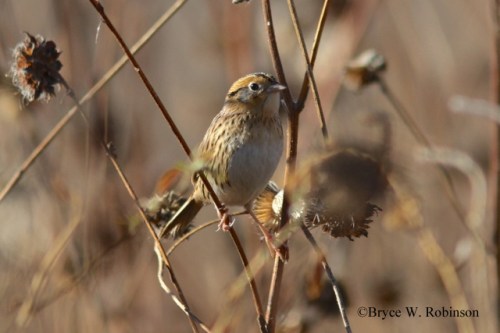
The bird of the day was easily a close and tolerant 2nd state Idaho record, the Le Conte’s Sparrow. We found out that the last record was a bird collected in the 1890’s. So, as Heidi aptly pointed out, this was the bird of the century!

It isn’t often that you find a rarity, everyone you are with gets incredible and sustained looks at the bird, and you get numerous great photographs. For whatever reason, the stars aligned and the experience was everything one could hope for.

Of course, this wasn’t the greatest find in the country today. Apparently, Jeff Bouton found an Amazon Kingfisher in south Texas. Thats a 2nd ABA area record. What a day!

Prairie Falcon- Falco mexicanus

by Bryce W. Robinson

Prairie Falcon- Falco mexicanus. 18x24" prismacolor on bristol

Prairie Falcon- Falco mexicanus. 18×24″ prismacolor on bristol

Of all the raptors I illustrate, it seems falcons give me the most trouble. I’m not entirely sure why, but the fact that I struggle with the family is a bit disheartening, as it is likely to be a group I spend a considerable amount of time studying for the rest of my life. Perhaps with time, I’ll work out the bugs in my inability to adequately illustrate the birds.

Falco mexicanus is a significant illustration for me. I’ve conducted a great deal of field work in the west, primarily in the flats of the great basin, and I’ve had many experiences with the sandy brown assassin. Get yourself lost on lonely dirt roads of the remote great basin in midst of winter, and you will undoubtedly come upon a Prairie Falcon perched on some high point, surveying for prey.

I remember last year, I was searching for eagles on the edge of the salt flats of north western Utah. I had pulled over to glass a mountain top, and found myself watching a perched Golden Eagle, some two kilometers away by my estimate. While I watched the bird, I notice a fast approaching figure headed straight for the large raptor. The figure was in fact the Prairie Falcon, come to conduct its business of bullying the large eagle. The tenacious bastard kept at it for nearly five minutes, until finally the eagle had enough of the dodging, and fled from the persistent falcon pest.

My success with illustrating this bird is fortunate, and gives me the courage to start a project that will be focused on gleaning some much needed extra funding for my work with the worlds largest falcon this summer. Stay tuned as this idea develops and materializes.

Birding in South West Idaho

by Bryce W. Robinson

LESA110213

It has been a while since I’ve posted to this blog, due mainly to the fact that some poor luck fell on me, and my laptop was stolen from my desk in my office while I was off teaching. Luckily, most of my photos and video were backed up, but it’s been rough not being able to share anything while I’ve searched for a solution. For the meantime, I’ve found a temporary fix in borrowing a computer. This has allowed me to look through some photos I’ve gathered while I was computer-less.

Anyway, the photo above was taken yesterday morning. I went for a day of birding with some new and talented Idaho birding friends to a large reservoir on the west end of the Treasure Valley. It was a great day with some good birds. We ventured to Deer Flats Reservoir in the early morning, making it to the mudflats just as the sun rose. The light was electric, and luckily we found some tolerant Least Sandpipers. I again found myself on my elbows and knees, shooting shorebirds, remembering my summer in the north.

I don’t know much about birding in Idaho, but I sure am learning. We found a juvenile American Golden-Plover, which is a great bird here. It was a lifer for one of the fellows in our group. That is always fun to be a part of, in my opinion, even if it is not you who gets to see something new.

Here are the ebird checklists for those interested in knowing what we found:

http://ebird.org/ebird/view/checklist?subID=S15553530

http://ebird.org/ebird/view/checklist?subID=S15553364

http://ebird.org/ebird/view/checklist?subID=S15553253

http://ebird.org/ebird/view/checklist?subID=S15553246

I really enjoy the new birding community I’ve found here in Idaho. Lots to learn as always, and hopefully now that I have a way to blog again, I’ll keep the posting regular.