A studio for bird study

Category: Alaska

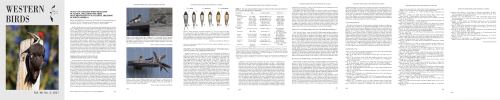
Published in Western Birds: First Record of Breeding Eurasian Barn Swallows (ssp. gutturalis) in North America

by Bryce W. Robinson

Fig.3.jpg

My friend Luke DeCicco and I published a paper in the Western Field Ornithologists journal Western Birds that details an observation I made during my last hours of the 2016 field season in Nome, Alaska. I happened upon four recently fledged Barn Swallows being provisioned by two adults, that were obviously white-bellied Eurasian birds. I couldn’t spend much time with them due to my departing flight, but I did my best to document everything in haste. The flight back to Anchorage was fun, as I sat there with my mind buzzing thinking of how to report this observation in the literature.

I asked my friend Luke be on the manuscript for a few reasons. First, Luke had identified a white-bellied bird in the same location (Nome DOT utility yard) a few days prior while we were loading our storage container. As such, I had my eyes open while traveling through the area when I spotted the birds being provisioned. Without his initial observation, I may have been effectively asleep at the wheel and may have missed the birds entirely. Birding was not the reason I was in the utility yard. Second, Luke has an impressive handle of the birdlife of Alaska, along with the connections necessary to expeditiously investigate the historical status of the species in the state, and to assess the potential that this record was indeed a first. In the end, he brought forward and engineered the aspect of the paper that is perhaps the most useful, an update on the status of Eurasian subspecies in AK, along with a summary of records of vagrant subspecies. The result is an article that will be very useful for folks in the future as they put their own observation into context. I feel really fortunate to have Luke’s contribution to this publication.

This publication represents a few firsts for me. Primarily it represents crossing a threshold in my career, as it is the first publication of mine where I have incorporated my passion for ornithological illustration. I painted a rendering of the differences between the subspecies discussed in text in the form of museum specimens. I’m very pleased with the figure, and I’m excited to continue to make illustration integral in my work.

The paper is worth a read for anyone interested in Alaska’s birdlife, and bird distributions in North America.

Click the image below and give it a read!
Untitled-1-01.jpg

Published in the Wilson Journal of Ornithology: First record in birds of nestling relocation following nest collapse

by Bryce W. Robinson

IMG_0787.jpg

Photo of a female Gyrfalcon holding a surviving nestling following partial collapse of the nest. Photo published in Robinson, B. W., N. Paprocki, D. A. Anderson, and M. J. Bechard. 2017. First record of nestling relocation by adult birds following nest collapse. Wilson Journal of Ornithology 129 (1) 216-221 

Since I’ve been hard at work in central America for the past month, I haven’t had the time to share a recently published article from my Gyrfalcon work. The article details the behavioral response of a female Gyrfalcon following the partial collapse of a nest. The photo above shows her holding the only surviving nestling following the partial collapse of their nest on a cliff side in Alaska. Just moments later, the female took the nestling to safety at another ledge farther down the cliffside. This behavioral response to threat is the first documented case in altricial birds!

Read the full article: 

Robinson, B. W., N. Paprocki, D. A. Anderson, and M. J. Bechard. 2017. First record of nestling relocation by adult birds following nest collapse. Wilson Journal of Ornithology 129 (1) 216-221

Gyrfalcons in Flight Print: A Gift for the Falcon Enthusiast

by Bryce W. Robinson

GYRF_Plate.jpg

Gyrfalcons in Flight. From left to right, juvenile gray morph, adult gray morph, and adult white morph. 10×20″ Giclee print comprising three Gouache paintings by Bryce W. Robinson. Purchase this print in the store. $40 + shipping and handling.

If you’re looking for a gift for a falcon or raptor lover, or even for the general bird lover, consider this print available in the ornithologi shop. This print details three Gyrfalcons that I painted while working in Alaska in the summer and fall of 2016.

Avian Keratin Disorder (AKD), Bill Deformities in Birds and Recent Breakthroughs

by Bryce W. Robinson

2l3a1740

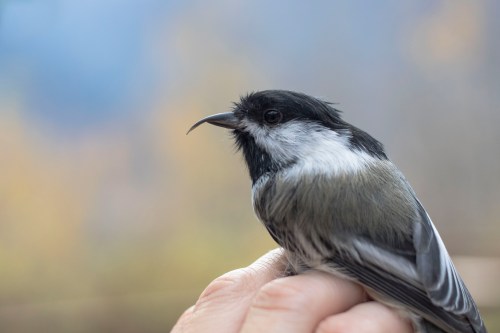
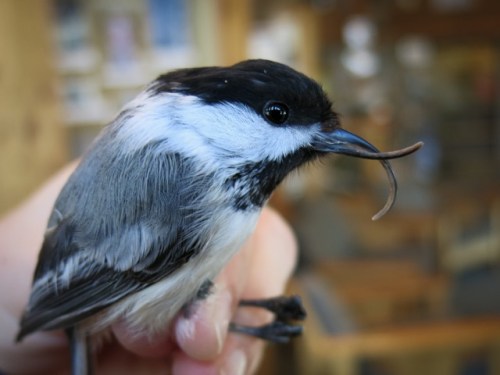
Photo 1. Female Black-capped Chickadee (Poecile atricapilla) with bill deformity.

I recently had the pleasure of spending a few days with my friend Rachel Richardson of USGS trapping birds in the Eagle River Valley of south-central Alaska. We captured a few species such as Black-capped and Boreal Chickadees (Poecile atricapilla and P. hudsonicus, respectively), and Red-breasted Nuthatch (Sitta canadensis). USGS has been trapping in these areas for years with the main focus of monitoring bill deformities, the prevalence of Avian Keratin Disorder, and the prevailing causes of a new found virus, Poecivirus.

The Alaska Science Center of USGS in Anchorage is part of a team of researchers, including the California Academy of Sciences, and the University of California San Francisco that have been investigating the causes of Avian Keratin Disorder for over ten years. Avian Keratin Disorder was first documented in Alaska in the 1990’s by Colleen Handel of USGS who leads the research team at the Alaska Science Center. In an article in Molecular Biology that came out in July 2016 (Zylberberg 2016), the team reports on the discovery of a new virus they termed Poecivirus, which may be responsible for the bill deformities.

Appropriately, the discovery is receiving a good deal of press. Below are a few links to national and international articles that detail the work and the discovery. All are worth a read (or a watch):

A new article by the Associated Press

Science Daily’s article

National Geographic article detailing the work effort

Alaska Daily News Article

An APN video on USA Today

2l3a1766

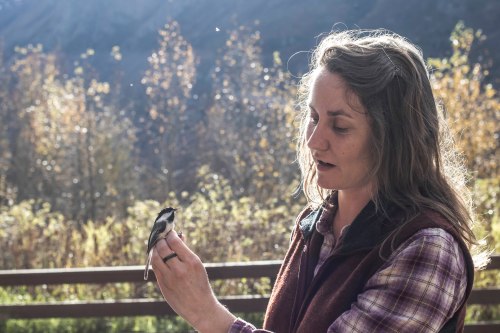
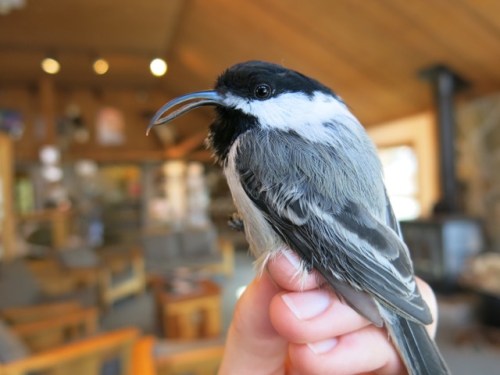
Photo 2. Rachel Richardson of the USGS Alaska Science Center holding a female Black-capped Chickadee (Poecile atricapilla) with a bill deformity.

On the day I spent with Rachel in the field trapping birds, we only had one Black-capped Chickadee show up with a deformity. However, the one bird had an interesting story. This female (Photo 1) was first captured in 2015 and had no signs of any deformity. This year she obviously has a developing deformity. Her bill grew 5.1 mm in one year, a 70% increase in length. Whether or not this developing deformity will impact her ability to forage, preen, or even breed and provision young is yet to be determined. There are reports of deformed birds successfully rearing offspring, however it is without question that the deformities present a handicap that will ultimately reduce the individuals fitness.

It is important to track the rates and severity of deformities across the world. Because of this, the Alaska Science Center has developed a submission form for anyone to report their sightings of deformities. Please contribute to this effort and submit details of any sightings of elongated bills, including photos and location along with any other evidence for Avian Keratin Disorder at the following website:

Beak Deformity Observation Record Report

2l3a1759

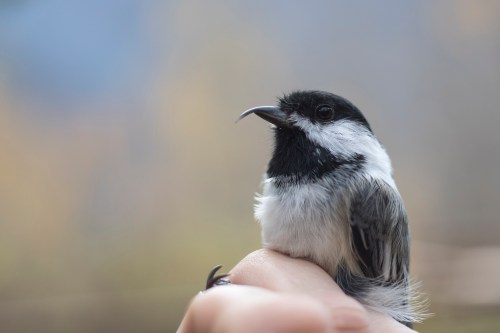
Photo 3. Female Black-capped Chickadee (Poecile atricapilla) with bill deformity.

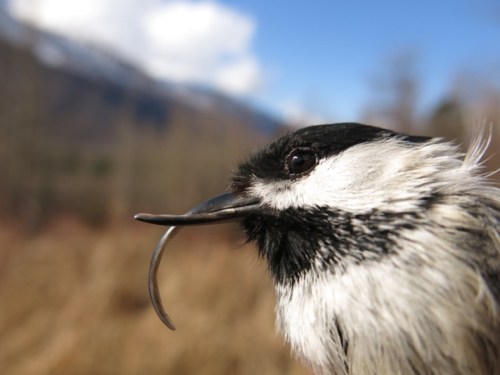
Below are additional examples of AKD in Chickadees that have been captured as part of the Alaska Science Center’s efforts near Anchorage. These individuals unfortunately have more developed deformities than the chickadee we caught while I was tagging along.

IMG_8665.jpeg

Photo 4. Black-capped Chickadee (Poecile atricapillus) with bill deformity. Photo copyright Rachel M. Richardson.

Black-capped Chickadee2_Richardson.jpeg

Photo 5. Black-capped Chickadee (Poecile atricapillus) with bill deformity. Photo copyright Rachel M. Richardson.

IMG_0028.jpeg

Photo 6. Black-capped Chickadee (Poecile atricapilla) with bill deformity. Photo copyright Rachel M. Richardson.

It’s excellent to have a breakthrough and a step forward. However, the problem still remains as well as the daunting task of discovering the correlation between Poecivirus and bill deformities, the causes of both, and what role humanity plays in the prevalence and transmission of either. I’d like to tip my hat to those who have done so much great work on this issue thus far. Keep up the good work.

Referenced Literature
  1. Maxine Zylberberg, Caroline Van Hemert, John P. Dumbacher, Colleen M. Handel, Tarik Tihan and Joseph L. DeRisi. Novel Picornavirus Associated with Avian Keratin Disorder in Alaskan BirdsmBio, July 2016 DOI: 10.1128/mBio.00874-16