
A studio for bird study

Category: Behavior Birding

Mixed Woodpecker Flocks in an Alaskan Burn

by Bryce W. Robinson
2L3A9410

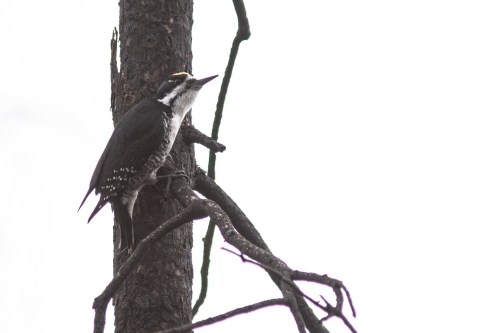
Male Black-backed Woodpecker working his way through a burn near Willow, Alaska. 

My friends Luke, Charlie, Linnaea and I recently visited a year old burn site near Willow, Alaska. Our purpose for the visit was to find a rarely encountered woodpecker species, the Black-backed Woodpecker (Picoides arctics). Luke had visited the site a year prior, only about a month after the burn, and found quite a few woodpeckers already foraging on the burned spruce. We were hoping to have the same luck.

When we reached the burn, we took a few roads that led towards the location Luke had luck in the year prior. While driving I noticed tan bark chippings flecked off of the charred trees, a sure sign of foraging woodpeckers.
2L3A9457

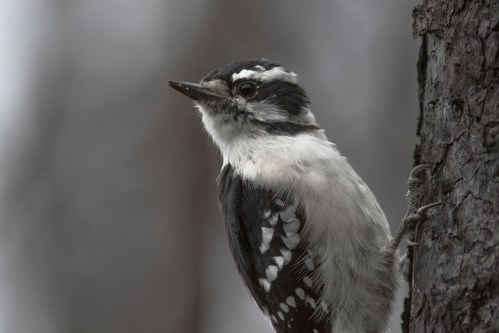
Downy Woodpecker foraging on a burnt spruce.

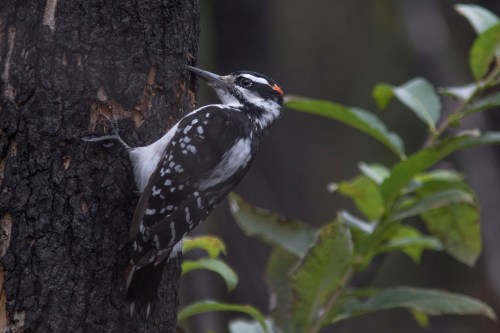
We set out on foot down a two track that led into a portion of the forest. Only two hundred meters down the track we heard woodpeckers. We first heard a Hairy Woodpecker (Leuconotopicus villosus), but soon after came the husky call of a Black-backed. We quickly had visual, and soon after had others. Multiple Black-backed Woodpeckers, the magic of the burn.

The flock foraged along through the forest, much like a winter passerine flock foraging through deciduous groves. Soon the birds had gone, and we continued down the track only to find more woodpeckers.
2L3A9447.jpg

Hairy Woodpecker foraging low on a burnt spruce.

We counted many individuals. At one point we were surrounded by Downy Woodpeckers (Picoides pubescens). Other birds joined the flock, including White-crowned Sparrow (Zonotrichia leucophrys), Ruby-crowned Kinglet (Regulus calendula), Myrtle’s Warbler (Setophaga coronata coronata), and Wilson’s Warbler (Cardellina pusilla). It was interesting to watch the woodpeckers interact with the passerines. Many times the Myrtle’s Warblers would chase the Downy and Hairy Woodpeckers.

Mixed flocks are excellent. Even more, a mixed flock is a symbol of fire ecology and the importance of natural fire cycles for many species, particularly Black-backed Woodpecker. Unfortunately I wasn’t able to get the photos I really wanted of the birds and their foraging behaviors. I’ll make it back to the burn soon, hopefully to film some behaviors as well. That way I can fully portray the importance of burns for these birds, and the excellent behavior of flecking bark in search of food.
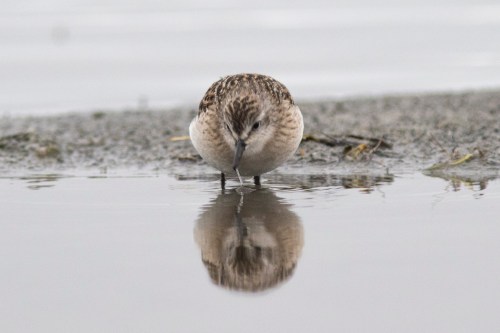
Spurting and Filter Feeding Behaviors of a Juvenile Red-necked Stint (Calidris ruficollis)

by Bryce W. Robinson


Apart from its scarcity and place as a formidable ID challenge, juvenile Red-necked Stint (Calidris ruficollis) is an excellent late summer encounter in Alaska because of its focus on feeding and building fat stores for migration. This focus makes the stint a great subject for close proximity observation, photography, and video. Interactive birds that tolerate your respectful but close proximity are the most fun.

While taking advantage of one such bird, I noticed a somewhat atypical feeding behavior. I was able to capture the behavior in the clip above, as the bird sifts through the water, filter feeding in a way, and consumes small items when it happens upon them. I’ve seen this before in other peeps, but it is certainly an uncommon feeding behavior.

Spurting is an even more uncommon feeding behavior, but one that is regular in many shorebird species (Fellows 2013). Fellows (2013) offers the following description of the behavior: “the bird dips its bill into the water for a couple of seconds, or sometimes a bit longer, presumably to obtain food. It then withdraws its bill and slightly pushes its head forward, usually (though not always) with the bill lowered and then ejects or spurts a stream of water, as if ridding itself  of surplus liquid taken in while feeding underwater. The bill is then reinserted in the water and the sequence is repeated“.

I’d never seen anything spurt before until I watched this juvenile Red-necked Stint  filter feed in shallow water this summer. Unfortunately the video above doesn’t capture anything but filtering, but I was able to manage a decent photo of a spurting event.

2L3A8935.jpg

Photo 1. A spurting juvenile Red-necked Stint at Safety Sound, Alaska. Note the stream of water trailing from the birds bill.

I feel quite fortunate to bear witness to spurting behavior. Special thanks to my friend Luke for not only knowing the name of the behavior, but also letting me know of a note that names and details the behavior in shorebirds (Fellows 2013). Excellent behavior and excellent birding.

Referenced Literature:

Fellows, B. 2013. Spurting Behaviour in Wading Birds. Wader Study Group Bulletin 120(3) pp. 208-209

White Wagtail Breeding in Teller, Alaska

by Bryce W. Robinson


Working again in Nome this summer, although for a relatively short time, provided me with the opportunity to attempt to see some of the birds of the region that I had missed in previous years. One such bird was the White Wagtail (Motacilla alba). Before traveling to Nome, my friend Luke had informed me that he had already seen the species in a lagoon near the Red Knot camp, so my chances were promising.

Red Knot work was in full swing when I reached Nome, which limited the chance to try for the wagtails. In the meantime came a report of a White Wagtail AND a Common Ringed Plover (Charadrius hiaticula) in Teller some 40 miles from our camp. On 5 July, a day of rain and weather, we took advantage of the inability to work with Knots and headed to Teller to try for both birds.

2L3A0610

An alarm calling adult White Wagtail (Motacilla alba) in Teller, Alaska.

When we reached Teller we began the search, more focused on the plover than the wagtail as the bird was a lifer for most in the group and the wagtail was not. After 20 minutes of fruitless plover searching Luke spotted our other target, a wagtail at the north end of the village. Luke and I both set out to photograph and film the bird and soon realized it was carrying food. Another adult appeared, also with food, and our minds tipped to the possibility that these birds bred in the area. Jim (head of the Red Knot project) watched the food carrying adult and followed it back to an electricity box on the side of a nearby building. The bird entered the utility box, and exited without the food. We quickly backed the truck up below the box to gain access and check for nestlings. Sure enough a grass nest sat in the corner of the box containing small nestlings.

IMG_3945

Electricity box containing a White Wagtail (Motacilla alba) nest. Teller, Alaska.

IMG_2210

White Wagtail (Motacilla alba) nest. Teller, Alaska.

After quickly documenting the nesting situation we left and let the adults return to provisioning the young. At the end of the day we left Teller with an excellent experience with White Wagtail, but unfortunately no Common Ringed Plover. Such is birding.

A few weeks later on 22 July, Luke and I returned to Teller on another poor weather day to check on the success of the brood. We soon found multiple juvenile wagtails chasing the adults, begging for food. Luke mentioned that White Wagtail had bred in Teller in years past, but I was left feeling like I had just struck oil – My first White Wagtails, breeding at that!

2L3A8201

Juvenile White Wagtail (Motacilla alba). Teller, Alaska.

The experienced left me excited. I’ve found that the best way to deal with the hangover excitement of a great birding experience is to illustrate, so after the initial sighting of the adults in early July I took advantage of the next day of weather and painted a White Wagtail on the inset of my Nome 2016 sketch journal.

IMG_0441

White Wagtail (Motacilla alba) in the inset of a 2016 field season sketch book for birds of the Seward Peninsula, Alaska. 

Seeing a bird species for the first time, and one that is quite uncommon in North America at that, is the best of birding. Especially if it feels like its been a long time coming. To see the bird and gain a first hand account of its breeding habits, well that is something else. It has a context, and context is what makes my experiences fruitful. I love life histories of birds, especially regarding breeding. I consider this experience to be the example of the what I seek when I step out the door aimed at observing birdlife.

July 2016 in Nome, Alaska had some magic, or something. But it seems that it was a continuation of a theme that started in early May. I bet that if you were to ask anyone that traveled to Nome, AK in the summer of 2016 they would agree. It was special summer, and I can’t wait to hear reports of what the fall brings in the region.

Great Gray Owl Fledglings

by Bryce W. Robinson

_MG_9942.jpg

Another highlight from my recent time spent on the Innoko National Wildlife Refuge was happening upon three Great Gray Owl (Strix nebulosa) owlets that had “branched”.

In fact, these birds had hatched in a nest that was nothing more than the top of a birch snag, so far as I could tell. There were no nest structures in the area, only a plenty of broken tree snags about 5 meters tall. I believe that once they were too big to fit, the owlets fledged. Each bird was on a partly fallen truck leaning diagonally, a ramp for them to climb from the ground to relative safety from ground predators.

The first bird my friend Nick and I found sat staring at us, but with only one eye open. It appears from the photo that a Moose Fly (Tabanidae sp.) was biting its eyelid. I became very familiar with these flies during my time in the area, and felt for the poor young owlet.   The flies have pinchers on their mouth that they use to break skin, and from my experience with them it seems they do this to draw the blood and then feed. At least mosquitoes are mostly painless during their blood draws…

_MG_9928.jpg

We first heard the owlets begging calls while conducting a point count a few hundred meters away, but by the time we found them they had quieted down and stood extremely still, staring at us. Without a doubt we were the first humans these birds had seen. The Innoko is a very remote place, as we never saw a single person during our five-day stay in the area despite covering a distance of over 200 river miles round trip.

_MG_9968.jpg

I was enamored. I’ve seen very few Great Gray Owls in my life, and seeing birds at this age was a first. It has always been something I’ve wanted to see, so it was a dream realized. After getting our fill of the owlets, we began searching for an adult. We soon found a large ghost-like owl, the adult Strix nebulosa, 50 meters from the owlets. In my experience with Great Gray Owls, they’ve been extremely tame birds that tolerate your intrusion and lend themselves to photography. This birds was not tame, and unfortunately flew into the forest as we drew near. I wasn’t able to get any photos, but I managed to watch through my binoculars for a bit.

I captured a short clip of one of the nestlings (below). It’s a rather uneventful short clip, but it adequately describes the experience and the owlets tactful poise as it remained motionless as it kept eyes on Nick while I took video.


Here it is in full, the media from my first encounter of a Great Gray Owl family in the remote Alaskan wilderness.