A studio for bird study

Category: Uncategorized

A Crested Auklet as a Prey Item in an Inland Gyrfalcon Nest as Detailed in Marine Ornithology

by Bryce W. Robinson

Fig-1-Crested-Auklet-insert-in-a-Gyrfalcon-nest-as-captured-by-a-motion-activated.png

Photo 1. Image of a Crested Auklet that was delivered to a Gyrfalcon nest, located over 100 km from the nearest coastline. Image published in Marine Ornithology 44(2) 229-231.

The fist publication from my Gyrfalcon research is now available online:

Click to access 44_2_229-231.pdf

The account (Robinson and Anderson 2016) published in Marine Ornithology details a strange prey item, an adult Crested Auklet, delivered to one of the Gyrfalcon nests I had placed a camera in during the summer of 2015. All details are in the paper, so be sure to give it a read.

More Gyrfalcon publications to come!

Referenced literature:

ROBINSON, B.W. & ANDERSON, D.L. 2016. Crested Auklet Aethia cristatella as a prey item in an inland Gyrfalcon Falco rusticolus nest. Marine Ornithology 44: 229–231.

Fork-tailed Storm Petrel (Oceanodrama furcata) Foraging on Tidal Flats: Part 1

by Bryce W. Robinson

Video 1. Dan Ruthrauff photographs passing Fork-tailed Storm Petrel as the tide comes in. Bristol Bay coast, Alaska. September 2016.

Over my time on the Bristol Bay coast near the village of Egegik on the Alaska Peninsula, I was privy to one of the most incredible experiences I’ve ever had with birdlife. The experience is captured in video 1, which shows Dan Ruthrauff kneeling on tidal flats at low tide photographing passing Fork-tailed Storm Petrels at close range. I’d never heard of anything like this for any pelagic bird. It turned out to be a regular occurrence, but still appears quite novel so far as we understand Fork-tailed Storm Petrel foraging behaviors.
2L3A9888.jpg

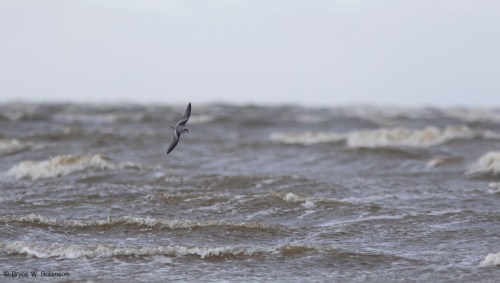
Photo 1. Fork-tailed Storm Petrel arcing down amidst a dynamic soar in high winds. This photo was taken from the shoreline at high tide. Bristol Bay coast, Alaska. September 2016.

Typical experiences with Fork-tailed Storm Petrels are like the image above: A dynamic soaring Hydrobatid at relatively close range. It’s very exciting, but nothing like walking through tidal flats surrounded by the birds.
2L3A1376.jpg

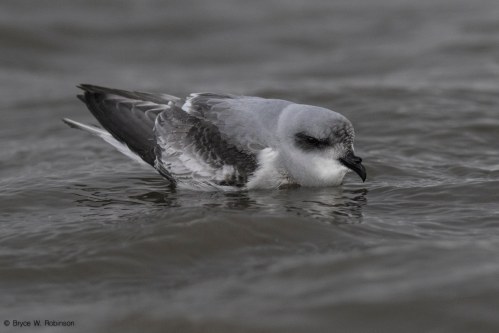
Photo 2. Fork-tailed Storm Petrel at rest on the water. I was standing in ankle deep water when this photo was taken. Bristol Bay coast, Alaska. September 2016

Other more typical experiences can provide observations such as the above photo, where calm water and resting birds near a boat might provide great views. Photo 2 is a bird that I stood near in ankle deep water. This bird was taking a moment to rest from foraging and seemed non-plussed by me. I’ve never heard of anything like it.
2L3A1113.jpg

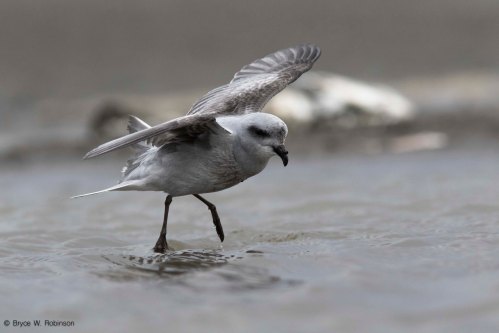
Photo 3. Fork-tailed Storm Petrel (Oceanodrama furcata) dabbing on water. I was lying on my belly when this photo was taken. Bristol Bay coast, Alaska. September 2016

The experiences continued for the entire two weeks I was on the Bristol Bay coast. After reading through the literature, the behavior seems undocumented and may warrant publication as a note. I’m excited to organize, avail myself of the literature, and share this experience with a crowd more knowledgeable and literate than myself. For me, experiences like these make field ornithology one of the best things about life.

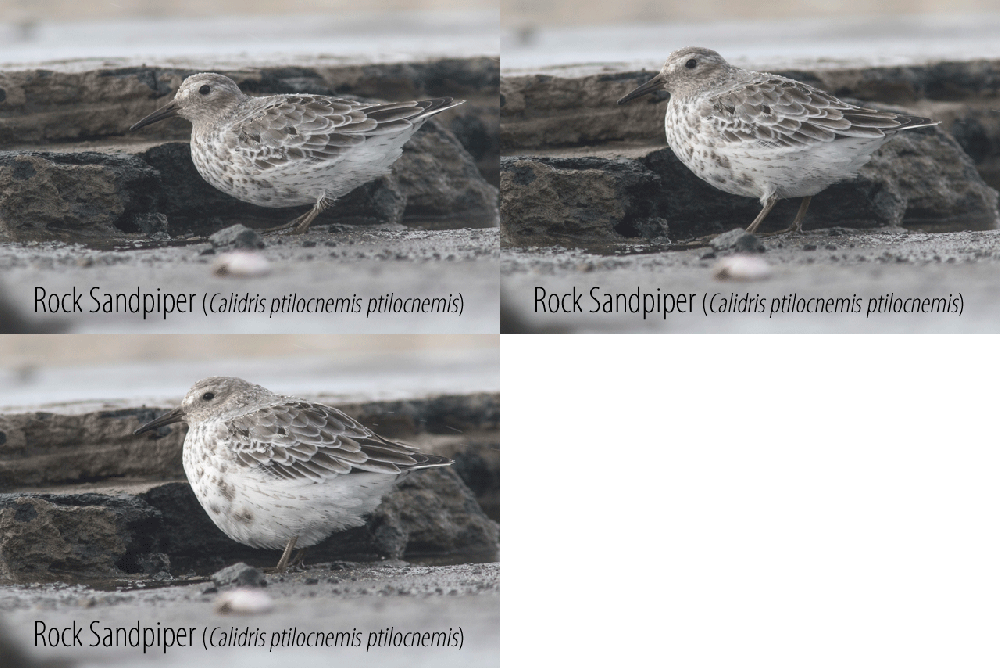
Rock Sandpiper (Calidris ptilocnemis) – A GIF to illustrate the power of feathers for rendering shape

by Bryce W. Robinson

ROSA.gif

I finally had the pleasure of seeing a “nominate” Rock Sandpiper (Calidris ptilocnemis ptilocnemis) during my time on the Bristol Bay coast of the Alaska Peninsula. This bird was hanging out with darker Rock Sandpipers (likely tschuktschorum) and Dunlin. These birds breed on Bering Sea Islands and mostly winter in Alaska’s Cook Inlet, farther north than any other shorebird (Gill et al. 2002).

While sifting through the many photos I took of this bird I found three taken almost simultaneously that illustrate the power of feathers for rendering a birds shape, and how much and quickly that can change for an individual bird.

After seeing the potential of putting the three photos together, I taught myself how to create a GIF (Graphic Interchangeable Format). I feel a GIF is an excellent way to show how only a few seconds and a relaxed posture can change the shape of a bird.

Referenced literature:

Gill, Robert E., Pavel S. Tomkovich and Brian J. McCaffery. (2002). Rock Sandpiper (Calidris ptilocnemis), The Birds of North America (P. G. Rodewald, Ed.). Ithaca: Cornell Lab of Ornithology; Retrieved from the Birds of North America: https://birdsna.org/Species-Account/bna/species/rocsan

DOI: 10.2173/bna.686

Black-bellied Plover (Pluvialis squatarola) Feeding on a Jellyfish

by Bryce W. Robinson


For the past two weeks I stayed at a small cabin along the Bristol Bay coast of the Alaska Peninsula near the village of Egegik.  I was part of an expedition to trap staging Bar-tailed Godwits (Limosa lapponica) led by the shorebird aficionado Dan Ruthrauff of USGS, accompanied by Lucas DeCicco, Stuart Fety, and Jaime Welfelt. We had poor luck with godwits, but had a spectacular time with the avifauna that was present. I have a lot of content to share from the expedition, and will start by sharing a clip of a Black-bellied Plover (Pluvialis squatarola) feeding on a beached Hydromedusae (Jellyfish).

Although not mentioned in any literature on diet of the Black-bellied Plover (so far as I’ve found), there is discussion of the behavior for Rock Sandpiper (Calidris ptilocnemis; Gill et al. 2002). Apparently the birds feed on the gonads of washed up jellyfish. There were many jellyfish that were left on the tidal flats each day as the tide receded, providing an ample food source for staging plovers preparing for the next leg of their fall migration.

Referenced literature:

Gill, Robert E., Pavel S. Tomkovich and Brian J. McCaffery. (2002). Rock Sandpiper (Calidris ptilocnemis), The Birds of North America (P. G. Rodewald, Ed.). Ithaca: Cornell Lab of Ornithology; Retrieved from the Birds of North America: https://birdsna.org/Species-Account/bna/species/rocsan

DOI: 10.2173/bna.686