A studio for bird study

Category: Uncategorized

Banding Calliope Hummingbirds in Idaho

by Bryce W. Robinson

_MG_7042

Palm release of a male Calliope Hummingbird – Selasphorus calliope

Last week I was fortunate to join my friends Jessica Pollock and Heidi Ware of the Intermountain Bird Observatory for some hummingbird banding near Idaho City, Idaho. The banding location is located in the mountains of central Idaho, consisting of healthy Ponderosa Pine forests complete with associated bird life.

_MG_7262

Last week was a bit early in the season, but we did have some luck catching Calliope Hummingbirds. We caught 7 birds, all males. Catching only males also indicates the early season, as in most species males are tasked with setting up territories before the arrival of females and are thus the first to arrive. The banding seemed to tell this story. Unfortunately the Rufous Hummingbirds weren’t around yet, but capturing a number of North America’s smallest bird was more than enough to satisfy my desire to see hummingbirds in hand.


_MG_7244

Weighing a male Calliope Hummingbird.

The whole day was excellent, but the perhaps the most exciting part of the day came with a recapture of a bird that has been captured every year for the past five years. It’s remarkable to hold proof of the resilience and livelihood of such a small and well travelled animal.

To find out more about IBO’s hummingbird work, please visit their website and get involved.

Singing House Wren on the Boise River

by Bryce W. Robinson


I recorded a singing House Wren (Troglodytes aedon) today while banding birds along the Boise River with the Intermountain Bird Observatory (note the bird is banded!).

Although spring migration hasn’t hit in its entirety at this site, the House Wrens seem to have arrived in full. There are at least three different individual males singing in the area, and I’ve noticed an additional four individuals in the area as well. The House Wren population at this site seems to be healthy.

Unfortunately the video I recorded does not capture the song of the House Wren. I wasn’t too far from the wren, but I believe the inability of the phone to capture the song is related to the masking of other noises in the environment (and the iPhone’s lack of a directional mic). First and foremost it was a windy day, which I believe is the main contributor to the masking. On top of the wind was the noise of the busy highway, the noise of the Boise River, and nearby construction (all large bandwidth, but mostly low frequency). With both natural and anthropogenic noise, I wonder how House Wren territory distributions differ between an area like this and a relatively noiseless area such as a remote forest location away from a river.

HOWR

House Wren (Troglodytes aedon) banded at the Intermountain Bird Observatory’s Boise River site on the east end of Boise, Idaho.

Despite the heightened noise, the wrens in this area seem to be thick and continuing with life as they would. A study may enlighten us on the human noise impacts coupled with natural noise (rivers, etc.) on bird territory distributions like in this case, but if I were to hedge a bet I’d say the House Wren is one species that seems to weather the added impacts of humanity enough to maintain a regular and healthy population within human disturbance areas.

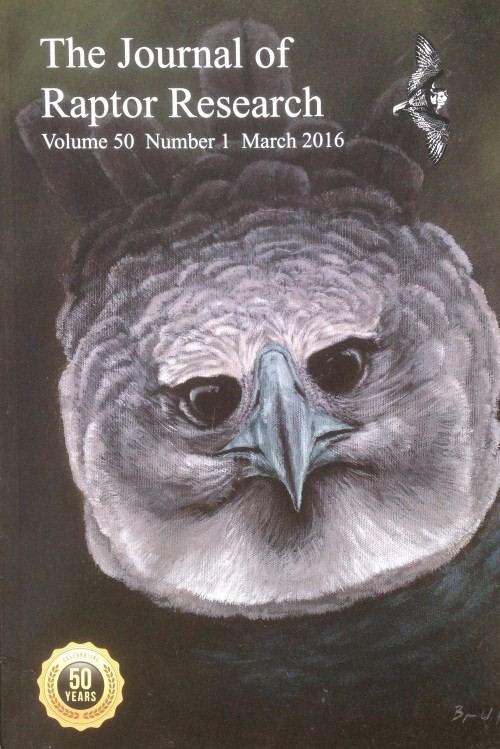
Harpy Eagle Painting for the Journal of Raptor Research

by Bryce W. Robinson

FullSizeRenderI’m honored and thankful for the opportunity to have painted the cover art for issue 1 of the 50th anniversary of the RRF’s Journal of Raptor Research. The issue features an article from The Peregrine Fund’s Harpy Eagle work, along with an article detailing a friend’s master’s work on Burrowing Owls, an excellent article on Gyrfalcon movement’s, and a lot more. I’m so happy for the opportunity to add to an organization that does such incredible work and carries the tradition of raptor studies forward.

For more information or to access the articles, visit the Journal of Raptor Research website.

The New Raptor ID App

by Bryce W. Robinson

IMG_0042

The newly released Raptor ID app, a collaborative production from Hawkwatch International and the Cornell Lab of Ornithology is, plainly put, unprecedented. Author’s Jerry Liguori and Brian Sullivan have accomplished something incredible.

The app is a first of its kind for raptor identification, but perhaps more impressive is the informative video of each North American raptor species that is included with each account. Jerry Liguori’s voice over for each video is instructive and informative. How priceless to have the nation’s leading raptor ID expert in your pocket to talk you through an ID.

Of course, the app is full of species account information and many excellent photographs detailing each species in all plumages. Captions supplement photos and describe important identification features. The “similar species” tab details confusing similarities, making observers aware of problematic or potential pitfalls and providing simple descriptions for avoiding identification mistakes.

The app strays from the classic american field guide, because it lacks annotated identification pointers to bird imagery (see The Sibley Guide to Birds, The National Geographic’s Birds of North America, or the guide that started it all the Peterson Field Guide to Birds, to name a few). Some will undoubtedly voice their complaints about this feature, but as many involved in raptor ID know and understand, the most important aspect of learning to identify raptors is understanding how to look at birds rather than memorizing single identification features. This app provides identification information in such a way, fully fitting the Liguori style guidebooks that have advanced raptor ID in North America much further than before.

Other features include vocalizations, range maps, and information for contacting Jerry and Brian with raptor ID questions. Truly, this app is an essential addition to the raptor ID enthusiasts toolkit. At $9.99, it is a bargain and should be purchased by all interested in raptor ID, and truly bird ID alike.


I’m honored to have contributed a small handful of images to this excellent app. I’m truly appreciative of that opportunity. Above are photos of mine featured in the app, including the species header for Gray Hawk.

You can find the app online on the App Store or Google Play for Android. Purchase the app, support two excellent non-profit organizations, Hawkwatch International and the Cornell Lab of Ornithology, and reap the rewards.