
A studio for bird study

Category: Uncategorized

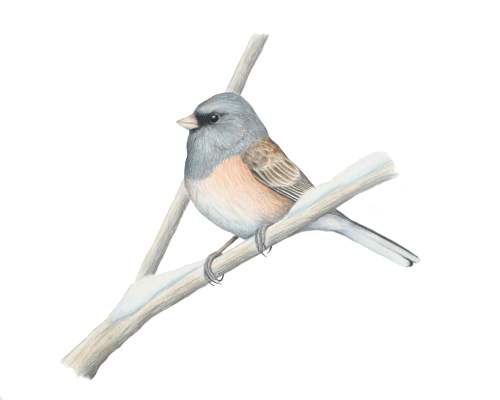
The Christmas Bird 2014 – “Pink-sided” Dark-eyed Junco

by Bryce W. Robinson
junco_copy

This year I chose a more common and well known winter bird for my annual year-end illustration The Christmas Bird. I chose a Dark-eyed Junco – Junco hyemalis, more colloquially known as a snowbird. The bird is fitting to represent the season, but I thought I’d make a bit of a twist to satisfy the nerds among us. I illustrated the subspecies mearnsi, the Pink-sided Junco. Those in the Rocky Mountain west are familiar with this bird, as it frequents feeders in mixed flocks with other Junco subspecies. It’s always a treat to see the distinctive pale blue-grey hood with a dark mask. I make sure to pay attention to the subspecies composition of Junco flocks here in western Idaho. We have flocks consisting mainly of “Oregon” Juncos, but occasionally we have “Slate-colored”, “Cassiar”, and the “Pink-sided”.

It is a bit strange to think that we are all at that point in the year once again. I certainly had a great year full of many birding adventures (3.5 months in western Alaska), plenty of satisfying illustrations, and loads of study and learning. I hope that others had an equally satisfying year. Here’s to another year of study and learning. Happy Holidays, and Happy New Year.

Virginia Rail Eating Fish Head

by Bryce W. Robinson

Last week I was birding with Caitlin Davis and Heidi Ware in a local hotspot. It was a clear and crisp day, following a few days of inclement weather that dumped an uncommon amount of snow on western Idaho. All of the still bodies of water were frozen. This weather was prime for sparrow chasing, but in wetland areas such as this, we were also keen on good glimpses at a hardy rail species, the Virginia Rail. Heidi quickly spotted a rail at the first reedy area we came upon. Immediately we recognized its strange behavior. It sat on the ice at the reed edge, next to what appeared to be a frozen fish head. We watched, and soon the rail began picking at the head of the fish. I quickly set my camera to video mode and began filming. I captured an interesting insight into the life of these rails during the harsh winter months. This bird was eating dead flesh, illustrating the need to diversify your food choices during trying conditions. Behavior birding; even when there isn’t much out, there is always knowledge to be gained.

Zonotrichia – The Adults

by Bryce W. Robinson

Zonotrichia - The Adults. 11 x 14 " prismacolor on bristol.  Top left: White-crowned Sparrow, top right: Golden-crowned Sparrow, bottom left: White-throated Sparrow, bottom right: Harris's Sparrow.

Zonotrichia – The Adults. 11 x 14 ” prismacolor on bristol. Top left: White-crowned Sparrow, top right: Golden-crowned Sparrow, bottom left: White-throated Sparrow, bottom right: Harris’s Sparrow. Image copyright Bryce W. Robinson

The genus Zonotrichia is comprised of four handsome sparrows. Since last winter, my first winter in Idaho, my admiration for this group has grown. In Idaho, it is possible to see all four species, even in one day.

The aesthetic of all four adult Zonotrichia sparrows together impresses me. They each have bold patterns, but altogether they compliment one another. Illustrating the differences gives one an appreciation for their similarities, and also allows an awareness of the features that separate each. Those that claim “sparrow ID is impossible” should sit down and sketch out every species. Even if it is a simple doodle, the act alone allows for a deeper understanding of what makes each species unique.

Roosting Western Screech Owl

by Bryce W. Robinson

Western Screech Owl - Megascops Kennecottii

A few days ago I was birding a wooded area along the Boise River, following a rowdy mixed flock of both Kinglet species, Black-capped Chickadees, and Brown Creeper. I’ve been developing a fascination with mixed flock behavior as the season falls into winter, and so I was taking the opportunity to watch the birds and listen to their communication. They were rolling through the area at an impressive rate, which struck me as odd. They seemed to be on the move, for one reason or another. As I followed, the flock hesitated at the edge of the thickets, so I was able to assess the composition and pay closer attention to the individuals. In doing so, my eyes settled on a feathered branch end, sticking up amidst the yellow leaves. A roosting Western Screech Owl, a treat.