
A studio for bird study

Category: Uncategorized

Red-tailed Hawk in Pen and Ink

by Bryce W. Robinson

After second-year Red-tailed Hawk - Buteo jamaicensis. 11 x 17" Pen and Ink on bristol.

After second-year Red-tailed Hawk – Buteo jamaicensis. 11 x 17″ Pen and Ink on bristol.

I view illustrating birds as an exercise of my ability to create an accurate rendition of my subject. I’ve recently began recognizing a need to incorporate study into this exercise, and as I stated in a previous post, I plan to do so by first illustrating and then reading a scientific article that pertains to my subject. But, I’d like to add another component to my illustrations. I want to make an image that communicates useful information.

I was asked to illustrate a Red-tailed Hawk in black and white, so I took the request and made it an opportunity for me to try a concept I’ve been thinking about. I want to create images that I can teach from, or that simply communicate information for those looking to learn something about each bird. For the Red-tailed Hawk, I wanted to create an image of a bird that could be aged, as if it were a real bird being scrutinized by a biologist.

The above bird is my first attempt at illustrating staffelmauser, or staggered molt. Through illustrating this as it is seen on actual hawks, I made an attempt at communicating the necessary information for age determination.

Here is the breakdown of the birds age:

This hawk is an adult, as dictated first by shape. The wings are broader, giving the tail a shorter appearance as well. The presence of a thick subterminal band on both the tail and wing also indicate that this bird is older than a juvenile. In age determination terms, it is at least “after hatch year”. But, we can take it further. The next step would be to search for molt limits in the flight feathers, that is the presence of retained feathers. Retained juvenile secondaries would be shorter than adult feathers, and lack a thick subterminal band. If this is found, then the bird is in its second year. I illustrated the bird with two generations of adult feathers in its secondaries, and two waves of molt in its primaries ( the staffelmauser, or step-wise molt). The older feathers are paler, as they would be in an actual Red-tailed Hawk. Because of these two generations of adult feathers in the secondaries, we know that this bird is an “after second year”.

Tail banding in Red-tailed Hawks is variable. Many “western” birds, subspecies calurus have multiple banded tails in their definitive plumage. So, this is a useless trait for age determination. To read more, and for a more clear and detailed explanation by the expert, check out a recent article written by Jerry Liguori on Hawkwatch International’s blog.

After all I produced the image I was hoping for, but it isn’t as correct as I’d like it to be. That is the exercise. Each time I finish an illustration, I take a few days to let it sit and be, then return and look for areas that I need to improve. This time I requested some additional critique from a knowledgable (understatement) friend. I now have a list of things to pay attention to the next time I illustrate this bird. I like where I’m at, but I see the need to keep going.
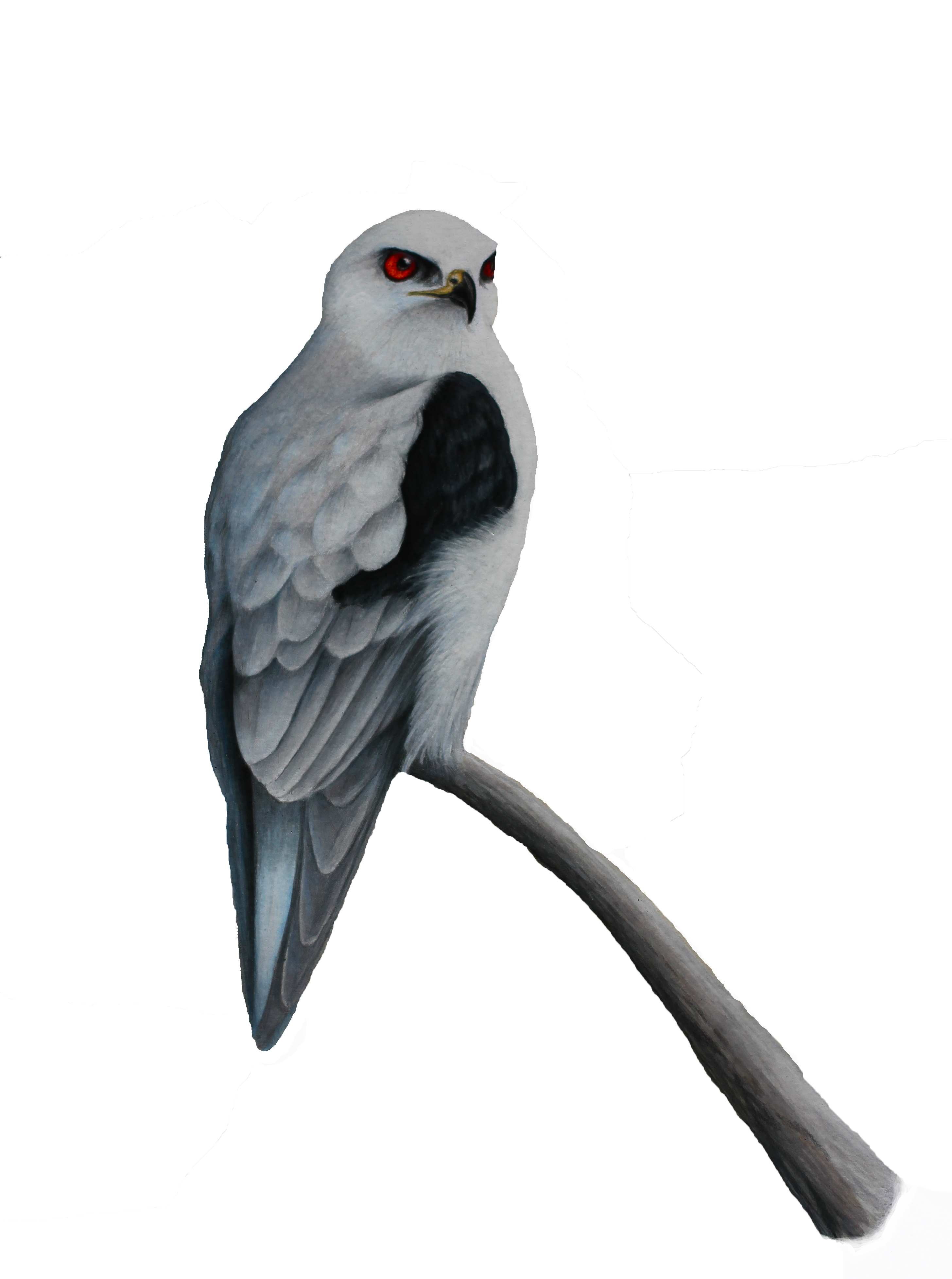
Illustrating and Studying the White-tailed Kite

by Bryce W. Robinson

White-tailed Kite - Elanus leucurus. 11 x 17" prismacolor illustration on bristol board.

White-tailed Kite – Elanus leucurus. 11 x 17″ prismacolor illustration on bristol board.

I’ve had the White-tailed Kite on my mind to illustrate for some time, and finally put it at the front of the priority list. But lately I’ve been illustrating and feeling a bit lost in purpose. It should be enough to put myself into drawing a particular bird, but I’ve felt a need to push myself further. Not only do I want to create a unique image, but now I think it is important to learn something new about my subject each time I produce an illustration. So, for this White-tailed Kite illustration I searched the literature for an interesting paper to read and increase my knowledge.

I read a paper discussing hunting synchrony in the White-tailed Kite (Skonieczny and Dunk 1997). Hunting synchrony? I’d never heard of this before. The paper is a short communication in the Journal of Raptor Research that discusses a study on hunting habits of Elanus leucurus near Arcata California. The authors observed White-tailed Kites hunting seemingly at the same time as one another. The question was, why? So, they made their observations and compared what they saw with what was expected using chi-square analysis. The results showed that White-tailed Kite hunted in synchrony with one another. That is, when one kite was hunting, other kites in the area would hunt as well. And conversely, when no kite was hunting, other kites were inactive. It was suggested from other studies that vole activity happens in peaks, which can then influence the optimal hunting period for the kite. So, when voles are active, kites hunt and are more successful. They cue on one another to save energy and wait for the best time to hunt.

My desire to illustrate one of North America’s few Kite species spurred my desire to study further, then learning about “hunting synchrony” and developing a new bit of knowledge to bolster my understanding of not only White-tailed Kite natural history, but raptor ecology as a whole. I think I need to make a habit of pairing illustrating and study.

Referenced Literature:

Skonieczny, M.F., J.R. Dunk. 1997. Hunting synchrony in white-tailed kites. Journal of Raptor Research 31: 79-81

Migrating Wood Storks in South Texas

by Bryce W. Robinson

A few weeks ago I was in South Texas for the Raptor Research Foundations annual conference. Corpus Christi in the fall is a mecca for those into raptor migration, and likewise the whole of south Texas is a mecca for those interested in the bird world. While I was visiting the hawk watch platform, run by Hawkwatch International, I saw many birds in large numbers. Of course the Broad-winged Hawk migration was flowing well, but I was able to see something unexpected that was equally satisfying. Large numbers of Wood Stork – Mycteria americana were streaming through in kettles. The kettles were in the same fashion as the migrating raptors, and the numbers were extremely large as well. I captured some video of the spectacle to share and spread the awe of the movement of these large North American Storks.

Burrowing Owl Illustration

by Bryce W. Robinson

Burrowing Owl - Athen cunicularia. 11 x 17" prismacolor on bristol

Burrowing Owl – Athene cunicularia. 11 x 17″ prismacolor on bristol

When I first began illustrating birds seriously almost three years ago, I spent the majority of my time on owls. For whatever reason, I was fascinated in the way their faces translated onto both canvas and paper. I remember when I realized the power that the eyes have for communicating the spirit of life within a creature. The exercise of illustrating owls taught me the importance of light and detail in the eyes of birds, especially raptors.

In the past I was focused on illustrating the face and busts of birds of prey. I stayed away from illustrating the full body of birds due in part to my fascination with the face, but also because I felt that I couldn’t create a proper and natural bird. Now I’ve started a campaign with myself to overcome my weaknesses and illustrate birds as a whole, either perched or in flight. While the exercise is to properly portray a bird in whole, I’ve made it a priority to take the lessons I learned from illustrating a birds face and invoke the same sense of life and attitude in the full-bodied bird.

Creating images of living creatures has more to it than I’ve ever thought. I see incredible paintings of Gyrfalcons in flight pursuing prey, or a Great Blue Heron stalking something in shallow water, and I can’t help but marvel at the mastery the artist holds over both their medium and their subject. I hope to reach even a fraction of the ability of some artists, but at the same time I’ve realized that perhaps the process is more enlightening and more worthwhile than the product. In the end, I’ll understand birds to a greater degree simply because I have put energy and focus into their details, and attempted to communicate their life and spirit through my own creative ability.