A studio for bird study

Category: Uncategorized

Male American Kestrel for Conservation

by Bryce W. Robinson

Male American Kestrel- Falco sparverius. 11X17" Prismacolor on bristol.

Male American Kestrel- Falco sparverius. 11X17″ Prismacolor on bristol. Copyright Bryce W. Robinson

I illustrated this male American Kestrel for a silent auction to benefit my local National Audubon Society Chapter, Golden Eagle Audubon here in Boise, Idaho. Let’s hope this illustration gleans some monetary attention.

SUPPORT YOUR LOCAL AUDUBON CHAPTER!

Peculiar Plumage of the Harlan’s Hawk

by Bryce W. Robinson

IMG_3925

I found this interesting Harlan’s Hawk today in Hagerman, Idaho. It’s overall plumage left me thinking about Harlan’s ID. I’ve heard many people describe the “distinguishing” characteristics of the Harlan’s Hawk, but I’m always left confused as most of the Harlan’s I’ve seen don’t quite fit the mold they describe. I only know of a handful of people that can properly articulate why a bird is a Harlan’s, or not. In fact, I don’t include myself in that small list. I can recognize the subspecies, but putting that recognition into words is challenging. I believe this is due to the extreme variation in these hawks.

IMG_3886

The white lores and flecking against a dark background on this bird are the only part of the body plumage that tips the filter for Harlan’s. It is not the deep black that everyone describes for the subspecies, nor is it highly contrasting. To be clear, this bird is very dark, but I’ve seen many Calurus that are highly melanistic, with deep dark brown bodies, even with light markings on the breast not unlike this bird. Many of the Harlan’s in Alaska and the Yukon Territory that I saw this past summer were soft brown, not at all high contrasting in plumage. This variability causes some confusion. So what makes a Harlan’s? As with all bird Identification, the ability to recognize a bird comes with study, exposure, and the overall impression of the bird. I have always compared bird identification to facial recognition, where multiple factors contribute to a recognizable image, without any cognizant processing. I leave the breakdown of what specific factors contribute to Harlan’s identification to the true experts, like J. Liguori.

IMG_3930

At times, there are single clinching factors that seal the deal in bird ID. For the Harlan’s, it is the iconic tail, the one mysterious trait that causes we the birder so much awe and admiration. But, I’ve seen Harlan’s with red, banded tails. Most of the birds I saw in the north last summer had extensive red in the tail. The Harlan’s tail can often be misleading. This fact, coupled with the variation in body plumage leads to the point of considering every bird as a whole.

The bizarre tail of this bird is fascinating. The central feathers are half ghostly silver, and half solid dark. The others are irregularly banded and spotted against a background of soft reddish tones reminiscent of its specific designation. After encountering this bird, I’m left with one question: Are any two Harlan’s alike?

Gadwall and a Dabbler Interaction

by Bryce W. Robinson


The other day I filmed a pair of Gadwall, and captured something interesting. The inter-specific interaction in this video is exciting (to me) and enlightening. Mallards are a larger Anas sp., and I assume they are more aggressive. Observing the Gadwall pair retreat in caution from the Mallard pair displays a “pecking” order between species. With birds such as waterfowl  that form massive multi-species flocks, it would be interesting to observe what other interactions portray the bullies and the submissive of the duck world.

The Rough-legged Hawk and the Need for Research

by Bryce W. Robinson

Rough-legged Hawk- Buteo lagopus. 11x17" prismacolor on bristol

Rough-legged Hawk- Buteo lagopus. 11×17″ prismacolor on bristol

I’ve always been fascinated by the Rough-legged Hawk, for many reasons. I especially enjoy the aesthetics of the heavily patterned males. But apart from the aesthetic, my fascination lies in the bird’s habits and life history.

I find the Arctic particularly alluring. The avian life of this region is ultimately fascinating. My natural affinity towards birds of prey puts my interest deep into the raptorial species that frequent the tundra ecosystem. I’m currently developing a project focused on the largest falcon in the world, a circumpolar Arctic denizen, the Gyrfalcon. This bird is king, but I must admit that I am equally captivated by the Arctic Buteo, the Rough-legged Hawk.

neilpaprockiRTHA

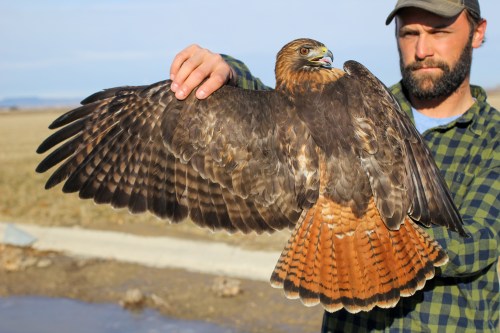
Neil Paprocki with a Red-tailed Hawk on a recent trapping outing.

I recently made the acquaintance of a kindred spirit whose fascination with the Rough-legged Hawk equals, if not surpasses my own. My new friend Neil Paprocki recently finished a study investigating the distributions of wintering raptors in North America. This study resulted in very enlightening and important results. He discovered using historic data from Christmas Bird Counts that over the past few decades winter raptor distributions have started a northward shift in range. The implications for these findings are profound. I encourage everyone to read his results on the online journal PLOS ONE.

The more I learn about how our changing climate is affecting the Arctic, the more driven I am to create or support monitoring and research programs to help understand the future of the Arctic community. I believe that research projects designed to understand changes in Rough-legged Hawk populations in the next fifteen years will help predict how our changing world will impact wildlife, especially those with particular strategies for survival. Neil is focused on the Rough-legged Hawk as an appropriate avenue to continue his research, so I decided to illustrate this bird for Neil to show my support and encouragement. Let’s start a research program focused on the Roughie, and how it is weathering a changing system.

Here is a video I made some time ago to promote HawkWatch International’s winter monitoring program. Citizen Science can be a great help to researchers such as Neil. Get involved at www.hawkwatch.org