A studio for bird study

Category: Uncategorized

Possible Red-naped X Red-Breasted Sapsucker Hybird: An Identification Dilemma

by Bryce W. Robinson

Possible RNSA x RBSA

Identifying true hybrids can be mind bending. Attempting to work out the ID can, however, provide a great opportunity to strengthen your knowledge and understanding of distributions and distinguishing characteristics between the species involved.

The bird pictured was reported a few days ago along the Boise River in south west Idaho as a Red-naped Sapsucker, possibly a hybrid with the Red-breasted Sapsucker. This morning, my friends Jay, Heidi, Mitch, and I went in search of the bird to get some photos and see what we thought of its plumage. 

Three Sapsucker species comprise the varius group, including Red-naped (nuchalis),  Red-breasted (ruber and daggetti), and Yellow-bellied (varius), which were all once considered conspecific. Now, each bird is recognized as a distinct species, yet at the confluence of each range, there is regular hybridization. The result is a confusing number of sapsuckers, waiting for the aware and inquisitive birder to work out their identification. 

The Red-breasted Sapsucker breeds on the west side of the Cascade range, continuing north into British Columbia. The area that RBSA and RNSA distributions meet is rather extensive in range, and provides the opportunity for extensive hybridization. It is then very possible for hybridization to occur in British Columbia, with birds migrating into the great basin and ending up in winter in places like Boise. Possible, plausible, but only conjecture.
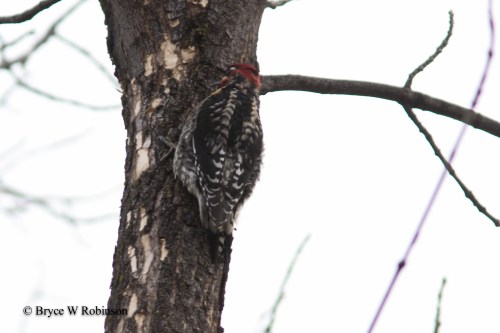
Possible RNSA x RBSA

This bird shows mostly the distinctive features of Red-naped Sapsucker. 

Here is my breakdown of the bird:

1. The back pattern is typical of RNSA, having two distinctive columns of white descending down the back.

2. The lack of red in the breast, and the dark black breast patch is typical of RNSA.

3. The facial pattern and nape are where this bird strays from the typical RNSA, and why I am considering this a possible hybrid. Note the extensive red in the cheek of the bird. It continues from the throat, breaking the white cheek line, and continuing through the white superciliary. To my knowledge, this is not typical for RNSA.

4. Lastly, the black bar on the back of the nape is broken by red. Again, to my knowledge, this is not typical of RNSA.
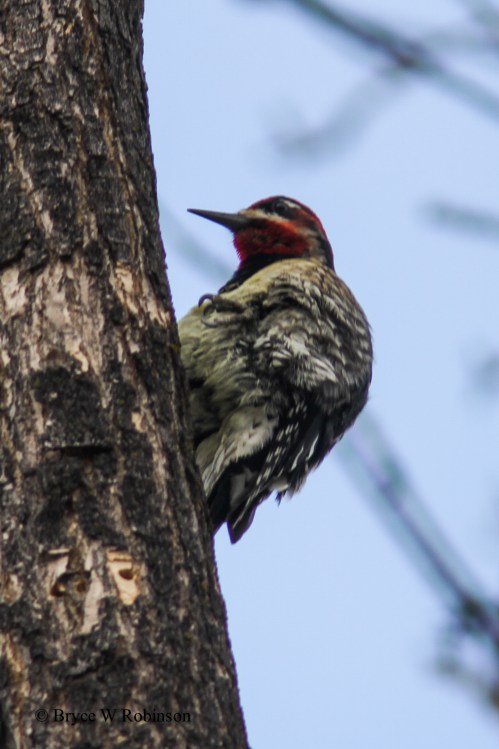
Possible RNSA x RBSA

So, is this a RNSA X RBSA hybrid? Could it be a backcross? Well, I think so, but can’t be sure. It is different, and peaks my curiosity. I’ll certainly be studying the subject more, and looking twice at all sapsuckers I come upon from here forward.

Here is a list of resources I used for this post. I welcome any comments and discussion on this bird.

1. Sapsucker Hybrids by S. Shunk. Birding May/June 2005

2. Hybridization Between Red-breasted (Sphyrapicus rubber) and Red-naped (Sphyrapicus nuchalis) Sapsuckers by J. Garrett 

3. The Sibley Guide to Birds of North America. 2000
 

Female Varied Thrush

by Bryce W. Robinson


This winter, at least two Varied Thrush have taken refuge in a very wild city park in Boise, Idaho. This park, Kathryn Albertson Park, is my go to spot for birding close to home. There have been a great collection of birds there this winter, including White-throated Sparrow, Bewick’s Wren, Evening Grosbeak, Both species of Waxwing, and the list goes on.

I’ve made it a personal goal to strengthen my video archive. Given the regularity of my sightings of both Varied Thrush and White-throated Sparrow, I’ve decided to focus on filming these birds while I have the opportunity.

Filming such secretive skulkers is tough. I’ve spent some time trying, botched multiple opportunities, and ended up empty handed time and again. Yesterday, the active White-throated Sparrow didn’t cooperate as usual, but a female Varied Thrush gave me the opportunity for the clip I’ve been hoping for. Although these clips are short, and at times anticlimactic, they are my goal. My goal is to create an opportunity for birders to get to know particular species a little better through more exposure to their plumage, posture, and behaviors, and re-live some birding moments through those short glimpses that make our day. These clips seem simple, but with most birds a decent video requires loads of persistence, patience, a little skill, and a moment of luck. The end result is so exciting for me, and something I plan to keep working on for the rest of my life.

Tribute to a Lost Friend

by Caitlin M. Davis

Art by Bryce W. Robinson

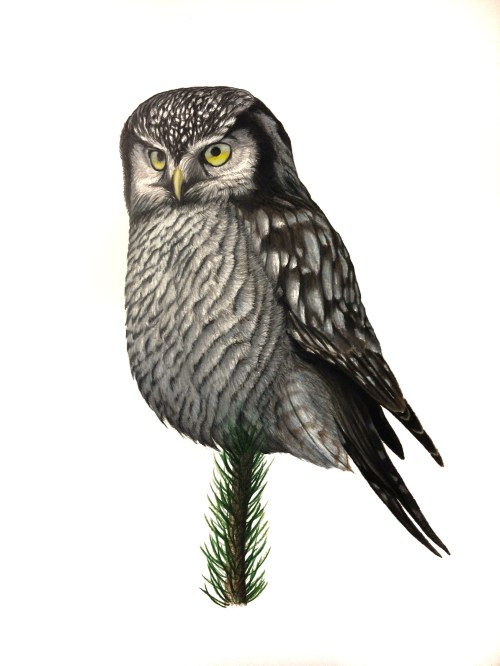
Original Prismacolor Illustration by Bryce W. Robinson

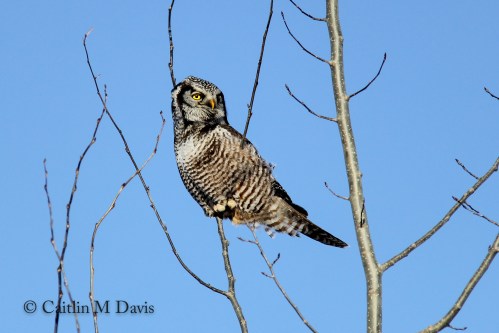
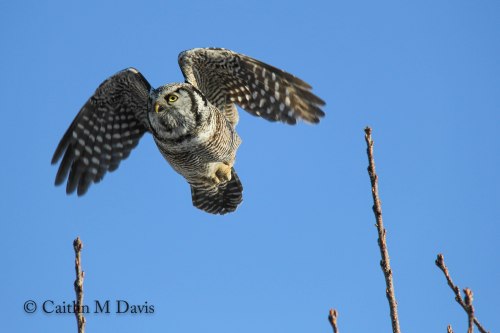
I found out last week that a friend I had met recently died, and I thought it only appropriate to pay tribute. This Northern Hawk Owl, a wanderer from the north, had been hanging out for several weeks at a shopping center in Moscow, Idaho, where he met his tragic fate with a vehicle.

A few weeks ago, Bryce Robinson, Heidi Ware and I made the icy 7 hour trek to see this amazing creature, far away from his home. We were hoping he would give us clues as to why he was lost, and why he had chosen this new city life. Was he dissatisfied with where he lived? Was there no food? Were his parents mean to him? Was he just a dreamy wanderer? Knowing that he is an owl, and probably won’t answer our questions, we were really just excited to spend some time with him.

IMG_1546

We found him within minutes of reaching the shopping center, perched on a telephone wire. He almost immediately dove down and landed in a low tree along a trail next to the road, about 5 feet from a pedestrian. Just imagine a bird you never knew existed, an owl no less, landing in arms reach on your afternoon stroll. A crazy story for even a non-birder. The man made very slow, calculated movements to snap a cell phone picture, while a hoard of birders materialized out of the brush. Everyone, including our cohort, rushed over to see this bird, up close for the first time.

The Hawk Owl was everything we had dreamed of and more! He was extremely docile and tolerant of the barrage of squealing fans and cameras. He just kept with his daily routine, actively looking for prey and  flying from perch to perch. He allowed us to study and enjoy his animated antics for a good amount of time. While we were there he crossed the road and almost got hit by traveling soccer moms, rowdy teenagers and cowboys, multiple times. The owl seemed very content in his new home, so it was only a matter of time before he would meet his inevitable fate.

IMG_1528

It wasn’t surprising to hear the news that he had been hit by a car, but it was quite sad. The drainages next to the road were too full of delicious food and there was cozy, safe infrastructure for roosting. The fact is, even roads hours away from anywhere create a deadly barrier for birds. Raptors are oftentimes drawn to roads because there are comfortable perches and there is ample prey either already dead, or thriving on an endless smorgasbord of waste. They stoop down quickly for a meal and cannot change direction in time to avoid a speeding 18-wheeler.

So, what do we do? This question is important, and I know that research is being done to help ease yet another impact we, humans, have on the world of birds.

Click here to see an adorable clip of this guy if you missed it a few weeks ago.

RIP little buddy.

Black Tern in the High Prairie

by Bryce W. Robinson

BLTE

I think one of my favorite birds is the Black Tern- Chlidonias niger. They are visually striking birds, and their habits are equally intriguing. I remember last summer, making my way down through Canada, bound for the border, then Chicago. Once I hit southern Saskatchewan, the land became scattered with small ponds and marsh lands. It was a lush scene, full of birds. They call these scattered bodies of water on the high prairie the prairie potholes. They are the remnants of the last glacial maximum, and now are home to multitudes of waterfowl, and birds alike.

Black Terns are common in this part of North America. One afternoon, I pulled over at a small pond, where a group of Black Terns were coursing the sky, feeding on the open water. I watched their behavior for some time, and soon realized that they were feeding young, somewhere hidden in the reeds. I could hear the juvenile birds begging. It was impossible to locate a bird. They were simply too deep, safe in the marsh.

At this time of the year, some of the terns had already started their pre-basic molt. It interested me that not all of the birds in the flock had started molting. I know very little about the molt cycle of the Black Tern, but this variation between individuals stuck with me.

I hope to find myself watching Black Terns again, sometime in the late summer this year. If I do find a few, I’ll be paying attention to their plumage, the date, and what aspects might be influencing their individual molt timing. I’m sure someone like Steve Howell, who has studied the various molt strategies between taxa, and knows a thing or two, could offer some insight.