A studio for bird study

Category: Uncategorized

Support Gyrfalcon Conservation Efforts of The Peregrine Fund Through Year End Donations, or By Purchasing Artwork

by Bryce W. Robinson
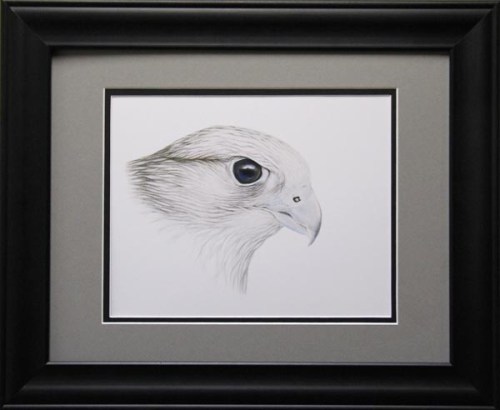
Click image to purchase

Click image to purchase **PRINT ONLY** *Original available

The Gyrfalcon, the Polar Bear of the bird world, is truly an iconic symbol of the frozen north.

It is undeniable, the earth is undergoing rapid change. To properly predict and prepare for the impacts this change will have on the Gyrfalcon, The Peregrine Fund has started a program to study particular aspects of Gyrfalcon biology, and form a conservation program.

I am part of The Peregrine Fund team, charged with developing a long term project to monitor Gyrfalcon populations, and conduct necessary research that will inform conservation biologists, to ensure the future of this powerful bird.

Please consider contributing to the efforts of The Peregrine Fund for a year end donation, and be part of a conservation effort aimed at ensuring the future of the Polar Bear of the birds, the Gyrfalcon. Doing so will not only help in the effort to understand and ensure the future of an arctic animal, but will inevitably help in understanding climate change and its real time implications on the earth as a whole, and in turn, on ourselves.

You can become part of this effort by visiting The Peregrine Fund website, and clicking on the DONATE NOW button on the top right of the page. The Peregrine Fund is a registered non-profit 501-C3, so all donations are tax deductible. In the comments section of the donation form, please specify that you wish your gift to contribute to the Gyrfalcon Project.

In an effort to diversify my funding sources, I have started THE GYRFALCON PROJECT, here on ORNITHOLOGI.COM. I will illustrate and paint, to capture the Gyrfalcon in its emblematic form. All illustrations will be featured on the blog and will be available as originals, along with prints. 50% of proceeds from all sales will be donated to The Peregrine Fund to support the Gyrfalcon Project.

Your action will help, no matter how small, in empowering the research and understanding of our rapidly changing world.

If you are interested in commissioning an original of any medium, please contact me at ofbirdsandbATgmail.com.
Late Changing Plumage of Rock Ptarmigan

by Bryce W. Robinson

ROPT

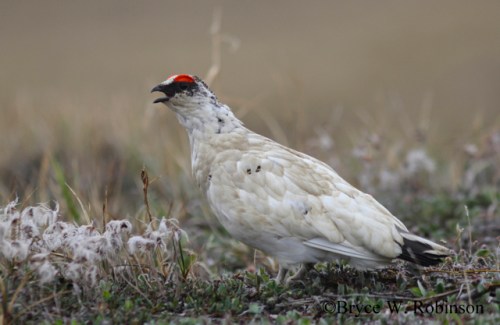
Male Rock Ptarmigan- Lagopus muta, still in basic plumage. June 21, 2013. Prudhoe Bay, Alaska

My exposure to Ptarmigan this past summer was not limited. Although I haven’t been able to track down the White-tailed Ptarmigan, I have had a lot of experience with both the Willow and Rock Ptarmigan.

Without hesitation I’d say that the easiest way to distinguish the two species is by call. This is very helpful in early summer, when males are traipsing around the open tundra, full of hormones, calling and chasing one another constantly. But what about later in the season, when birds are more cryptic? What about females?

The differences in plumage are subtle, and so far I feel I could only distinguish females in alternate plumage if they were side by side.

Shape is a helpful tool. Richard Crossley asked me how I distinguish between the females of the two species. My response was head shape, but he persisted and exposed my lack of confidence with the parameter. I feel like I have head shape down, but I’ll need more practice this coming summer as I chase the Gyrfalcon around the Seward Peninsula.

I chose to share the above photo as it shows a Rock Ptarmigan in late June. In late may, male Willow Ptarmigan already have full reddish necks, as they have started their pre-alternate molt. Interestingly, male Rock Ptarmigan do not begin their pre-alternate molt until early July. This makes for a simple identification tool. I’ve yet to research any answers to this difference in timing of molt between the two species. I of course, encourage any discussion on the matter.

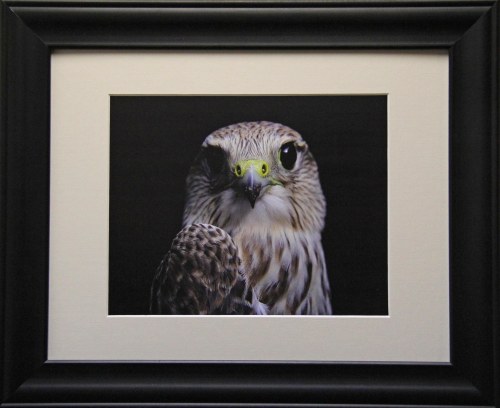
Portrait of a Female Prairie Merlin- Falco columbarius richardsoni

by Caitlin M. Davis

Portrait of a Prairie Merlin- Framed 8x10 Giclee Print

Merlins are one of my absolute favorite birds, and all three subspecies are equally incredible.  Sometimes I’ve only witnessed them as bolts of light, jetting past with an audible whooosh of beating wings.  Close encounters with these fierce little falcons are always the best!

This original Giclee print is for sale at the OrnithologiArt Shop, sans frame.   5×7″, 8×10″ and custom orders available.

Identifying Female Goldeneye

by Bryce W. Robinson

IMG_0924

Last weekend at Cascade Reservoir in central Idaho I photographed three female Goldeneye. Initially I thought I had captured two Common Goldeneye, with a Barrow’s Goldeneye in between.

After reviewing the photos, my initial identification became muddled. I wondered if the middle bird was indeed a Barrow’s. For one thing, it simply didn’t fit the bill shape, but it was obviously different from the other birds.

Of course some review provided me with a helpful article on David Sibley’s blog. He details the dilemma of differentiating female Goldeneye.

When I first saw the middle bird, I noticed the difference in head shape, which set me towards Barrow’s in the field. After reviewing the photos, the head shape is one aspect that made me question my initial ID. I expect the head shape to be more dramatic on a Barrow’s Goldeneye, with a steeper forehead. Still, as Sibley cautions, using head shape can be problematic, as it changes with the mood and activity of the bird.

The bill shape for the middle bird is different from the other two, but the difference is subtle. I started questioning my identification because although the bill seems smaller and shorter, it isn’t quite the right shape for Barrow’s. The bill of the middle bird is still rather geometric, or straight edged, as I’d expect in a Common Goldeneye.

I’ll admit, the difference in bill color of the middle bird is what my in the field identification was mainly based upon. This is where the learning comes in to play. I consulted my friend and new found birding mentor, Jay Carlisle, just after I had looked over some of the photos on our drive away from the shoreline. He couldn’t focus on the photos in the car (so he said, but perhaps he was being polite). He simply said that although he could only bear a quick glance, the bill color for Common Goldeneye can appear lighter. Sibley describes the occurance of light billed female Common Goldeneye as very rare. He does, however, talk about the bill color of juveniles as being an olive yellow color. This color description seems to fit the middle bird.

Of course there are many other factors that contribute to a positive ID either way. Regrettably, I did not study the birds as much as I should have in the field. Regardless, I believe I have a confident ID on the middle bird. I believe it is a juvenile Common Goldeneye. Although the shape differs from the other birds, and the bill color is not black, as you might expect for a female common goldeneye, there is nothing else that suggests that this bird is a Barrow’s. So, separated from the two adult Common Goldeneye based on bill color, smaller head size, muted eye color, the bird must be a juvenile Common Goldeneye.

I can’t quite claim that I have the issue down to a science, although it has been a worthy learning exercise. I encourage and welcome any discussion on the topic. It would be fun to hear what others think.