A studio for bird study

Category: Uncategorized

Osprey

by Bryce W. Robinson
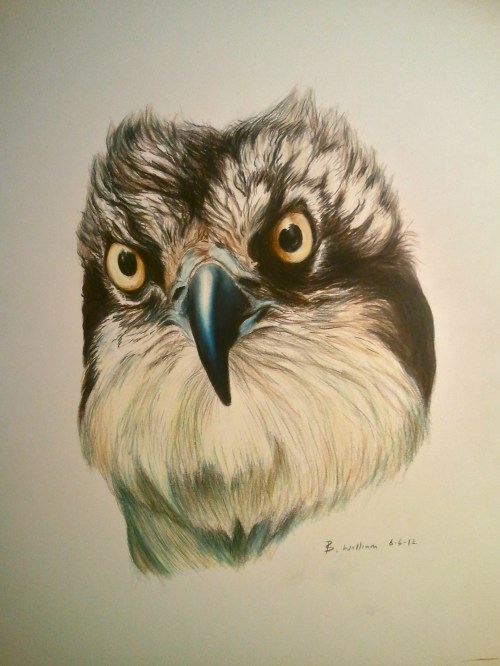
Osprey- Pandion haliaetus. 11×14″ colored pencil on bristol

Throughout my life I have had limited exposure to the fish hunter Pandion haliaetus. I’d like to spend more time in search of this bird, and really get to know all of it’s behaviors and characteristics. It stands true to say that there certainly is not a bird in the sky quite like the Osprey. It is remarkably unique, a fact that induces fascination and intrigue. Every time I find the Osprey, I sit in awe as it hunts the waters for its finned food.

In the past six months I have had two experiences with the Osprey. Of the two, one sits as a special memory in my mind. I was birding along the Colorado River in eastern California. I had come to see the Cibola Refuge, after hearing rumors of its birding grandeur. I wouldn’t say it lived up to its hype, however I certainly wasn’t disappointed. On my way out of the refuge, I passed a small inlet of calm water, separated from the Colorado much like an ox-bow. Catching a hovering silhouette in the golden light of the setting sun, I stopped the car to the spectacle of a hunting Osprey.

The Osprey hovers above water, watching for fish as they surface to glean their own food. Seeing a chance, the Osprey dives to the water with wings flexed back, talons stretched forward, open and ready for the grab. The osprey I watched seemed hesitant at each opportunity. It would dive, catching itself half way down as it lost lock on its fish, and the opportunity for food. It appeared as something of a dance, as the rhythm of the hover was periodically interrupted with a reverberating roll as it dove and rolled back into a hover. With the long light of the setting sun casting long shadows, all anxieties melted away as I let myself become fully involved with the hunting raptor. This instance is one of too few in my life, when my spirit settles and I am truly at peace.


Owls In the Desert Night

by Bryce W. Robinson

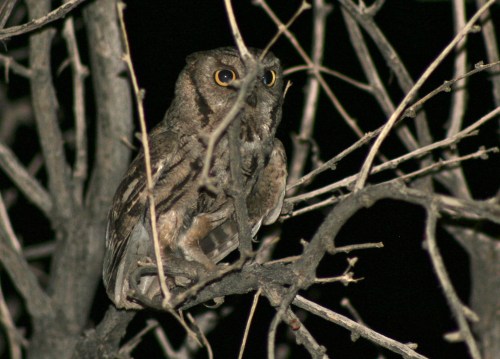
Western Screech Owl- Megascops kennicottii

This evening I joined some friends on an owling adventure into the evening heat which still hovered near 100 degrees farenheit. We were in search of the world’s smallest owl, the Elf Owl. The desert of southern California is not the normal range of this tiny creature, but for whatever reason, there has been a bird living in one canyon for some time.

We watched some palm snags with nice cavities as the sun light began to fade. At one point, a small head poked from a cavity. We thought we had our owl, but soon after an American Kestrel flew from the hole. We were disappointed, even though a nesting kestrel is quite the prize.

The sun fell, and darkness ensued. No owl. After a while we realized we would no longer be able to see the owl, even if it was around. We listened for any calls, but none came. Before we left we decided to check for other owls. We knew there were probably screech owls in the area. They had been heard before. We whistled a few calls and listened. Sure enough two birds responded. Interestingly, the birds were perched ten feet in front of us on some limbs. We had some great looks at them.

The two birds called, and each bird had an obvious difference in pitch. One bird was noticeably lower. I know that in many species of owls the vocalizations differ, with the male being a lower pitch. I’ve heard this many times in the Great Horned Owl as they hoot back and forth at the inception of nightfall. I’m not certain if there is a difference between male and female voices in the screech owl, but it certainly seems so. I plan to do some reading to find out.

Although we were unsuccessful in finding the Elf Owl, I was very happy with the night. An owling adventure is surely successful when any owl is found.

Western Screech Owl- Megascops kennicottii

Flamms in the Future

by Bryce W. Robinson

Flammulated Owl- Otus flammeolus. 11×14″ colored pencil on bristol

It looks like I will be doing some work with the Flammulated Owl again this summer. I am very excited. I’ve missed this bird. With flam on the brain, I decided to put some effort today into illustrating my first colored pencil Flammulated Owl. About halfway through the illustration I was pleased with what was turning out, but I could feel myself getting a bit tired. Instead of taking a break and finishing the bird later, I continued. Needless to say the bird turned out a bit sloppy. I’m not too upset that the illustration didn’t turn out as well as I had hoped. I will return time and time again to paint, draw, or sketch this particular owl. It is such a fun species to work with. Overall, lesson learned. If I feel tired or burnt out, it is always better to take a break rather than soldier through.

Desert Peregrine

by Bryce W. Robinson

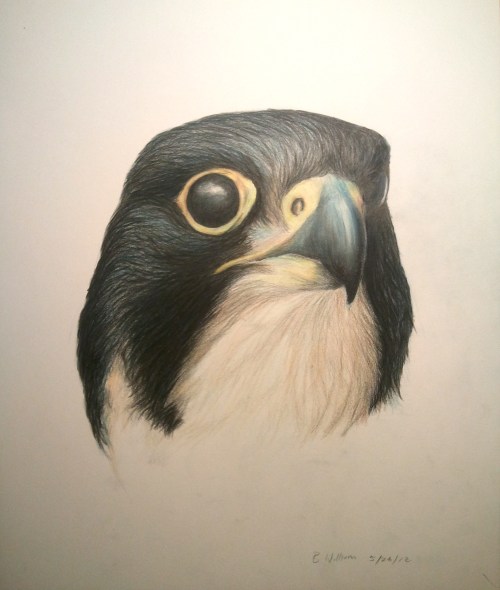
Peregrine Falcon- Falco peregrinus. 11×14″ colored pencil on bristol

At times I am asked to check on and re-assess the activity of raptor or raven nests on transmission towers here in the desert. This task requires me to sit vigil to the nest for at least a four hour period, or until I see activity in the nest. Last week I was asked to check on a Red-tailed Hawk nest in a particularly sandy and desolate section of the desert. The first hour was uneventful, until I noticed a bird sitting on the edge of the nest. I hadn’t seen the bird fly in, and so assumed it was a raven that had jumped up to stretch and take a rest from incubation. The bird was dark, and small, but when I looked through the scope, it was not a raven that sat in the nest. The unmistakable face pattern of the Peregrine falcon left me excited and confused.

For the next twenty minutes I tried wrapping my brain around why a Peregrine Falcon, a cliffside nester, would inhabit a Red-tailed Hawk nest in the middle of the desert. They have been documented using old hawk nests, but surely not in the middle of this desert, entirely out of their range. These falcons feed primarily on birds, and this portion of the desert is certainly lacking any bird activity that would sustain a single falcon, let alone a family. The only thing that made sense was that the bird made the daily trip some thirty miles east to the Colorado River to hunt. This seems highly unlikely. After fifteen minutes, the bird hunkered down into the nest. I could hardly believe what I was seeing. Soon after, the bird left the nest, circling high, riding thermals, and making a straight line fly for the south east. I was perplexed. Certainly this bird was not nesting on the tower. I expect it was passing through, and took advantage of the only shaded roost for miles, only to rest. Still, what an enigma.

This mysterious bird is the only Peregrine falcon I have seen all season. It makes sense as they are not seen often in the desert, and certainly do not nest or winter in the area. It is out of their range. I love when birding presents the unexpected. As birds have wings, they certainly can turn up anywhere.

I have been meaning to illustrate this falcon for some time. Today I decided that given last weeks experience, I ought to put forth the energy towards illustrating that distinctive face that left me puzzled and surprised. The bird was very far away, so I couldn’t use my camera get a decent photo. I did make an attempt to use the scope and my phone to get a photo. Certainly there is no mistaking it. The bird was not a Prairie Falcon, a bird that frequents the area I was in. I cropped the photo substantially to make sure the bird was shown clearly.

I also thought I would include another digi-scope attempt I made as I watched a family of Burrowing Owls. These guys were a blast to watch. I only wish I could have used my camera to get some better pictures. Maybe the opportunity will present itself soon. The Burrowing Owl is such a charismatic bird. I love every chance I get to watch them and their antics.