A studio for bird study

Category: video

Fork-tailed Storm Petrel (Oceanodrama furcata) Foraging on Tidal Flats: Part 2

by Bryce W. Robinson


I captured too many images from my recent experience with Fork-tailed Storm Petrels (Oceanodrama furcata) along the Bristol Bay coast of the Alaska Peninsula. Given that our observations warrant a full report in a journal, I’ll maintain some brevity for now. However, I think it is helpful in the interim to share supplementary video and images that set the stage for the publication. The rest will come out with the article sometime in the coming year.

2l3a1345

Stuart Fetty walks towards a resting Fork-tailed Storm Petrel as the tide rises.

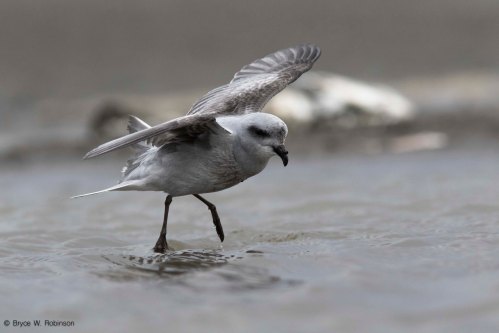
We had a few days where the birds lent themselves to close proximity photography. They were all around us, and didn’t seem to understand or comprehend the concept of a terrestrial predator. In one instance, we walked as close as a meter or so to a bird sitting on the water with no response. Whether this was an ill or a healthy bird resting, I can’t be sure. We do however have some indication that these birds were healthy, but these are details that will be discussed in publication.

2l3a1170

Fork-tailed Storm Petrel kiting in an onshore wind. Note the fish carcass in the foreground, an attractant for the birds to this location.

The past six months have been full of unique encounters with bird life in Alaska, and have produced a nice list of potential publications that I’ll be working on throughout the winter. I’ve taken a lot of satisfaction in working in a place where the birdlife is still relatively understudied, a place where paying attention, taking good notes, and diligent photography all support the opportunity to add to our basal knowledge of natural history of the less understood species of North America.
Fork-tailed Storm Petrel (Oceanodrama furcata) Foraging on Tidal Flats: Part 1

by Bryce W. Robinson

Video 1. Dan Ruthrauff photographs passing Fork-tailed Storm Petrel as the tide comes in. Bristol Bay coast, Alaska. September 2016.

Over my time on the Bristol Bay coast near the village of Egegik on the Alaska Peninsula, I was privy to one of the most incredible experiences I’ve ever had with birdlife. The experience is captured in video 1, which shows Dan Ruthrauff kneeling on tidal flats at low tide photographing passing Fork-tailed Storm Petrels at close range. I’d never heard of anything like this for any pelagic bird. It turned out to be a regular occurrence, but still appears quite novel so far as we understand Fork-tailed Storm Petrel foraging behaviors.

2L3A9888.jpg

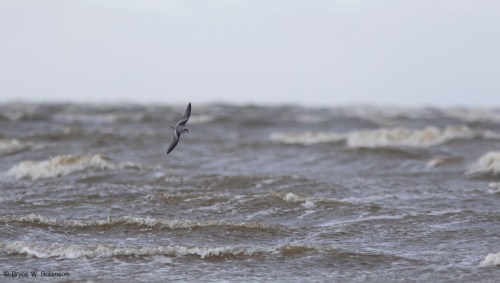
Photo 1. Fork-tailed Storm Petrel arcing down amidst a dynamic soar in high winds. This photo was taken from the shoreline at high tide. Bristol Bay coast, Alaska. September 2016.

Typical experiences with Fork-tailed Storm Petrels are like the image above: A dynamic soaring Hydrobatid at relatively close range. It’s very exciting, but nothing like walking through tidal flats surrounded by the birds.

2L3A1376.jpg

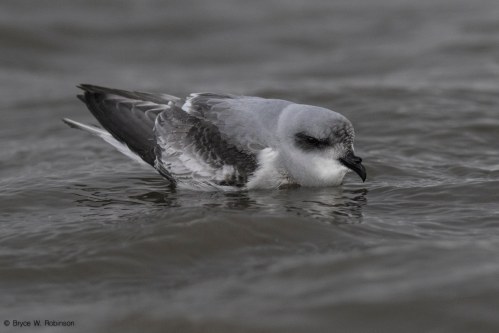
Photo 2. Fork-tailed Storm Petrel at rest on the water. I was standing in ankle deep water when this photo was taken. Bristol Bay coast, Alaska. September 2016

Other more typical experiences can provide observations such as the above photo, where calm water and resting birds near a boat might provide great views. Photo 2 is a bird that I stood near in ankle deep water. This bird was taking a moment to rest from foraging and seemed non-plussed by me. I’ve never heard of anything like it.

2L3A1113.jpg

Photo 3. Fork-tailed Storm Petrel (Oceanodrama furcata) dabbing on water. I was lying on my belly when this photo was taken. Bristol Bay coast, Alaska. September 2016

The experiences continued for the entire two weeks I was on the Bristol Bay coast. After reading through the literature, the behavior seems undocumented and may warrant publication as a note. I’m excited to organize, avail myself of the literature, and share this experience with a crowd more knowledgeable and literate than myself. For me, experiences like these make field ornithology one of the best things about life.

Black-bellied Plover (Pluvialis squatarola) Feeding on a Jellyfish

by Bryce W. Robinson


For the past two weeks I stayed at a small cabin along the Bristol Bay coast of the Alaska Peninsula near the village of Egegik.  I was part of an expedition to trap staging Bar-tailed Godwits (Limosa lapponica) led by the shorebird aficionado Dan Ruthrauff of USGS, accompanied by Lucas DeCicco, Stuart Fety, and Jaime Welfelt. We had poor luck with godwits, but had a spectacular time with the avifauna that was present. I have a lot of content to share from the expedition, and will start by sharing a clip of a Black-bellied Plover (Pluvialis squatarola) feeding on a beached Hydromedusae (Jellyfish).

Although not mentioned in any literature on diet of the Black-bellied Plover (so far as I’ve found), there is discussion of the behavior for Rock Sandpiper (Calidris ptilocnemis; Gill et al. 2002). Apparently the birds feed on the gonads of washed up jellyfish. There were many jellyfish that were left on the tidal flats each day as the tide receded, providing an ample food source for staging plovers preparing for the next leg of their fall migration.

Referenced literature:

Gill, Robert E., Pavel S. Tomkovich and Brian J. McCaffery. (2002). Rock Sandpiper (Calidris ptilocnemis), The Birds of North America (P. G. Rodewald, Ed.). Ithaca: Cornell Lab of Ornithology; Retrieved from the Birds of North America: https://birdsna.org/Species-Account/bna/species/rocsan

DOI: 10.2173/bna.686


Spurting and Filter Feeding Behaviors of a Juvenile Red-necked Stint (Calidris ruficollis)

by Bryce W. Robinson


Apart from its scarcity and place as a formidable ID challenge, juvenile Red-necked Stint (Calidris ruficollis) is an excellent late summer encounter in Alaska because of its focus on feeding and building fat stores for migration. This focus makes the stint a great subject for close proximity observation, photography, and video. Interactive birds that tolerate your respectful but close proximity are the most fun.

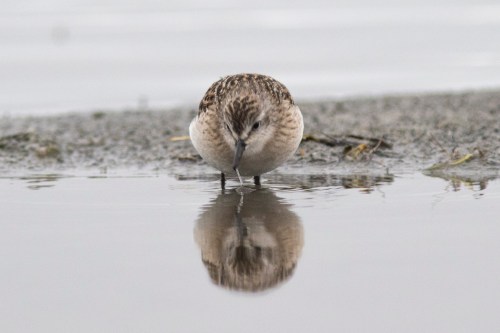
While taking advantage of one such bird, I noticed a somewhat atypical feeding behavior. I was able to capture the behavior in the clip above, as the bird sifts through the water, filter feeding in a way, and consumes small items when it happens upon them. I’ve seen this before in other peeps, but it is certainly an uncommon feeding behavior.

Spurting is an even more uncommon feeding behavior, but one that is regular in many shorebird species (Fellows 2013). Fellows (2013) offers the following description of the behavior: “the bird dips its bill into the water for a couple of seconds, or sometimes a bit longer, presumably to obtain food. It then withdraws its bill and slightly pushes its head forward, usually (though not always) with the bill lowered and then ejects or spurts a stream of water, as if ridding itself  of surplus liquid taken in while feeding underwater. The bill is then reinserted in the water and the sequence is repeated“.

I’d never seen anything spurt before until I watched this juvenile Red-necked Stint  filter feed in shallow water this summer. Unfortunately the video above doesn’t capture anything but filtering, but I was able to manage a decent photo of a spurting event.

2L3A8935.jpg

Photo 1. A spurting juvenile Red-necked Stint at Safety Sound, Alaska. Note the stream of water trailing from the birds bill.

I feel quite fortunate to bear witness to spurting behavior. Special thanks to my friend Luke for not only knowing the name of the behavior, but also letting me know of a note that names and details the behavior in shorebirds (Fellows 2013). Excellent behavior and excellent birding.

Referenced Literature:

Fellows, B. 2013. Spurting Behaviour in Wading Birds. Wader Study Group Bulletin 120(3) pp. 208-209