A studio for bird study

Black Rosy-Finch Use Cliff Swallow Nests to Roost

by Bryce W. Robinson


East of Boise, Idaho, on a cliffside along the Boise River is a conglomerate cliffside of volcanic rock. On this cliffside is a group Cliff Swallow (Petrochelidon pyrrhonota) nests. The Cliff Swallow is migratory, so during the winter months the Cliff Swallow does not occupy these nests.

In winter, the mud cavity nest sites are utilized by other bird species as roost sites. Interesting, to me, is that wintering Rosy-Finch species use these nest sites as well. I finally succeeded in capturing a video clip of a Black Rosy-Finch (Leucosticte atrata) entering a mud cavity to roost for the evening.

The composition of the flocks at this particular site are also of interest. Take a look at the eBird checklist of the time I spent filming this small flock. Most were Black Rosy-Finch, the next most numerous were “Hepburn’s” which are a coastal breeding subspecies of Gray-crowned Rosy-Finch, and there was only one “tephrocotis” Gray-crowned Rosy-Finch, the interior subspecies.

http://ebird.org/ebird/view/checklist?subID=S27027048

The regularity of this Cliff Swallow – Rosy-Finch relationship is of interest to me. I have read accounts of the behavior in California and Washington, but these accounts are few. I do not know of other areas that these birds currently use Cliff Swallow nests, but I will be searching for them and would appreciate any information from other’s observations.

Wintering ecology, what a fascinating faction of bird study.


American x Eurasian Wigeon Hybrid

by Bryce W. Robinson


The phenotypic expression that results from hybridization is fascinating, especially in colorful birds such as the male ducks. One duck hybridization I enjoy is the American x Eurasian Wigeon. The subtle combination between the traits of the two species is pleasing to the eye, but also presents a fun and satisfying ID challenge.

I found a drake American x Eurasian Wigeon the other day in a large group of American Wigeon feeding on a grass field at a large sports park in Boise, ID. The winter group that frequents this field every year generally holds a drake Eurasian Wigeon. This year no Eurasian, but a hybrid.

_MG_4612

Note the retention of the American Wigeon head pattern. The Eurasian has a beautiful red-orange head with a golden fore-crown. The neck and auriculars do not differ in color than the superciliary and hind-neck as in the American. This hybrid holds the American pattern, but with strong Eurasian coloring throughout the head. The other most obvious quality on this bird is the gray flanks unlike the American Wigeon which have rufous flanks. Thus, the combination of American head pattern with reddish hints and the gray flanks are enough to confidently call this bird an American x Eurasian Hybrid.

_MG_4621

Eurasian Wigeon sure show up regularly each winter in N. America. I’d love to know if the regularity of Eurasian in N. America mirrors the regularity of American in Asia. It’s fun to wonder, but with the growing popularity of eBird, answering these types of questions are beginning to seem more and more possible.

Swallow-tailed Kite Movements

by Bryce W. Robinson

Swallow-Tailed Kite - Elanoides forficatus. 11 x 17

Swallow-Tailed Kite – Elanoides forficatus. 11 x 17″ prismacolor on bristol.

I illustrated this Swallow-tailed Kite for my friend Russ. He found Arizona’s first state record back in 2012, so understandably the Swallow-tailed is a special bird to him. You can see the accepted record here:

http://abc.azfo.org/ABCVote/_ABCReports_Public_View_list.aspx

It would be so exciting to see an unexpected X soaring high above the desert. Lately, Swallow-tailed Kites have been showing up in some odd places. For whatever reason a few birds have strayed farther north than their normal range. In this past weeks Rare Bird Alert on the ABA Blog, four separate sightings of the species were made in three different states: Illinois, Indiana, and Kansas. Sometimes birds make strange movements in great distances. You never know, you might be at a hawk watch this fall somewhere in the west and see a large X soaring in the sky. Better start scanning…

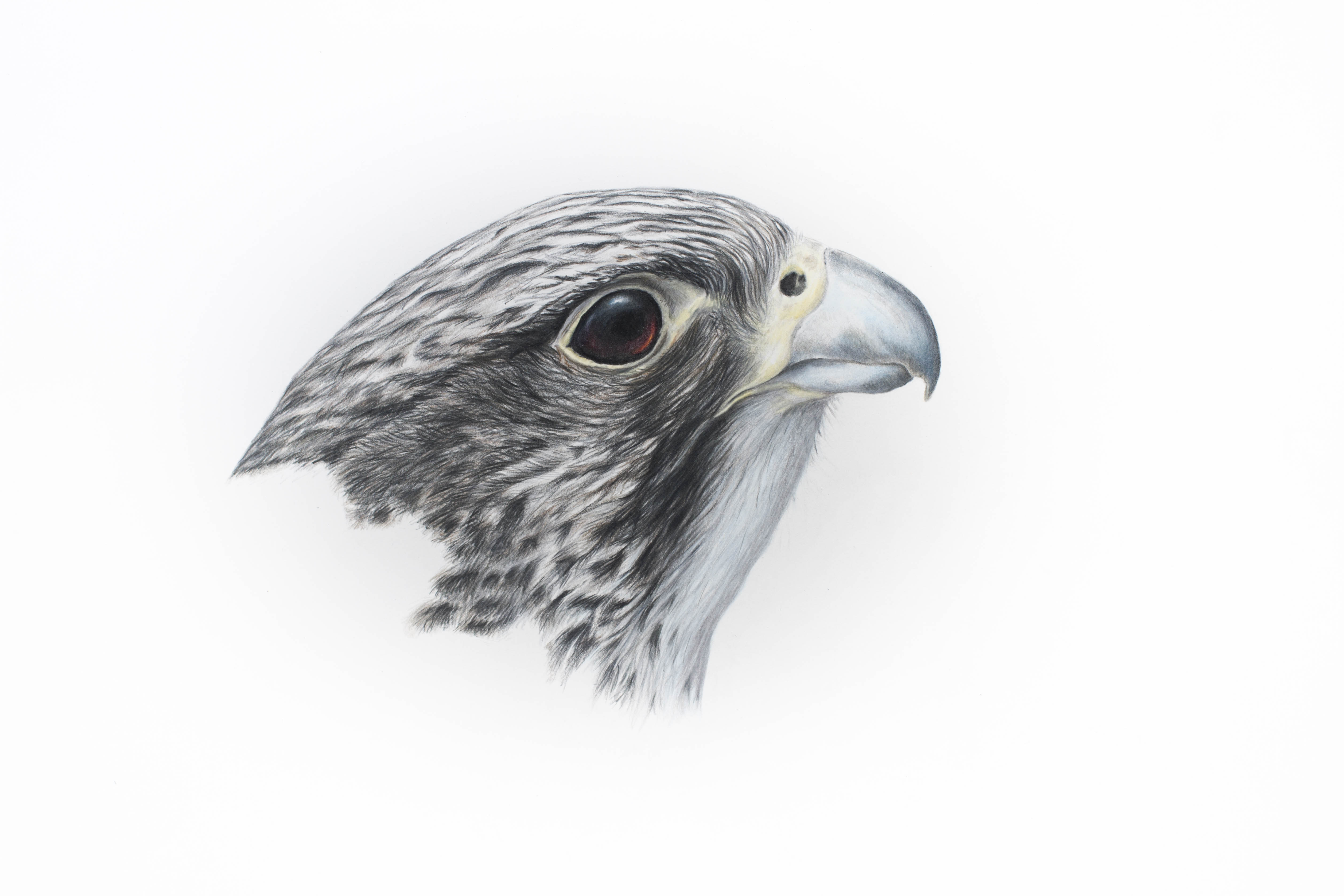
Adult Gyrfalcon Illustration; For John

by Bryce W. Robinson

11 x 17" prismacolor on bristol. Image copyright Bryce W. Robinson

11 x 17″ prismacolor on bristol. Image copyright Bryce W. Robinson

I’m at the end of my final field season of Gyrfalcon work for my Masters degree in Raptor Biology. I came here over a year ago, new to the region and unsure of how to accomplish the goals I had planned on paper. Luckily I had the help of a local man with a lot of knowledge, a falconer with a passion for Gyrfalcons, John. From the beginning he has been an integral part of the work here, providing logistical support through the use of ATV’s, trailers, his land, and the list goes on. The man is so generous, and won’t accept payment or help in return. So, to try and pay him back I illustrated this Gyrfalcon. I used his bird, Tinsel, as the model. This illustration is certainly not enough to repay John for everything. I myself, and The Peregrine Fund, will be forever indebted to him for his help. Thanks John.