A studio for bird study

Tag: alaska

Northern Shrike Nest in Western Alaska

by Bryce W. Robinson

IMG_7056-2

I’ve been on the ground in Alaska with my friend Neil for a week now, and the hunt for Gyrfalcon nests has been all consuming. We haven’t had much luck on the Gyrfalcon front, most nest sites are occupied by Rough-legged Hawk, Golden Eagle, and Common Raven.

Although we’ve had little success with finding Gyrfalcon nests, we have found many other natural treasures. We’ve already seen our fill of Grizzly Bears, and even caught a brief but close look at a Gray Wolf. It seems that every day in the Alaska bush turns up a number of great experiences. One that tops the list for this past week was when I found a Northern Shrike nest in a small tree along a creekside.
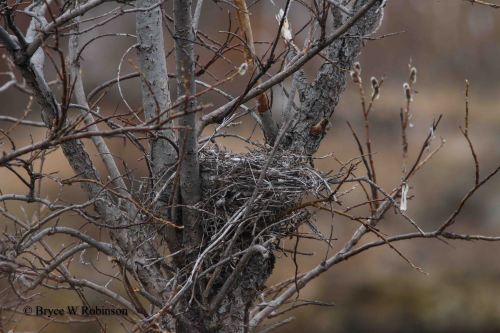
NSHR Nest

The mother held tight in the nest until we were within twenty feet. She then fled, and as we were checking the nest and counting eggs, she came back to her nest. Her responsible behavior and fidelity to her clutch provided me with some great opportunities to photograph her. I appreciate the tenacity of these small passerines. They are truly a vicious song bird. You can see she has some blood on her beak. NSHR

I’ve spent some time at Loggerhead Shrike nests in the desert southwest while doing nesting bird surveys, but I’ve never seen a Northern Shrike nest until now. I’ll tell you, the nests of excubitor are not at all unlike ludovicianus. This nest, like the Loggerhead, was in the middle of the small tree, cones shaped and made of many twigs. The cup was rather deep, and lined with many feathers to insulate eggs and young from the severe weather of the Alaskan tundra. This was a great moment in my first hand education in ornithology, so I had to share.

NSHR Nest wm-0900s


The Gyrfalcon Project is on the Ground in Alaska

by Bryce W. Robinson

Adult female Gyrfalcon- Falco rusticolus

I’m in Alaska to start the first field season of The Peregrine Fund’s Gyrfalcon Project. I landed only three days ago, and hit the search for nests right away. At this point, the earliest nesting Gyrfalcons will have hatching eggs any day. For my research, I need to find them before they hatch.

Gyrfalcon Eyrie

Already I’ve located two occupied territories, with one nest well into incubation. With the help of my friend and field assistant Neil, I made my first entry into an eyrie yesterday to assess nest age, and gather other important data. While I was in the nest, Neil took advantage of the disturbance and documented two very responsible adult Gyrfalcons as they circled and watched my intrusion.

Adult Female Gyrfalcon- Falco rusticolus

After we finished our tasks of data collection, we left the nest. When we reached a distance of approximately 500 meters from the nest cliff, we turned around and took a look at the nest. We were happy to see the female had already returned to the nest to resume incubation. While I was in the nest, I was able to see that one egg had pipped, meaning that in a couple of days there will be some newly hatched Gyrfalcons.

Stay tuned as the summer progresses. There will be numerous reports over the course of the season. Soon there will be nestlings, and I’ll be there to photograph them. You can find out more about this work on ornithologi’s Gyrfalcon Project page, and be sure to check out the Peregrine Fund’s website and consider supporting my work, and raptor conservation as a whole. Here’s to a successful summer, with loads of Gyrfalcon’s!


Pacific Loon, a Load of Feathers

by Bryce W. Robinson

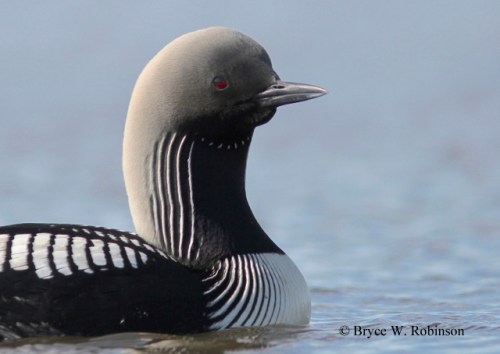
PALO

I’ve seen Pacific Loon in all states of plumage. I’ve always been impressed by a loons looks, but this summer I had the chance to get very close to many Pacific Loons, and really gain an appreciation for their feather composition.

I think that most consider tropical birds to be among the most decorated, and striking in plumage. Colors that come from the tropical regions of the world are truly unique, but I consider some birds of the northern hemisphere to be equally exotic, and equally striking.

The Pacific Loon in full breeding plumage is breathtaking. At close proximity, you notice the velvet appearance of the throat, and its iridescent qualities enhanced. Purple, on an Arctic bird, is awe inspiring. The ghostly grey of the head and nape always leaves me mesmerized. I think that the numerous, dense, and fine quality of the feathers gives the bird a shape and form unlike any other feathered creature. In fact, the form does not even seem feathered at all.

The patterns of the loon are of note, as they are unlike any pattern I’ve ever seen in a creature. The fine lines and stripes are neat, organized, and crisp. This sharp appearance matches well with the behaviors of the bird. It holds its head high, glances about with confidence, and dives with absolute grace. In fact, the regality of the Pacific Loon impresses me, as I admire all creatures who frequent this world in confidence and style.

In winter, it interests me that the bird seems more sleek, and thin. I’ve yet to get close to a wintering Pacific Loon. When I do, I hope to study the difference in feathers and shape, and compare and contrast the two looks of the same bird. It fascinates me, that evolutionarily, two molts have evolved for this bird, and the two resulting plumages are dramatically different.

I can’t explain my fascination with the bird any further. As I’m scheduled to frequent the Arctic summer again for the next two years, I’ll be seeing breeding loons once more. At every opportunity, I’ll record the behaviors and appearance of each individual, and communicate their beauty the best I can. As I’ll be in Western Alaska, there is a great chance I’ll happen upon the Arctic Loon. It will be fascinating to compare my images between the Arctic and the Pacific, two birds that are very similar. I suppose I’ll have to wait and see what comes about, but when it does, I’ll be sharing.


Late Changing Plumage of Rock Ptarmigan

by Bryce W. Robinson

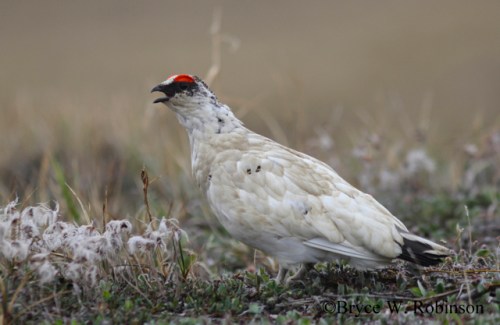
ROPT

Male Rock Ptarmigan- Lagopus muta, still in basic plumage. June 21, 2013. Prudhoe Bay, Alaska

My exposure to Ptarmigan this past summer was not limited. Although I haven’t been able to track down the White-tailed Ptarmigan, I have had a lot of experience with both the Willow and Rock Ptarmigan.

Without hesitation I’d say that the easiest way to distinguish the two species is by call. This is very helpful in early summer, when males are traipsing around the open tundra, full of hormones, calling and chasing one another constantly. But what about later in the season, when birds are more cryptic? What about females?

The differences in plumage are subtle, and so far I feel I could only distinguish females in alternate plumage if they were side by side.

Shape is a helpful tool. Richard Crossley asked me how I distinguish between the females of the two species. My response was head shape, but he persisted and exposed my lack of confidence with the parameter. I feel like I have head shape down, but I’ll need more practice this coming summer as I chase the Gyrfalcon around the Seward Peninsula.

I chose to share the above photo as it shows a Rock Ptarmigan in late June. In late may, male Willow Ptarmigan already have full reddish necks, as they have started their pre-alternate molt. Interestingly, male Rock Ptarmigan do not begin their pre-alternate molt until early July. This makes for a simple identification tool. I’ve yet to research any answers to this difference in timing of molt between the two species. I of course, encourage any discussion on the matter.