
A studio for bird study

Tag: animal

Orange-breasted Falcon Plucking Prey

by Bryce W. Robinson


For the Orange-breasted Falcon whose diet consists primarily of avian prey, to eat requires a great deal of work. First, the birds must capture a food item. They specialize in above canopy surprise and pursuit capture, a technique that blends a bit of skill and luck. When the two align and the bird finally captures a meal, they then must prepare it. Falcons prefer to ingest little amounts of feather from their prey items, and thus need to efficiently remove the extraneous feathers to access the muscle. To remove these feathers, they pluck their prey nearly clean. Plucking can be beautiful, as I found with the Orange-breasted Falcon in the video above as it prepared a Great-tailed Grackle. Perched on a limb high overlooking a deep river valley, the bird plucks. The observer can easily recognize the bird’s technique of rip and flick, as it efficiently carries out its daily ritual and feathers calmly drift away in the hot Central American air.
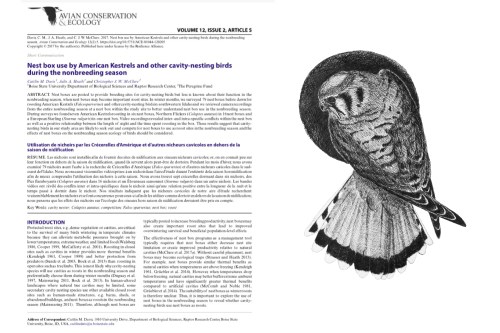
Just Published in Avian Conservation and Ecology: Nest Box Use During the Non-breeding Season

by Bryce W. Robinson


_MG_6507-01.jpg

Caitlin just published an excellent paper detailing nest box use in the non-breeding season in Idaho.

This publication is an important contribution because it discusses patterns in nest box use during a period that has received little attention. Additionally, because nest box programs are engineered to supplement natural cavities to saturate an area with nesting habitat geared to benefit species, a full understanding of its impacts throughout the yearly cycle is important. This paper not only reports how nest boxes are used in the non-breeding season, but illustrates some possible negative impacts as well. Such impacts are primarily associated with the variable thermodynamic nature of nest boxes relative to natural cavities, resulting in deaths at temperature extremes.

The paper also details some inter and intraspecific interactions in nest boxes, and patterns of use in other cavity roosting species such as the Northern Flicker and European Starling. With this discussion comes supplementary video of some such encounters, and excellent inclusion to add further context.

WATCH THE VIDEOS (CLICK HERE)

READ THE PAPER (CLICK HERE) 

Sulphur-rumped Flycatcher (Myiobius sulphureipygius) Foraging in the Dark Understory of Southern Belize

by Bryce W. Robinson

2L3A8821

I’ve been in Central America for nearly two months, and I haven’t had the time or energy to post any stories, images, or illustrations from my experience thus far. There are of course many stories to tell.

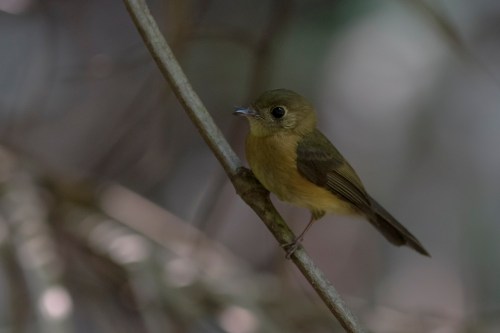
Flycatcher (Family: Tyrannidae) diversity in Central America is very high. Getting to know this diversity has been an excellent challenge. I’ve had a lot of luck seeing most species that I might encounter in Belize, and among my favorite have been the small and endearing flycatchers of the rainforest, such as the Sulphur-rumped Flycatcher (Myiobius sulphureipygius).

2L3A8855.jpg

I’ve seen the bird only a few times. It sits low in the understory of the rainforest, near relatively open areas and perch hunts for insects. Its large eyes are obviously engineered to spot prey, and it tactfully watches and waits until it sees an opportunity. This can be for a minute or more.

These birds don’t seem to mind my close proximity when I’m watching and photographing, and seem only focused on its task of procuring food.

2L3A8794.jpg

Contrasting this seemingly patient and calculated technique with another small flycatcher, the Ruddy-tailed Flycatcher (Terenotriccus erythrurus) has been enlightening. From what I have observed, these birds are constantly making attempts at captures, and hardly sit still for more than a few seconds. It’s difficult to tell if these many attempts are all successful, because the insects it is after are much too small to observe at any distant.

Hopefully I’ll be able to capture both foraging techniques on video. There’s always another way to describe the behavior, whether it be writing, illustration, or video. I’d like to blend all three for these birds.

Published in the Wilson Journal of Ornithology: First record in birds of nestling relocation following nest collapse

by Bryce W. Robinson

IMG_0787.jpg

Photo of a female Gyrfalcon holding a surviving nestling following partial collapse of the nest. Photo published in Robinson, B. W., N. Paprocki, D. A. Anderson, and M. J. Bechard. 2017. First record of nestling relocation by adult birds following nest collapse. Wilson Journal of Ornithology 129 (1) 216-221 

Since I’ve been hard at work in central America for the past month, I haven’t had the time to share a recently published article from my Gyrfalcon work. The article details the behavioral response of a female Gyrfalcon following the partial collapse of a nest. The photo above shows her holding the only surviving nestling following the partial collapse of their nest on a cliff side in Alaska. Just moments later, the female took the nestling to safety at another ledge farther down the cliffside. This behavioral response to threat is the first documented case in altricial birds!

Read the full article: 

Robinson, B. W., N. Paprocki, D. A. Anderson, and M. J. Bechard. 2017. First record of nestling relocation by adult birds following nest collapse. Wilson Journal of Ornithology 129 (1) 216-221