
A studio for bird study

Tag: arctic

Pacific Loon, a Load of Feathers

by Bryce W. Robinson
PALO

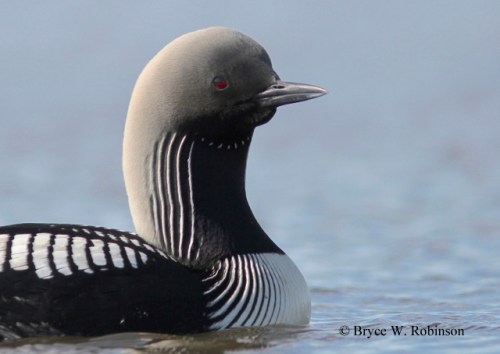
I’ve seen Pacific Loon in all states of plumage. I’ve always been impressed by a loons looks, but this summer I had the chance to get very close to many Pacific Loons, and really gain an appreciation for their feather composition.

I think that most consider tropical birds to be among the most decorated, and striking in plumage. Colors that come from the tropical regions of the world are truly unique, but I consider some birds of the northern hemisphere to be equally exotic, and equally striking.

The Pacific Loon in full breeding plumage is breathtaking. At close proximity, you notice the velvet appearance of the throat, and its iridescent qualities enhanced. Purple, on an Arctic bird, is awe inspiring. The ghostly grey of the head and nape always leaves me mesmerized. I think that the numerous, dense, and fine quality of the feathers gives the bird a shape and form unlike any other feathered creature. In fact, the form does not even seem feathered at all.

The patterns of the loon are of note, as they are unlike any pattern I’ve ever seen in a creature. The fine lines and stripes are neat, organized, and crisp. This sharp appearance matches well with the behaviors of the bird. It holds its head high, glances about with confidence, and dives with absolute grace. In fact, the regality of the Pacific Loon impresses me, as I admire all creatures who frequent this world in confidence and style.

In winter, it interests me that the bird seems more sleek, and thin. I’ve yet to get close to a wintering Pacific Loon. When I do, I hope to study the difference in feathers and shape, and compare and contrast the two looks of the same bird. It fascinates me, that evolutionarily, two molts have evolved for this bird, and the two resulting plumages are dramatically different.

I can’t explain my fascination with the bird any further. As I’m scheduled to frequent the Arctic summer again for the next two years, I’ll be seeing breeding loons once more. At every opportunity, I’ll record the behaviors and appearance of each individual, and communicate their beauty the best I can. As I’ll be in Western Alaska, there is a great chance I’ll happen upon the Arctic Loon. It will be fascinating to compare my images between the Arctic and the Pacific, two birds that are very similar. I suppose I’ll have to wait and see what comes about, but when it does, I’ll be sharing.
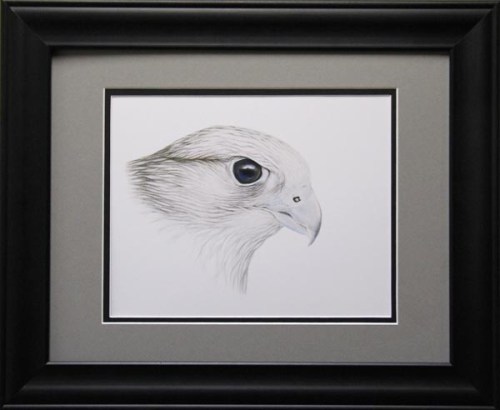
 

Support Gyrfalcon Conservation Efforts of The Peregrine Fund Through Year End Donations, or By Purchasing Artwork

by Bryce W. Robinson

Click image to purchase

Click image to purchase **PRINT ONLY** *Original available

The Gyrfalcon, the Polar Bear of the bird world, is truly an iconic symbol of the frozen north.

It is undeniable, the earth is undergoing rapid change. To properly predict and prepare for the impacts this change will have on the Gyrfalcon, The Peregrine Fund has started a program to study particular aspects of Gyrfalcon biology, and form a conservation program.

I am part of The Peregrine Fund team, charged with developing a long term project to monitor Gyrfalcon populations, and conduct necessary research that will inform conservation biologists, to ensure the future of this powerful bird.

Please consider contributing to the efforts of The Peregrine Fund for a year end donation, and be part of a conservation effort aimed at ensuring the future of the Polar Bear of the birds, the Gyrfalcon. Doing so will not only help in the effort to understand and ensure the future of an arctic animal, but will inevitably help in understanding climate change and its real time implications on the earth as a whole, and in turn, on ourselves.

You can become part of this effort by visiting The Peregrine Fund website, and clicking on the DONATE NOW button on the top right of the page. The Peregrine Fund is a registered non-profit 501-C3, so all donations are tax deductible. In the comments section of the donation form, please specify that you wish your gift to contribute to the Gyrfalcon Project.

In an effort to diversify my funding sources, I have started THE GYRFALCON PROJECT, here on ORNITHOLOGI.COM. I will illustrate and paint, to capture the Gyrfalcon in its emblematic form. All illustrations will be featured on the blog and will be available as originals, along with prints. 50% of proceeds from all sales will be donated to The Peregrine Fund to support the Gyrfalcon Project.

Your action will help, no matter how small, in empowering the research and understanding of our rapidly changing world.

If you are interested in commissioning an original of any medium, please contact me at ofbirdsandbATgmail.com.

Late Changing Plumage of Rock Ptarmigan

by Bryce W. Robinson

ROPT

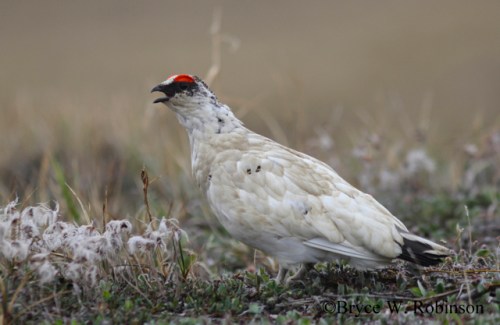
Male Rock Ptarmigan- Lagopus muta, still in basic plumage. June 21, 2013. Prudhoe Bay, Alaska

My exposure to Ptarmigan this past summer was not limited. Although I haven’t been able to track down the White-tailed Ptarmigan, I have had a lot of experience with both the Willow and Rock Ptarmigan.

Without hesitation I’d say that the easiest way to distinguish the two species is by call. This is very helpful in early summer, when males are traipsing around the open tundra, full of hormones, calling and chasing one another constantly. But what about later in the season, when birds are more cryptic? What about females?

The differences in plumage are subtle, and so far I feel I could only distinguish females in alternate plumage if they were side by side.

Shape is a helpful tool. Richard Crossley asked me how I distinguish between the females of the two species. My response was head shape, but he persisted and exposed my lack of confidence with the parameter. I feel like I have head shape down, but I’ll need more practice this coming summer as I chase the Gyrfalcon around the Seward Peninsula.

I chose to share the above photo as it shows a Rock Ptarmigan in late June. In late may, male Willow Ptarmigan already have full reddish necks, as they have started their pre-alternate molt. Interestingly, male Rock Ptarmigan do not begin their pre-alternate molt until early July. This makes for a simple identification tool. I’ve yet to research any answers to this difference in timing of molt between the two species. I of course, encourage any discussion on the matter.

A Highlight of Birding- Breeding Sabine’s Gulls

by Bryce W. Robinson

IMG_7996

I can write a book about how many birding highlights I had this past summer on Alaska’s north slope. It seemed every day I had a memorable experience that will last a lifetime.

I’ve mentioned before that Richard Crossley came to Prudhoe Bay on my last week of work in the region. I agreed to guide him around the oil fields for a day and show him where I had seen particular species. He, of course, had an agenda, and I was tasked to help him out.

We had a hell of a day. I think we started around 8 in the morning, and by midnight, I was still wandering around the tundra photographing birds. He was very keen on finding the Sabine’s Gulls, a bird of which I had seen little. Still, I had a reliable spot that would likely turn up a few gulls, in the least. Just after midnight, we headed that way.

We stopped near the spot I planned to check, only to photograph a small group of Semipalmated and Pectoral Sandpipers. While Richard took photos, I scanned about. I then saw a single Sabine’s some yards away. I alerted Richard. After scanning about a bit, we found a dozen more.

Excitedly we approached the group of gulls and began photographing. The gulls would lift off, and take turns harassing us. Such behavior is typical of breeding birds, defending their young. I took advantage of their tenacity and let my shutter fly. After gathering more photos than necessary, I began the search for the young. Soon enough I found a single bird across a pond, sitting with an adult. It was nothing more than a single ball of grey fluff. So adorable, and so vulnerable.

Our intrusion lasted only a moment. We recognized the stress we were causing the birds, and left. It couldn’t have been better; finding Sabine’s, which I’d barely seen, and having the opportunity to see both adult and young at such close proximity. The experience will stick with me for my lifetime.

The tragedy comes with the benefits of digital photography. Through some glitch, I lost nearly all photos from that evening. Luckily, I have one. It is a photo in the striking midnight sun of the arctic, of a bird I will never forget, and hope to see again, somewhere on the open arctic tundra.