A studio for bird study

Tag: art

White Wagtail Breeding in Teller, Alaska

by Bryce W. Robinson


Working again in Nome this summer, although for a relatively short time, provided me with the opportunity to attempt to see some of the birds of the region that I had missed in previous years. One such bird was the White Wagtail (Motacilla alba). Before traveling to Nome, my friend Luke had informed me that he had already seen the species in a lagoon near the Red Knot camp, so my chances were promising.

Red Knot work was in full swing when I reached Nome, which limited the chance to try for the wagtails. In the meantime came a report of a White Wagtail AND a Common Ringed Plover (Charadrius hiaticula) in Teller some 40 miles from our camp. On 5 July, a day of rain and weather, we took advantage of the inability to work with Knots and headed to Teller to try for both birds.

2L3A0610

An alarm calling adult White Wagtail (Motacilla alba) in Teller, Alaska.

When we reached Teller we began the search, more focused on the plover than the wagtail as the bird was a lifer for most in the group and the wagtail was not. After 20 minutes of fruitless plover searching Luke spotted our other target, a wagtail at the north end of the village. Luke and I both set out to photograph and film the bird and soon realized it was carrying food. Another adult appeared, also with food, and our minds tipped to the possibility that these birds bred in the area. Jim (head of the Red Knot project) watched the food carrying adult and followed it back to an electricity box on the side of a nearby building. The bird entered the utility box, and exited without the food. We quickly backed the truck up below the box to gain access and check for nestlings. Sure enough a grass nest sat in the corner of the box containing small nestlings.

IMG_3945

Electricity box containing a White Wagtail (Motacilla alba) nest. Teller, Alaska.

IMG_2210

White Wagtail (Motacilla alba) nest. Teller, Alaska.

After quickly documenting the nesting situation we left and let the adults return to provisioning the young. At the end of the day we left Teller with an excellent experience with White Wagtail, but unfortunately no Common Ringed Plover. Such is birding.

A few weeks later on 22 July, Luke and I returned to Teller on another poor weather day to check on the success of the brood. We soon found multiple juvenile wagtails chasing the adults, begging for food. Luke mentioned that White Wagtail had bred in Teller in years past, but I was left feeling like I had just struck oil – My first White Wagtails, breeding at that!

2L3A8201

Juvenile White Wagtail (Motacilla alba). Teller, Alaska.

The experienced left me excited. I’ve found that the best way to deal with the hangover excitement of a great birding experience is to illustrate, so after the initial sighting of the adults in early July I took advantage of the next day of weather and painted a White Wagtail on the inset of my Nome 2016 sketch journal.

IMG_0441

White Wagtail (Motacilla alba) in the inset of a 2016 field season sketch book for birds of the Seward Peninsula, Alaska. 

Seeing a bird species for the first time, and one that is quite uncommon in North America at that, is the best of birding. Especially if it feels like its been a long time coming. To see the bird and gain a first hand account of its breeding habits, well that is something else. It has a context, and context is what makes my experiences fruitful. I love life histories of birds, especially regarding breeding. I consider this experience to be the example of the what I seek when I step out the door aimed at observing birdlife.

July 2016 in Nome, Alaska had some magic, or something. But it seems that it was a continuation of a theme that started in early May. I bet that if you were to ask anyone that traveled to Nome, AK in the summer of 2016 they would agree. It was special summer, and I can’t wait to hear reports of what the fall brings in the region.
Gyrfalcon (Falco rusticolus) Painting

by Bryce W. Robinson

_MG_9407

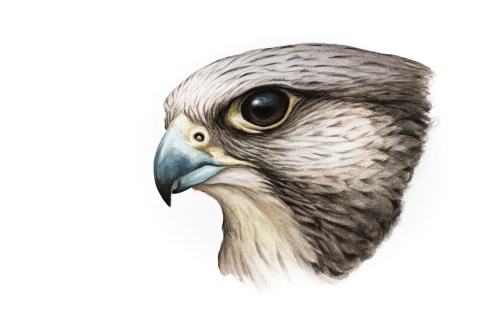
Gyrfalcon (Falco rusticolus). 11 x 17″ Gouache on paper.

Over the past three years my study has revolved around the Gyrfalcon, as I’ve pursued my Master’s of Raptor Biology degree at Boise State University. In May I completed my degree and finished my thesis. At the moment, I’m doing field work in Alaska with the U.S. Fish and Wildlife Service on a few different bird projects across the state, but I’m also working on getting my Gyrfalcon work published. As my work gets published (hopefully) I’ll be sure to share links and a brief description of what each paper details.

While in school I did my best to be actively illustrating and painting birdlife. I’ve painted a number of different species over the past three years, but I’m left with the feeling that I did not paint my subject species enough. I suppose this feeling indicates that I’ll need to regularly return to painting the Gyrfalcon. I’d like to illustrate some of the concepts detailed in my research, but for now I decided to paint a simple head shot of the Gyrfalcon as a cessation of my “structured” work on the species. Now the page turns to a new chapter, the subject of which is unknown to me but I get the feeling it may be quite broad.

California Gnatcatcher – Polioptila californica

by Bryce W. Robinson

FullSizeRender-1

This month I found myself fortunate to have the opportunity of illustrating a “Coastal” California Gnatcatcher (Polioptila californica californica). I was asked to do an illustration for Sea and Sage Audubon in southern California, and I decided to illustrate the California Gnatcatcher because it is perhaps the most pressing avian conservation issue facing southern California.

A few decades of rapid urban development in southern California’s coastal sage scrub habitat has left California Gnatcatcher’s with shrinking suitable habitat and a fragmented range. These pressures have taken their toll on the United State’s only California Gnatcatcher populations, to a point that in 1993 the gnatcatcher received threatened status.

Today it seems that the California Gnatcatcher’s presence and future in the coastal sage scrub is that of small fragmented populations. In essence, the damage has been done, and efforts now focus on preserving what quality habitat is left and ensuring that the small populations remain.

My choice to illustrate this bird was founded on 1. maintaining awareness for the plight of this incredible bird, 2. supporting a feeling of identity for those that live in the area and invoking the California Gnatcatcher as an important part of that identity, and 3. a reminder that these birds act as a symbol for the broad impacts human development has to the ecosystem, a symbol that goes well beyond single species conservation.

For more information on the history of the conservation effort for this species, and to stay updated on current action visit:

The USFWS’s Environmental Conservation Online System page for the Coastal California Gnatcatcher.


Western Grebe with Young

by Bryce W. Robinson

IMG_0006.JPG

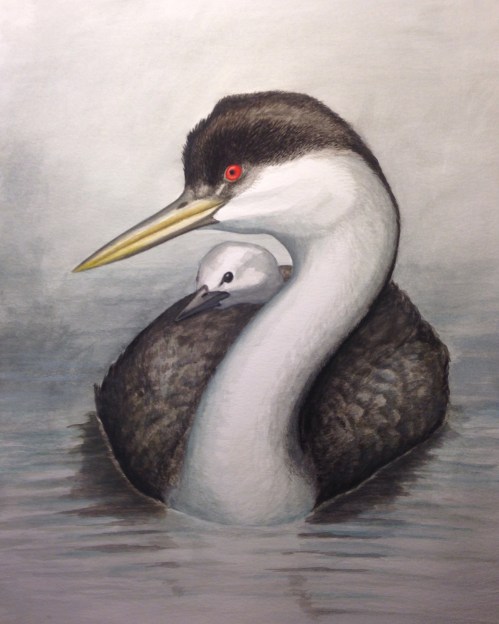
Western Grebe (Aechmophorous occidentalis) with young. 11 x 15″ Gouache painting. Copyright Bryce W. Robinson

I really enjoy the strange behaviors found in the bird world. The Western Grebe (Aechmophorous occidentalis) is then naturally a favorite, due to a few behaviors that are on the surface quite strange.

The first is the rushing, or the synchronous courtship dance where a pair runs in contorted posture across the water. I’ve never painted, photographed, or filmed this behavior but I hope to this coming spring.

The second is the behavior pictured above. Young grebes ride on their parents back, situated between the wings. The parent dives for fish with young in tow, then surfaces with a catch and feeds it to the young.

The third is perhaps the strangest of the behaviors. Grebes eat their own feathers, and parents feed their feathers to their young. There are many hypotheses of what they may do this, but perhaps the most plausible is to line their stomachs. Grebes of course eat fish, yet their gizzards may not fully crush the bone. To protect the soft tissue of their proventriculus and perhaps parts of the intestines, grebes then eat a large amount of feathers that line their insides.

Rather incredible….