
A studio for bird study

Tag: Audubon

Beatnik Birding: Sabel Palms

by Bryce W. Robinson
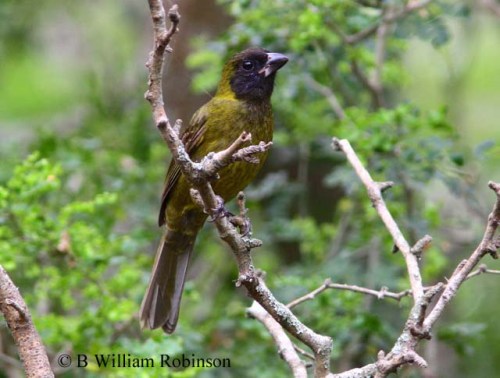
Female Crimson-collared Grosbeak-  Rhodothraupis celaeno.

Female Crimson-collared Grosbeak- Rhodothraupis celaeno.

South of Brownsville, along the Rio Grande, sits an Audubon sanctuary named Sabel Palms. It is one of my favorite places thus far. The trails feel very tropical, the birds are spectacular, and the other visitors are characters. I am odd in the world of birding, especially in the special places such as Sabel Palms. I am odd because I am young.

I came to Sabel Palms with one bird on my mind, the Crimson-collared Grosbeak. To see this bird would be a personal first, a treat to expound upon the bounty of fortunate birding experienced thus far. Asking around, I discovered that a female had been hanging about that day, so I posted up to patiently wait. And sure enough, the beauty revealed herself. Only birders understand the thrill of a life bird, of an exotic life bird, of a quest fulfilled. I’ll tell you as much as this, and let you the reader understand that this bird was special. I felt the purity and love of birding in the moment while experiencing this bird. A highlight, to be understated.
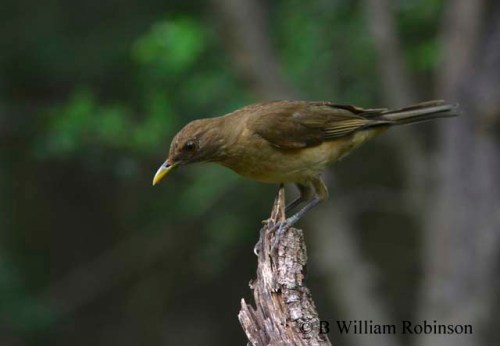
Clay-colored Thrush- Turdis grayi

Clay-colored Thrush- Turdis grayi

Another bird that was busy about the forest that morning was the Clay-colored Thrush. This bird is a new favorite. They are a very large Turdis, much larger than the American Robin of the north. I was fascinated by their habits, and fell in love with their song. They, along with a host of others, provided some music that helped build the experience of traveling about Sabel Palms. I council the birder, the reader, the adventurer, the inquisitive, I council you, to travel to the valley of the Rio Grande, and visit the Sabel Palm Audubon Sanctuary. A place for birds, aged birders, and beatniks indeed.
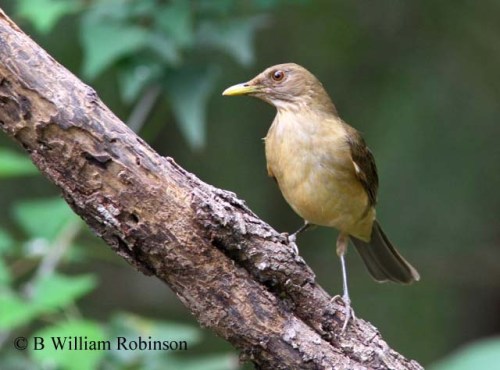
Clay-colored Thrush- Turdis grayi

Clay-colored Thrush- Turdis grayi


Western Screech Owl

by Bryce W. Robinson

Western Screech Owl- Megascops kennicottii. 11×14″ colored pencil on bristol.

A few weekends back I had the good fortune of finding myself on an Audubon ranch in southern California. Starr Ranch is an incredible coastal forest tucked behind a large gated community in Orange County. I came to the ranch to band owls.

The night was incredible. We had a few Big Brown Bats find their way into the nets, providing me the experience of seeing these winged mammals up close. I have never seen teeth so delicate yet fierce. We did have luck with capturing owls. Our first owl of the night was a beautiful female Barn Owl. I was able to take her from the net and band her. Having this ghostly creature in hand, staring into its dark marble eyes, is an experience I will never forget.

We also had four Western Screech Owls caught in the nets. I love the small owls, and was looking forward to the chance of banding one of these birds. The small birds are so endearing. Cute fits them perfectly, they are so full of fight and life. Returning the bird to the night was spectacular. I walked to the woods and perched the bird on my fingers. It sat for a while, not certain of its ability to flee. After a minute or two, the bird took to the night air and disappeared into the dark.

Today I spent my afternoon illustrating a headshot of the Western Screech Owl. I thought it appropriate to revisit this subject, given my recent intimate interaction with the bird. Every time I finish the owl, I feel a bit dissatisfied with the outcome. For whatever reason, I can never get the owl quite right. I would have probably loved this illustration if I would have left the ear tufts tucked back. I feel I drew them a bit too long. Still the exercise was rewarding, and I’m sure I will come out with a screech owl I am happy about if I only keep trying.

Ardea alba- The Great Egret

by Bryce W. Robinson

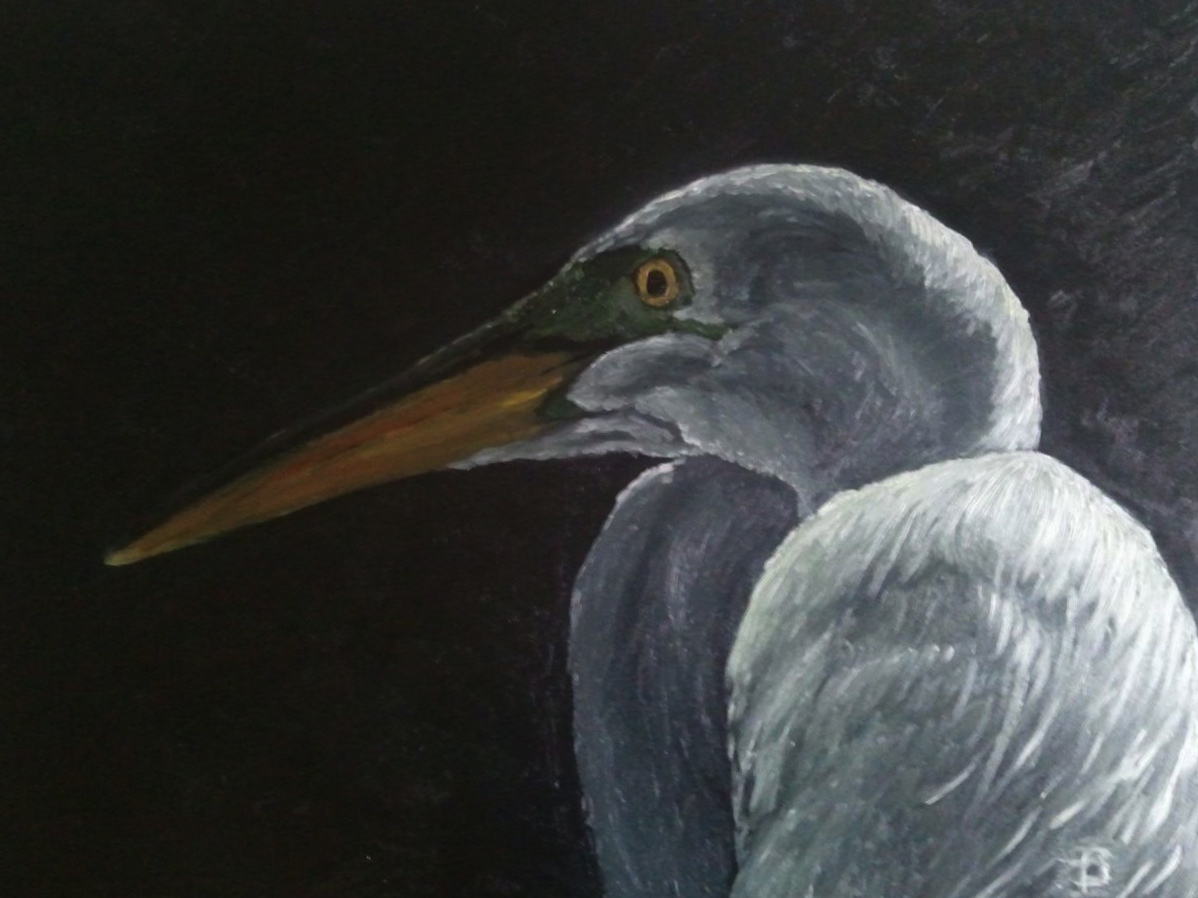
The world is saturated with paintings of the Great Egret, and for good reason. I myself have always made plans to paint the bird, but I never made the effort for fear of falling short of producing an image that truly captures the beauty and grace of the fine creature. Finally, I felt comfortable with giving a go at painting my first Great Egret.

The all white egret juxtaposed against any landscape is stunning. Evolutionarily speaking, it makes little sense why any animal would want to wear plumage of piercing white, unless perhaps their habitat was a snow covered ice land. Thriving in tropical climates, the Great Egret defies any sensible survival strategy and boldly stands out as a symbol of the grace and allure of the avian world.

Deep in the mangroves, a bird studies the shallows. Calm and steady, with long flowing plumes, the beauty of the Great Egret stabs through the shadows. Densely covered forests filter the light, creating a dark world of wonder. Sunlight filters through the shrubbery, and the bright white plumage of Ardea alba shines with vitality. An image of elegance preserved in time, preserved through time.

The Great Egret, Ardea alba. 18x24" oil on stretched canvas. Original not for sale.

Preserved is precisely the word. Saved from the lustful commodification of the new America, the Great Egret now stands as a symbol of what is that might have been lost. Plume hunters at the turn of the 19th century sought after the long white decorative feathers that the egrets wear in breeding season. The stunning feathers adorned the hats of many wealthy women, who served as eyesores against the beautiful white decorations worn upon their heads.

How such a creature could be disrespected leaves me grasping. I have never been able to pass an egret without stopping, stepping back, and paying homage to its exquisite nature. I now see the Great Egret as the powerful symbol that through sacrifice and near extinction, awoke humanity to their destructive nature, resulting in the birth of the conservation movement. No wonder the bird is chosen to accent the National Audubon Society’s logo. Their name reflects their human heritage, and their symbol reflects their avian awakener.

It is nearly the first of January, and multiple reports have come of these birds in the marshlands of the Great Salt Lake. If you have never seen a live egret, make a diligent effort to do so. Perhaps when it is found, it will awaken you much like it awakened America. Perhaps you will see the elegance, the beauty, the allure, and the importance of the natural world.