
A studio for bird study

Tag: bird

Barred Owl – Out of Range but Seemingly Comfortable

by Bryce W. Robinson


Around the turn of the year a Barred Owl – Strix varia, was reported in Boise, Idaho. The owl has been seen regularly for the past month. Barred Owls occur in Boise once every few years as vagrants from somewhere unknown. This Barred Owl showed up in a city park on the east side of town, only about a mile from the foothills. The peculiar part is that the park is adjacent to the Boise River, a large wooded area, and acres of open field. Instead of occupying these more wild, less human areas, the owl has chosen the back yards adjacent to the park to roost. The bird hunts the park edges and greens at night, apparently having loads of success. This behavior is a testament to the hardness of this species against human disturbance. It is one of those few species that seems to do well with the world we are creating.

I took the video above a few days ago just before sunset. The owl was alert, no longer snoozing. The most interesting thing about the video is the birds behavior coupled with the anthropogenic noise. In the clip you can hear a man playing fetch with his dog, someone closing a house door, and many other human sounds typical of urban living.

Why is this Barred Owl able to tolerate a lifestyle like this, yet other species are so sensitive to disturbance? The Barred Owl’s closest North American relative, the Spotted Owl, is certainly having a hard time with the way we are changing its world. These types of questions are worth entertaining as more and more we change the world around us, better for some but certainly not for all.
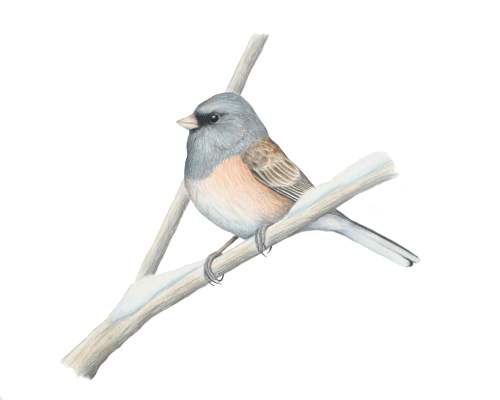
 

The Christmas Bird 2014 – “Pink-sided” Dark-eyed Junco

by Bryce W. Robinson

junco_copy

This year I chose a more common and well known winter bird for my annual year-end illustration The Christmas Bird. I chose a Dark-eyed Junco – Junco hyemalis, more colloquially known as a snowbird. The bird is fitting to represent the season, but I thought I’d make a bit of a twist to satisfy the nerds among us. I illustrated the subspecies mearnsi, the Pink-sided Junco. Those in the Rocky Mountain west are familiar with this bird, as it frequents feeders in mixed flocks with other Junco subspecies. It’s always a treat to see the distinctive pale blue-grey hood with a dark mask. I make sure to pay attention to the subspecies composition of Junco flocks here in western Idaho. We have flocks consisting mainly of “Oregon” Juncos, but occasionally we have “Slate-colored”, “Cassiar”, and the “Pink-sided”.

It is a bit strange to think that we are all at that point in the year once again. I certainly had a great year full of many birding adventures (3.5 months in western Alaska), plenty of satisfying illustrations, and loads of study and learning. I hope that others had an equally satisfying year. Here’s to another year of study and learning. Happy Holidays, and Happy New Year.

Juvenile Gyrfalcon – Falco rusticolus

by Bryce W. Robinson

Juvenile Gyrfalcon - Falco rusticolus. Image taken 7 July, 2014 at an eyrie in Western Alaska.

Juvenile Gyrfalcon – Falco rusticolus. Image taken 7 July, 2014 at an eyrie in Western Alaska.

I’m working on research that is meant to highlight the key parts of what Gyrfalcons eat while they are raising their young, and how any changes may impact their ability to thrive. I’ve gained an appreciation for the amount of effort and energy that is required to transform an egg into a Gyrfalcon capable of flight. The entire lives of the parents during this period revolves around the need for food and the care of the young. It is an impressive spectacle, and a wonder that they are able to put out young so successfully.

Additionally, I’ve come to an appreciation of the fact that the existence of these creatures depends solely on the destruction of other life. They destroy to thrive. This fact seems almost antithetical, but it touches upon an absolute in nature. That absolute is that both the burgeon and termination of life is all part of the natural flow of energy. This absolute keeps me on my path to explore birdlife and ensure that this flow continues for as long as I am responsible.

Red-tailed Hawk in Pen and Ink

by Bryce W. Robinson

After second-year Red-tailed Hawk - Buteo jamaicensis. 11 x 17" Pen and Ink on bristol.

After second-year Red-tailed Hawk – Buteo jamaicensis. 11 x 17″ Pen and Ink on bristol.

I view illustrating birds as an exercise of my ability to create an accurate rendition of my subject. I’ve recently began recognizing a need to incorporate study into this exercise, and as I stated in a previous post, I plan to do so by first illustrating and then reading a scientific article that pertains to my subject. But, I’d like to add another component to my illustrations. I want to make an image that communicates useful information.

I was asked to illustrate a Red-tailed Hawk in black and white, so I took the request and made it an opportunity for me to try a concept I’ve been thinking about. I want to create images that I can teach from, or that simply communicate information for those looking to learn something about each bird. For the Red-tailed Hawk, I wanted to create an image of a bird that could be aged, as if it were a real bird being scrutinized by a biologist.

The above bird is my first attempt at illustrating staffelmauser, or staggered molt. Through illustrating this as it is seen on actual hawks, I made an attempt at communicating the necessary information for age determination.

Here is the breakdown of the birds age:

This hawk is an adult, as dictated first by shape. The wings are broader, giving the tail a shorter appearance as well. The presence of a thick subterminal band on both the tail and wing also indicate that this bird is older than a juvenile. In age determination terms, it is at least “after hatch year”. But, we can take it further. The next step would be to search for molt limits in the flight feathers, that is the presence of retained feathers. Retained juvenile secondaries would be shorter than adult feathers, and lack a thick subterminal band. If this is found, then the bird is in its second year. I illustrated the bird with two generations of adult feathers in its secondaries, and two waves of molt in its primaries ( the staffelmauser, or step-wise molt). The older feathers are paler, as they would be in an actual Red-tailed Hawk. Because of these two generations of adult feathers in the secondaries, we know that this bird is an “after second year”.

Tail banding in Red-tailed Hawks is variable. Many “western” birds, subspecies calurus have multiple banded tails in their definitive plumage. So, this is a useless trait for age determination. To read more, and for a more clear and detailed explanation by the expert, check out a recent article written by Jerry Liguori on Hawkwatch International’s blog.

After all I produced the image I was hoping for, but it isn’t as correct as I’d like it to be. That is the exercise. Each time I finish an illustration, I take a few days to let it sit and be, then return and look for areas that I need to improve. This time I requested some additional critique from a knowledgable (understatement) friend. I now have a list of things to pay attention to the next time I illustrate this bird. I like where I’m at, but I see the need to keep going.