A studio for bird study

Tag: bird

Rough-legged Hawk Feeding

by Bryce W. Robinson


I found this male Rough-legged Hawk the other morning. Delighted that he was enjoying a morning meal, I decided to make another attempt at digiscoping with my phone and scope. It turned out great. The video quality is what is expected out of a phone camera and scope, but it adequately illustrates the feeding behavior. It is a bit long. Some of the most interesting behavior is towards the end. If you grow tired of watching the bird consume, at least catch the last thirty seconds.

The video is also best viewed without the sound on. I added some comments for my own personal notes. My nerdy commentary and some passing vehicles may detract from the video, so I suggest lowering the volume. Enjoy!

by Bryce W. Robinson

Dark Morph Juvenile Red-tailed Hawk- Buteo jamaicensis

The past few months have been full of incredible encounters with the winged world. Recently I found a young Red-tailed Hawk perched atop a fence post along the roadside. I stopped to photograph the bird, as is my custom. I took notice of the dark coloration of the bird, which always excites me. As is possible in winter, I always get excited about dark Red-tailed Hawks and the possibility that they might be Harlan’s. I recently posted about how to distinguish between dark juvenile Westerns and Harlan’s. As I described, it is easy to see that this is a dark Western, not a Harlan’s. Still, I love the chance to see all of the diversity in the species.

What struck me about this particular bird was not anything dealing with plumage. I noticed a large clump of grass in the birds talons. Chuckling, I passed it off as a missed attempt at some prey, coming away with only a healthy talon full of weeds. I didn’t even raise my binoculars to check. Luckily, the photo tells the story. This young bird was successful in obtaining a morning meal.

It tickles me to find myself with a photo of a bird clutching its prey. The story continues, however. The bird lit off of the pole, headed away from the highway to a more secretive feeding spot. I was taken aback as a large tumbleweed flew with the hawk. I couldn’t help but laugh. In the desperate attempt to glean a morning meal, the youthful raptor grabbed more than its target, and couldn’t risk releasing the extras until it began consuming the meal.

I’ve seen some peculiar and comical behavior from young birds in the past. At the beginning of the migration season, I observed a juvenile Red-tailed Hawk grab a pine cone from a tree. It soared about for some time, regularly checking the object in its talons. One can only speculate as to what this bird was doing, but it was quite the sight, to be sure. These special instances display the character that birds possess, only becoming apparent with detailed observation, too often overlooked.


Pen and Ink Sketching

by Bryce W. Robinson

American Kestrel- Falco sparverius. Pen and ink on paper

When I am not counting them, I am drawing them. I sat in my hotel room this morning, pondering how I might make use of my day. Of course my only day off of the mountain for the week is important for household chores such as a shower and laundry, but I always find pressure to stay away from the television and do something constructive. Sketching in my journal seemed like perfect way to pass the time. After all, I need to work on refining my skills. With the most appropriate music, I sat and sketched the day away. It was both relaxing and fruitful.

Light morph Red-tailed Hawk- Buteo jamaicensis. Pen and ink on paper

My journal is 8×5.5″, so it is very difficult to fit a flying hawk onto a page. I also used the smallest pen I have at the moment, an 01 which is not my preferred pen. I normally use 005, especially when illustrating a smaller bird. I still feel that my pen drawings are a bit unrefined. More effort and practice may produce more desirable birds. Still, I find myself staring at this flying Red-tailed Hawk with a smile on my face. I am trying to make the bird stand out with all of the particular field marks that make it appear true to the winged wanderer that I see nearly every day.

Dark morph Immature Red-tailed Hawk- Buteo Jamaicensis. Pen and ink on paper.

I love topside views of soaring hawks. This is possible my favorite thing about observing the fall migration on a ridge top. Only the most special of places leave you with a view of a soaring raptor below. I am always giddy when I come away with a good photo of a bird below my eye level, and illustrating the birds as such provides something similar to that feeling.

Golden Eagle- Aquila chrysaetos. Pen and ink on paper

I had to sketch a Golden Eagle today. We have caught three this season, each bird as special as the last. I cannot describe the feeling of beholding these large winged predators. They are as beautiful and fierce as any big cat, bear, or predator alike. They are powerful, intelligent, and proud. The spirit of these birds interacting with my own caused such an emotional clash, that I could not help myself from shedding a tear. This emotion I will forever remember, and work to pour into every piece put forth that highlighs the majesty of the Golden eagle.


Views of Migration- An Update From the Goshutes

by Bryce W. Robinson

Immature Northern Goshawk- Accipiter gentilis

Progressively, the daily totals are rising. After a month of counting, the season total has already surpassed 3000. I’ve left the mountain for a day, so I would like to take the opportunity to make a brief report of the season to date. I haven’t the energy or the time to put much into the writing of this post, so I hope poor grammar and diction can be overlooked. Pay attention to the images, as I attempt to convey some of the images of the ridge top raptor migration at the Goshutes.

Broad-winged Hawk- Buteo platypterus


The highlight of the season thus far has been the Broad-winged Hawks. Six have flown through, and the above photo is the first of the season. This bird is actually a first for me. I had never seen a Broad-winged before. When I noticed the bird, and knew what it was, I could hardly contain my excitement. Hooting and hollering ensued, and I celebrated for minutes following. The western migration of Buteo platypterus was a thing of rumor in the past. It was thought that the bird did not migrate through the inter-west, and did not pass by the Goshutes migration sight. Jerry Liguori was the first to discover that the bird did indeed use the flight line, and many have been counted in the years since his revolutionary discovery. I hope to see many more to come, and am holding high hopes for a dark morph bird in close proximity to the observation point.
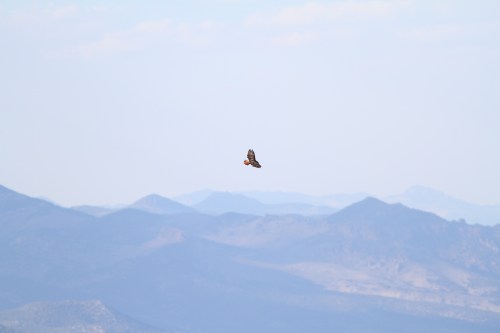
Red-tailed Hawk- Buteo jamaicensis

I’ve been able to get some amazing photographs from passing birds, many very close and detailed. I am saving the best for a future project, so for now I would like to present some photos that show what it is really like at the sight. Mainly, while watching the migration, the observer gets distant views at birds. Identifying the birds to species, sex, or age can be extremely difficult at times. Jerry Liguori has written two books to aid the observer in this task, illustrating a vast amount of tips and tricks to gleaning positive Identifications from distant specs. These books have become invaluable in my study.
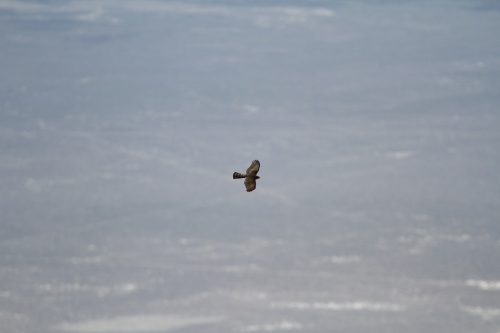
SSHA

Sharp-shinned Hawk- Accipiter striatus

Even better, Jerry has joined me many times at the sight this season. It has been great to have one of the best raptor experts, and arguably the best migration counter, on the ridge to teach me and aid me in becoming a better and more effective counter. I am in intense study of raptor migration, and I am neither overwhelmed or exhausted by this fact. It has been remarkable. My only complaint is that the season will end too soon.

Osprey- Pandion haliaetus

One of my favorite passers-by is Pandion haliaetus, the Osprey. We usually see a few a day, each bird a delight. I have heard of the bird carrying with it a fish, a next meal. I look forward to the day I witness this peculiar behavior myself. Hopefully it is soon, and I am able to get photos.

Male American Kestrel- Falco sparverius

The evenings on the ridge are dramatic, to phrase it lightly. The long light casts shadows across the mountains, highlighting hills contrasted against dark canyons. Often birds will catch light streaming through deep canyons, lighting up agains the dark hillside. The beauty is indescribable, and so often leaves me with a feeling of peace as my soul settles and I fall upon thoughts of comfort. I am in the right place, doing the best thing, feeling no anxiety, and having zero complaints. I am fulfilled, and for the first time in a long time, I have found a home.