A studio for bird study

Tag: bird

From the Field Journal- Golden Eagles at the Goshutes

by Bryce W. Robinson

Two full weeks have passed at the Goshutes, and already I have accumulated many incredible stories. Life on the mountain is as close to heaven as I can get at the moment, I am sure. I’ve decided to chronicle my time here in a field journal. I will share my experiences from the journal by posting particularly interesting accounts. What follows is an entry I made last week, after observing one of the most spectacular wildlife events I have ever witnessed.

August 21st, 2012

Early August has been fairly bird-less as far as migration goes. Although birds haven’t been moving through, a great host of local raptors are keeping me entertained. I have many stories and experiences to tell of a whiny young Goshawk, pestering Sharp-shinned Hawks, bold and curious buteos, and countless others. For now, I’d like to tell of an experience I had today on my observation post. Jerry and Deneb were helping me with the count, as my co-counter Steve had yet to arrive on the mountain. Jerry and Deneb are old friends of seasons past here at the Goshutes. It was rather enjoyable to listen to their banter as they interacted as old friends often do. Jerry helped pass the time, taking it upon himself to teach me the tricks and tips he has accumulated from some thirty years of experience counting migrating raptors. Needless to say the lack of birds was made up for with teaching, chatter and humor. 

About mid-day, the three of us, steeped in some conversation of trivial matters of the world, were rocked as an intense sound of friction filled the air. Looking above towards the source of the sound, we saw two large air masters pass directly overhead. In fact, what we observed were two large adult Golden Eagles engaged in a dramatic and deliberate stoop, heading directly east with conviction. Excited and in awe, we watched the birds descent. By sight and sound, the large Aquila birds resembled two fighter jets in arial pursuit. Near the bottom of the canyon, the two birds abandoned their stoop, spreading wings, slicing the air with legs hanging, a posture of aggression. As we watched, we realized their intention. Picking up a third bird, we saw the eagles close on a soaring buteo, an adult Red-tailed Hawk.

The unsuspecting buteo realized the danger just in time. It began evasive maneuvers to avoid the slashing talons of the eagles. The menacing eagles made pass after pass at the fleeing buteo. I was astonished at the sight of their cooperative offensive. Such slow soaring raptors had turned on their agile abilities, and it became apparent that these birds are masters of the wind and sky. The dog fight continued, and the skilled buteo somehow remained untouched by the merciless eagles. Finally, finding a bubbling thermal, the Red-tailed Hawk lifted swiftly in the air. The heavy eagles slowly pursued, but were unable to match the rising speed of the fleeing buteo. I was in awe at the violence I had witnessed. Such raw experiences rip away the feeling of fluffy beauty nature often promotes. The natural world is wild, harsh, and unforgiving. This time the hawk had evaded the eagles, and peace returned to the air. 

As we stood recounting the natural marvel we had just witnessed, our reflection was rocked by the majestic image laid out before us. To the east, against the expansive backdrop of the salt flats of western Utah, another Red-tailed Hawk joined the soaring victim of the eagles. Separated by hundreds of feet, two buteos above, two eagles below, raptors alike soared in unison, circling in the calm afternoon air. Taken aback, I again and for the hundredth time that week, voiced my feelings for the place. Full of magic and natural wonder, even before the migration has truly begun, the Goshutes has captured my heart, and I am truly at peace in this place. There is no where I would rather be, as I sit on a mountain top, feeling as close to heaven as is possible.

Moving West for Migration

by Bryce W. Robinson

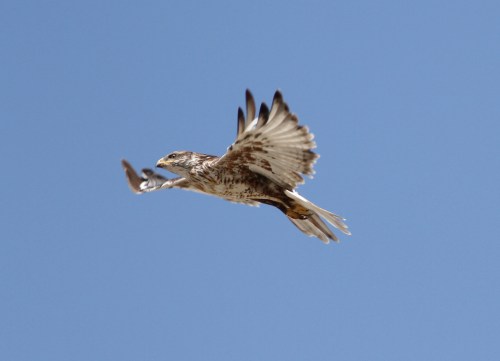
Ferruginous Hawk- Buteo regalis

Tomorrow morning I head west from Salt Lake City, across the salt flats, to a desert mountain for the fall migration raptor count. The island in the sky is lush for its location, and is one of the most spectacular places I have ever been. For the next three months, I will be living on the mountain, in a tent, counting migrating raptors. I will have my camera with me, as I plan to come away with as much video and photographs as possible. My posting will lull as I will not have internet connection, but when the opportunity arises, I will be sure to share as much of my experiences as I can.

A Bounty of Summer Buteos

by Bryce W. Robinson

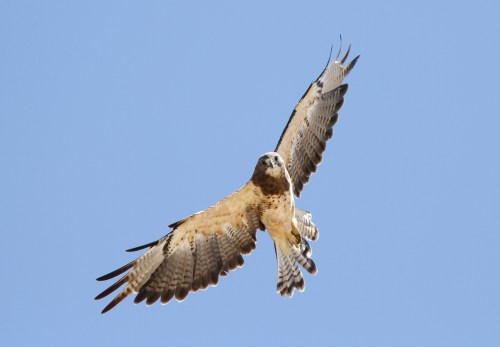
“Intermediate” morph Swainson’s Hawk- Buteo swainsoni.

Yesterday I ventured out to find some raptors with Jerry. We found found an area covered with “summering” Buteos, in densities unprecedented in my young and limited experience with the raptor world. I am enthralled with the ecology of wintering birds of prey, primarily for the interspecies interactions that occur in high density hunting grounds. Yesterday, I found the same densities and something of the same diversity. I have never seen so many Swainson’s Hawks and Ferruginous Hawks in one area. I was very delighted to observe numerous interactions between each species. Surprisingly, the bully seemed to be the Swainson’s Hawks. The Ferruginous didn’t seem to mind the Swainson’s, but a few times I observed Red-tailed Hawks being bullied by the summer migrants.

One particular incident made my day, and provided me with a glimpse of something I’ve never seen, and actually was unaware existed. A Swainson’s hawk and Red-tailed Hawk soared together rather high in the noon sky. The Swainson’s began buzzing the Red-tailed Hawk, resulting in some dramatic arial displays as they twisted to push the other away. Finally the climax of the interaction came when the two birds latched talons and began tumbling through the air. After multiple rolls, the birds broke, sending the Red-tailed Hawk fleeing from the scene. I have seen tumbling between Red-tailed Hawks as they engage in talon clasping to reinforce pair bonds, but never as an aggressive territorial interaction between two different species. The birds were some distance away, so the photos I came away with are not ideal, but interesting nonetheless.

Red-tailed Hawk (top) and Swainson’s Hawk (bottom) engaged in an aggressive tumbling interaction.

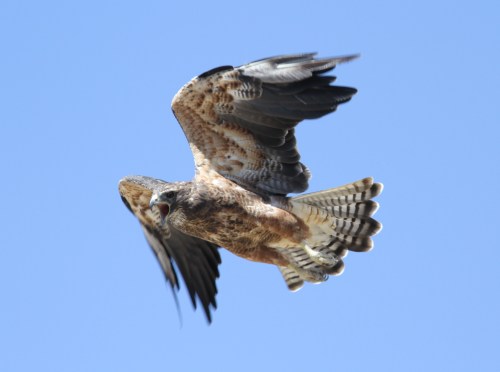
Birds blanketed the valley. Every other telephone pole supported a perching buteo, and the irrigation lines were covered with ravens and buteos as well. On one particular raven-less wheel line I counted eleven birds, comprised evenly of Swainson’s and Ferruginous Hawks. Not only was there interspecies diversity, but within each species, variation in plumage was present as well. I love dark morph Ferruginous Hawks, and a few flew around. These birds were leery of our intrusion, so I was unable to get any good photographs. I did photograph a very interesting adult Ferruginous. I assume it to be something like a rufous morph, perhaps in the midst of body molt, however its present state gave it a tiger like appearance. This is by far the most spectacular Ferruginous I have found to date.

“Tiger” Ferruginous Hawk- Buteo regalis

“Tiger” Ferruginous Hawk- Buteo regalis

I’m a plumage enthusiast when it comes to buteos, so this day was all that I could hope for. The diversity in Swainson’s Hawks was a treat. These birds vary immensely. I found the typical light morph birds, rufous birds, dark birds, and even some that exhibit mottling, perhaps intergrades between the morphs or showing body molt. I remember one particular bird near the end of the day that was nearly black, but it had extensive mottling not unlike a dark Harlan’s. Regrettably, I failed in my attempts to photograph this bird.

Intermediate Swainson’s Hawk- Buteo swainsoni

Light morph Swainson’s Hawk- Buteo swainsoni

It was surprising to find an area so devoid, relatively, of Red-tailed Hawks. There were few hanging about, most likely due to the attention they received from the gangs of Swainson’s Hawks. Still, we found a few birds and were able to come away with some photos.

Light morph Western Red-tailed Hawk- Buteo jamaicensis calurus

Juvenile light morph Western Red-tailed Hawk- Buteo jamaicensis calurus

The above birds was found sitting in a tree with a nest, and another young bird. Given their behavior, Jerry thought this bird to be very young, which is surprising given that most birds fledge early in the year. A late nest is peculiar, but it is highly probable that these birds have only recently taken to the air.

I have a few qualms about the photos I have shared. Although they are the best I have taken thus far, I failed to capture the catch light in most images, and for whatever reason many of the wings are blurred. I resolve to figure out how these problems can be corrected, but I feel great about my successes thus far. My homelessness and beatnik birding lifestyle continues for little longer, but in the small amount of time much will be chronicled. Let the good times soar.


Great Blue Heron- Ardea herodias

by Bryce W. Robinson

Great Blue Heron- Ardea herodias. 11×15″ prismacolor on bristol.

My childhood was spent in study of the Great Blue Heron. I stalked the large wader all summer, learning its habits and admiring its stoic poses. I became engrossed in a passion for the bird, and for what reason I will never know. This childhood connection will forever be an integral part of who I am. I spent many hours illustrating the bird in multiple positions, always enjoying the process of recording the creature I so admired. Today, I feel troubled that I have not put the same passion and effort into this bird. I took the morning to do so, and resolved to schedule a goal for myself. As the Great Blue Heron is responsible for my introduction into the world of birds, I find it so appropriate to write an essay detailing my admiration, feelings, and understanding on its life history. I have only posted one essay thus far, and feel that I must rectify my lapse in writing with a second essay, appropriately paying homage to the most special bird to me. This is only a preview, and I will undoubtedly take my time putting the essay together. In two weeks I will leave society to count migrating hawks for some months, and will have no opportunity to work on the essay. So it may be long coming, but be assured it will. I only found it necessary to voice my goals, as an exercise to solidify the plan for my own sake.