A studio for bird study

Tag: bird

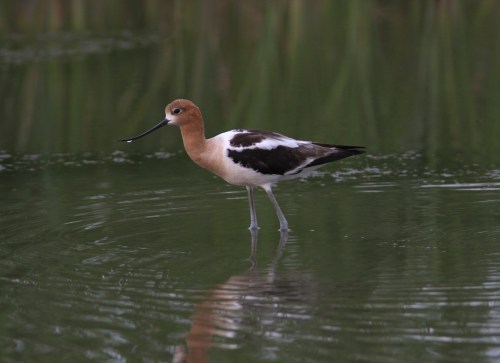
Animated is the Avocet

by Bryce W. Robinson

Animated is a proper term describing the unique American Avocet. I have photographed this common wetland denizen in the past, but given my newly acquired gear, I thought a return to the rusty colored subject would prove fruitful. The birds themselves are striking. The Avocet provides an aesthetic presentation; A rusty orange neck, balanced by long blue-grey legs and contrasting white and black body. As always, I found watching the avocets a delight, as they fed and flew around the shallow wetland waters.

When the avocet stands still it holds itself with poise. The slight upturn of the bill is delicate, and demands reverence. As it moves through the water, it maintains alertness, while conducting its business. The avocet feeds on micro-biota, utilizing its upturned bill to sift through mud and water.

Any area the avocet frequents will carry the sound of the recurvirostra call. Kleet kleet fills the air, neither loud nor obnoxious.  Often, the talkative birds lift to the sky, circling the waters. For minutes the bird flies, finally fulfilling whatever need that put it to the air, and calmly settles back to the water. The avocet is active, in voice, in feeding, in flying. Watching this wetland walker touches upon every aspect I enjoy in birding. Unique sights, unique sounds, unique experiences. A glimpse into a world so alive and independent from my own, its existence commands my respect and admiration.

I began birding in wetland areas. These inhabitants are special to me. Although my study has focused much on birds of prey, and will undoubtedly continue in that direction, I will not forget my roots. I love nothing more than walking among the reeds, listening to the birds, enjoying the long light of the setting sun. I am at that moment, engrossed in a world I certainly respect, but not a part of. I record my findings to pay homage, and draw attention to the fact that other worlds exist outside of humanity, equally integral and important.

 

A Start to Beatnik Birding: California Coast Beginning at Big Sur

by Bryce W. Robinson

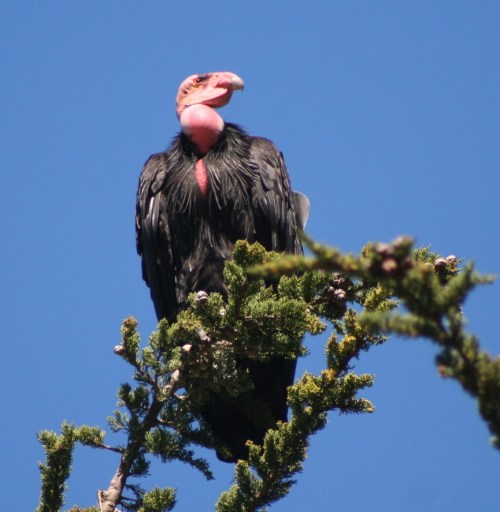
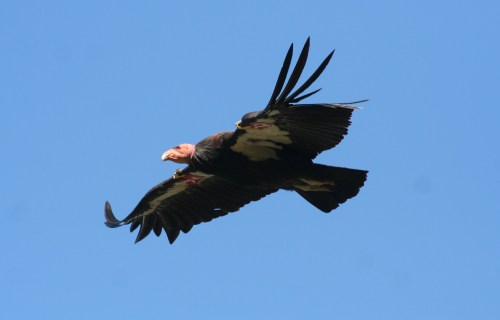
California Condor- Gymnogyps californianus

I left the desert the other day, and set my heading west. My plan is to take the PCH, highway 1 as far north as I desire. So far the journey has been phenomenal. Truly phenomenal, for I cannot describe in words the sights I have seen and the feeling that they have stirred. My main focus for heading through Big Sur was to see the monsterous California Condor. The other night I camped on the southern end of the area known as Big Sur. I had not seen many birds, but I certainly was pleased with the place I called home for the night. I looked out my tent to an ocean view.

Looking north in Big Sur

I had yet to find the condors, but I knew that I had plenty of time to search. I hit the road with wanting eyes. I told myself that the top priority above any else was to find the condor. I couldn’t help my urges to stop and take in the scene as I wound along the cliffs of the ocean front. My mind had let go of its preoccupation with finding the condors, for the distraction of the scenery was too much.

My eyes caught a glimpse of orange as I wound a corner coming upon a roadside grove of tall conifers. I was in disbelief. Immediately my mind registered the possibility that I had already found my prize. Sure enough, sitting atop a tall tree, overlooking the endless pacific, were two of the largest winged creatures I have ever seen.

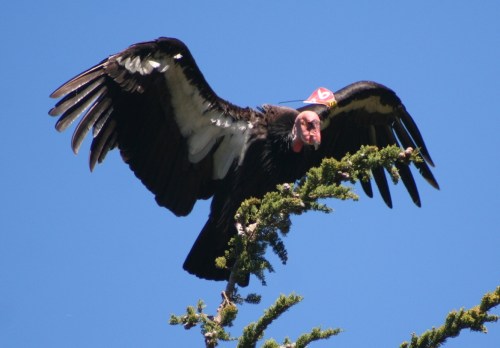
California Condor- Gymnogyps californianus

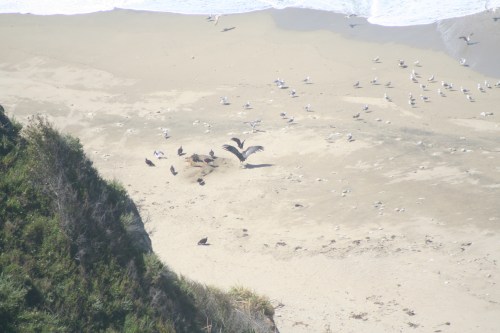
The two birds were very tolerant of me and my camera. I watched them as they sat preening, content with the passing cars and occasional passersby. After nearly an hour, one of the birds left the tree, soaring slow and strong towards the coast. Nearly five hundred feet below the road, the bird landed on the sand. Through my binoculars, I saw a number of birds gather around a large corpse. Gulls and Turkey Vultures yielded their meal to their superior. Every bird backed away as the condor fed upon a decaying elephant seal.

California Condor- Gymnogyps californianus

California Condor arriving at Elephant Seal carcass.

I didn’t expect such a sight for my first time with the California Condor. I noticed another bird below, too large to pass for a vulture. Indeed a juvenile condor soared along the beach. Three condors seemed overly generous for my diligent effort, but I would not complain nor squander the opportunity. I remained for a great deal of time.

The road called to me, and soon I answered. Pulling from the place where I first met the condor, I looked ahead to a long road forward with many birds to come.

Osprey

by Bryce W. Robinson

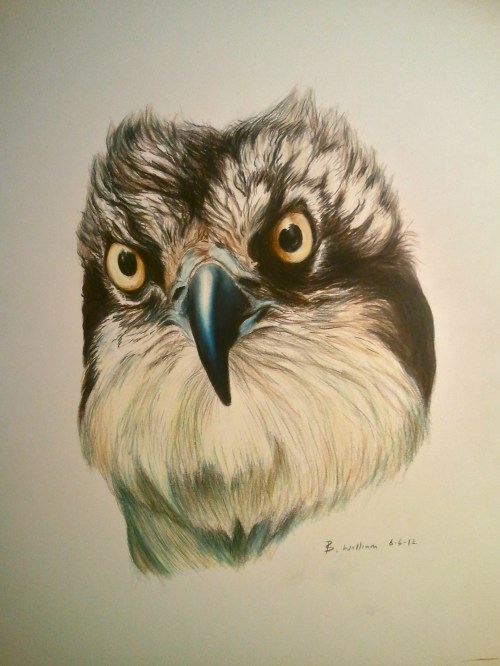
Osprey- Pandion haliaetus. 11×14″ colored pencil on bristol

Throughout my life I have had limited exposure to the fish hunter Pandion haliaetus. I’d like to spend more time in search of this bird, and really get to know all of it’s behaviors and characteristics. It stands true to say that there certainly is not a bird in the sky quite like the Osprey. It is remarkably unique, a fact that induces fascination and intrigue. Every time I find the Osprey, I sit in awe as it hunts the waters for its finned food.

In the past six months I have had two experiences with the Osprey. Of the two, one sits as a special memory in my mind. I was birding along the Colorado River in eastern California. I had come to see the Cibola Refuge, after hearing rumors of its birding grandeur. I wouldn’t say it lived up to its hype, however I certainly wasn’t disappointed. On my way out of the refuge, I passed a small inlet of calm water, separated from the Colorado much like an ox-bow. Catching a hovering silhouette in the golden light of the setting sun, I stopped the car to the spectacle of a hunting Osprey.

The Osprey hovers above water, watching for fish as they surface to glean their own food. Seeing a chance, the Osprey dives to the water with wings flexed back, talons stretched forward, open and ready for the grab. The osprey I watched seemed hesitant at each opportunity. It would dive, catching itself half way down as it lost lock on its fish, and the opportunity for food. It appeared as something of a dance, as the rhythm of the hover was periodically interrupted with a reverberating roll as it dove and rolled back into a hover. With the long light of the setting sun casting long shadows, all anxieties melted away as I let myself become fully involved with the hunting raptor. This instance is one of too few in my life, when my spirit settles and I am truly at peace.


Owls In the Desert Night

by Bryce W. Robinson

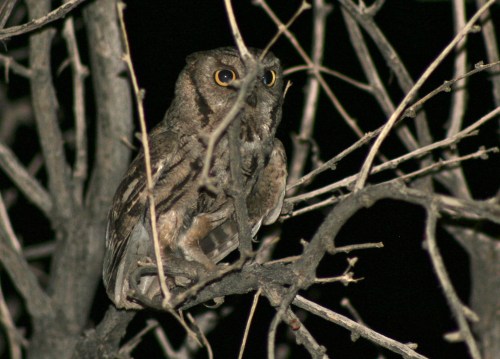
Western Screech Owl- Megascops kennicottii

This evening I joined some friends on an owling adventure into the evening heat which still hovered near 100 degrees farenheit. We were in search of the world’s smallest owl, the Elf Owl. The desert of southern California is not the normal range of this tiny creature, but for whatever reason, there has been a bird living in one canyon for some time.

We watched some palm snags with nice cavities as the sun light began to fade. At one point, a small head poked from a cavity. We thought we had our owl, but soon after an American Kestrel flew from the hole. We were disappointed, even though a nesting kestrel is quite the prize.

The sun fell, and darkness ensued. No owl. After a while we realized we would no longer be able to see the owl, even if it was around. We listened for any calls, but none came. Before we left we decided to check for other owls. We knew there were probably screech owls in the area. They had been heard before. We whistled a few calls and listened. Sure enough two birds responded. Interestingly, the birds were perched ten feet in front of us on some limbs. We had some great looks at them.

The two birds called, and each bird had an obvious difference in pitch. One bird was noticeably lower. I know that in many species of owls the vocalizations differ, with the male being a lower pitch. I’ve heard this many times in the Great Horned Owl as they hoot back and forth at the inception of nightfall. I’m not certain if there is a difference between male and female voices in the screech owl, but it certainly seems so. I plan to do some reading to find out.

Although we were unsuccessful in finding the Elf Owl, I was very happy with the night. An owling adventure is surely successful when any owl is found.

Western Screech Owl- Megascops kennicottii