A studio for bird study

Tag: bird

Western Screech Owl

by Bryce W. Robinson

Western Screech Owl- Megascops kennicottii. 11×14″ colored pencil on bristol.

A few weekends back I had the good fortune of finding myself on an Audubon ranch in southern California. Starr Ranch is an incredible coastal forest tucked behind a large gated community in Orange County. I came to the ranch to band owls.

The night was incredible. We had a few Big Brown Bats find their way into the nets, providing me the experience of seeing these winged mammals up close. I have never seen teeth so delicate yet fierce. We did have luck with capturing owls. Our first owl of the night was a beautiful female Barn Owl. I was able to take her from the net and band her. Having this ghostly creature in hand, staring into its dark marble eyes, is an experience I will never forget.

We also had four Western Screech Owls caught in the nets. I love the small owls, and was looking forward to the chance of banding one of these birds. The small birds are so endearing. Cute fits them perfectly, they are so full of fight and life. Returning the bird to the night was spectacular. I walked to the woods and perched the bird on my fingers. It sat for a while, not certain of its ability to flee. After a minute or two, the bird took to the night air and disappeared into the dark.

Today I spent my afternoon illustrating a headshot of the Western Screech Owl. I thought it appropriate to revisit this subject, given my recent intimate interaction with the bird. Every time I finish the owl, I feel a bit dissatisfied with the outcome. For whatever reason, I can never get the owl quite right. I would have probably loved this illustration if I would have left the ear tufts tucked back. I feel I drew them a bit too long. Still the exercise was rewarding, and I’m sure I will come out with a screech owl I am happy about if I only keep trying.

Manifesting My First Hermit

by Bryce W. Robinson

Hermit Warbler- Setophaga occidentalis. 11×14″ colored pencil on bristol.

I sat in the sun, waiting for the others. Of course I was on a high from the Townsend’s Warbler ten minutes earlier. I had been looking for the bird for a week. People had been telling that the Townsend’s had been seen regularly across the desert for the past week. I’d never seen the bird, so I spent the week with my eyes out, actively checking every tree for the hyperactive warbler. Finally on Saturday morning the bird found me.

After seeing my first Townsend’s, more began showing up. I realized that there were other warbler’s migrating through the area that I had never seen. One bird in particular was a close relative to the Townsend’s, the Hermit Warbler. It was the next on the list, I had to see it.

So, sitting in the sun, talking with a friend Jeff, I began voicing my wishes to see the Hermit Warbler. I raised clenched fists, exclaiming to the sky, HERMIT WARBLER! Jeff responded in the same fashion, but exclaiming MANIFEST IT!  Afterwards, I explained that I knew that the bird migrates through southern California, however, I didn’t know if it came through the desert. It was my next life bird to see. Literally seconds later a shadow flew overhead. Jeff and I both raised our glasses.

The bird had landed in a Palo Verde only ten feet to the north. It took a while for the spastic warbler to show itself enough to glean anything. When it finally came forward from the green shrubbery, it was unmistakable. Jeff and I had manifested a life bird, the Hermit Warbler. Possibly the most miraculous birding experience I have ever had.

Jeff loves warblers. I give him credit for turning me to my most recent interest in the bird world. After seeing the Hermit, he kept mentioning how incredible it would be to find a Townsend’sxHermit hybrid. As rare as the bird is, I couldn’t help but think of the possibility of finding the cross. After all, we had manifested my last life bird.

Today we saw many warbler’s, and believe it or not, one bird made us think. At first I thought it to be a drab Hermit, but after some research and consultation, I’ve decided to settle on a hybrid. Given the streaking on the flanks, and the markings on the auriculars, I am fairly confident the bird we found is a first spring HermitxTownsend’s Hybrid. Migration is a beautiful thing, especially in the warbler realm.

Possible 1st spring Hermit X Townsend’s Warbler Hybrid

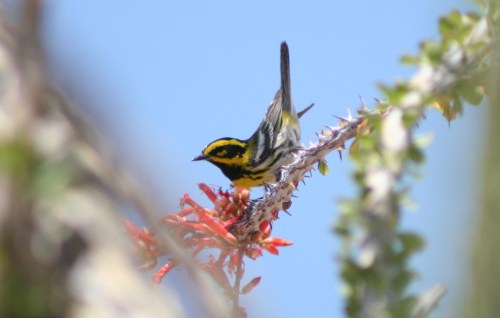
I also thought I would include a photo of a Townsend’s Warbler I found. These birds are striking. Hope to see more.

Townsend’s Warbler- Setophaga townsendi

It’s been quite the spring migration, and it is only the midpoint. Tomorrow undoubtedly brings more!

Finally, a Heron Photo

by Bryce W. Robinson

Great Blue Heron- Ardea herodias

I first met the Great Blue Heron as a boy, in the fields of Ithaca, New York. This large bird is solely responsible for my interest in the entire avian world. I spent the remainder of my childhood drawing the Great Blue Heron over and over. Many birders and ornithologists alike have similar stories, each with their own bird. The Great Blue Heron is my bird, and will forever be special to me.

I have never been able to come away with any decent photos of my favorite bird. Although common, they are rather shy. The other day I went to a wetland near the California coast. Bolsa Chica is a large reserve of estuaries near Huntigton Beach. I walked through the reserve birding, finally coming upon a very tolerant heron. I couldn’t believe how relaxed it was, as I was standing only fifty feet from the bird, taking my photos.

Of course the photo could be better. I’m not so concerned with that fact. I am satisfied with the reference photo, and thankful for the luck of a cooperative bird in a beautiful place. Perhaps in the future, with more luck, better equipment, and new skills, I will capture a photo that will truly deliver the deserved respect to this stoic creature.

Nashville Warbler- Oreothlypis ruficapilla

by Bryce W. Robinson

Nashville Warbler- Oreothlypis ruficapilla. 11x15" colored pencil on bristol.

I’ve started a study of Warblers. I am seeing quite a few in the field, as we are in the full swing of spring migration. The warblers are a large group of birds. I feel an appropriate way to make sure I learn the ins and outs of these birds is to not only actively search them out, but illustrate them and really study each species. The first time I saw the Nashville Warbler, I thought it might be a MacGillivray’s. After seeing it a few more times, and really spending some time in my guidebook, I learned the difference. The red crown of the Nashville males is often hidden. I have only seen it once so far. The most helpful tip to quickly separate the Nashville from the MacGillivray’s is the throat. Nashville is yellow, MacGillivray’s is grey. There are other factors separating the two, but I feel that the throat is the most helpful tip. I have still not seen the MacGillivray’s, but I will and when I do, I will illustrate it as well.