A studio for bird study

Tag: bird

A Green Heron GIF to illustrate Tail Flicking Behavior

by Bryce W. Robinson

GRHE.gif

While photographing a vagrant juvenile Green Heron (Butorides virescens anthonyi) along the Boise River in early November, I noticed a behavior I wasn’t aware of for this species. When I would get a bit too close the heron would notice me, stop foraging, and flick it’s tail while it slowly walked away, as if it had a nervous tick.

Tail flicking is a behavior that many species exhibit. A recent study with the Black Phoebe found support for the explanation that tail flicking was a sign of vigilance to predators, a topic I’ve written about here. When the bird flicked its tail, the predator got the cue that the bird was aware of its presence and the predator had lost the advantage of surprise. This seemed to make sense in explaining the behavior of the Green Heron I stalked on the Boise River. Each time it began flicking its tail, I’d let off until it relaxed and continued to forage.

Fork-tailed Storm Petrel (Oceanodrama furcata) Foraging on Tidal Flats: Part 2

by Bryce W. Robinson


I captured too many images from my recent experience with Fork-tailed Storm Petrels (Oceanodrama furcata) along the Bristol Bay coast of the Alaska Peninsula. Given that our observations warrant a full report in a journal, I’ll maintain some brevity for now. However, I think it is helpful in the interim to share supplementary video and images that set the stage for the publication. The rest will come out with the article sometime in the coming year.

2l3a1345

Stuart Fetty walks towards a resting Fork-tailed Storm Petrel as the tide rises.

We had a few days where the birds lent themselves to close proximity photography. They were all around us, and didn’t seem to understand or comprehend the concept of a terrestrial predator. In one instance, we walked as close as a meter or so to a bird sitting on the water with no response. Whether this was an ill or a healthy bird resting, I can’t be sure. We do however have some indication that these birds were healthy, but these are details that will be discussed in publication.

2l3a1170

Fork-tailed Storm Petrel kiting in an onshore wind. Note the fish carcass in the foreground, an attractant for the birds to this location.

The past six months have been full of unique encounters with bird life in Alaska, and have produced a nice list of potential publications that I’ll be working on throughout the winter. I’ve taken a lot of satisfaction in working in a place where the birdlife is still relatively understudied, a place where paying attention, taking good notes, and diligent photography all support the opportunity to add to our basal knowledge of natural history of the less understood species of North America.

A Crested Auklet as a Prey Item in an Inland Gyrfalcon Nest as Detailed in Marine Ornithology

by Bryce W. Robinson

Fig-1-Crested-Auklet-insert-in-a-Gyrfalcon-nest-as-captured-by-a-motion-activated.png

Photo 1. Image of a Crested Auklet that was delivered to a Gyrfalcon nest, located over 100 km from the nearest coastline. Image published in Marine Ornithology 44(2) 229-231.

The fist publication from my Gyrfalcon research is now available online:

Click to access 44_2_229-231.pdf

The account (Robinson and Anderson 2016) published in Marine Ornithology details a strange prey item, an adult Crested Auklet, delivered to one of the Gyrfalcon nests I had placed a camera in during the summer of 2015. All details are in the paper, so be sure to give it a read.

More Gyrfalcon publications to come!

Referenced literature:

ROBINSON, B.W. & ANDERSON, D.L. 2016. Crested Auklet Aethia cristatella as a prey item in an inland Gyrfalcon Falco rusticolus nest. Marine Ornithology 44: 229–231.

Rock Sandpiper (Calidris ptilocnemis) – A GIF to illustrate the power of feathers for rendering shape

by Bryce W. Robinson

ROSA.gif

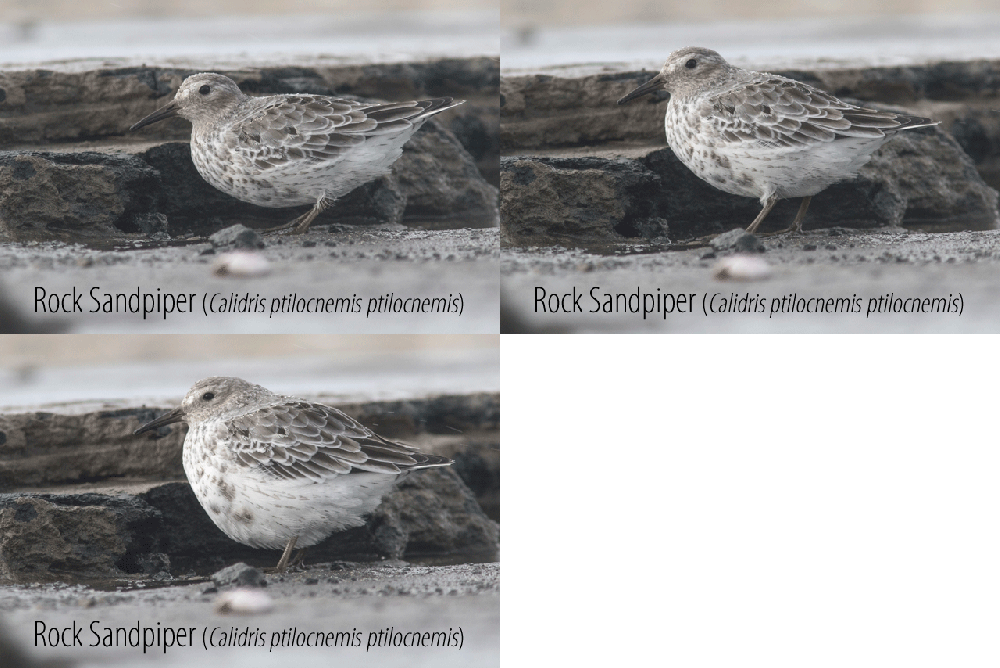
I finally had the pleasure of seeing a “nominate” Rock Sandpiper (Calidris ptilocnemis ptilocnemis) during my time on the Bristol Bay coast of the Alaska Peninsula. This bird was hanging out with darker Rock Sandpipers (likely tschuktschorum) and Dunlin. These birds breed on Bering Sea Islands and mostly winter in Alaska’s Cook Inlet, farther north than any other shorebird (Gill et al. 2002).

While sifting through the many photos I took of this bird I found three taken almost simultaneously that illustrate the power of feathers for rendering a birds shape, and how much and quickly that can change for an individual bird.

After seeing the potential of putting the three photos together, I taught myself how to create a GIF (Graphic Interchangeable Format). I feel a GIF is an excellent way to show how only a few seconds and a relaxed posture can change the shape of a bird.

Referenced literature:

Gill, Robert E., Pavel S. Tomkovich and Brian J. McCaffery. (2002). Rock Sandpiper (Calidris ptilocnemis), The Birds of North America (P. G. Rodewald, Ed.). Ithaca: Cornell Lab of Ornithology; Retrieved from the Birds of North America: https://birdsna.org/Species-Account/bna/species/rocsan

DOI: 10.2173/bna.686