A studio for bird study

Tag: birding

The Le Conte’s Sparrow: An Idaho State Second, Not Seen Since the Late 1800’s

by Bryce W. Robinson

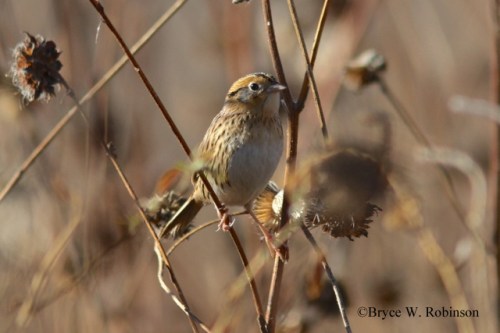
LCSP1113

I spent the day birding with Jay Carlisle, Heidi Ware, Caitlin Davis, and a number of great folks with the Golden Eagle Audubon Society from Boise, Idaho. We ventured to the area around CJ Strike Reservoir in southern Idaho and found a great diversity of birds with a few highlights.

The bird of the day was easily a close and tolerant 2nd state Idaho record, the Le Conte’s Sparrow. We found out that the last record was a bird collected in the 1890’s. So, as Heidi aptly pointed out, this was the bird of the century!

It isn’t often that you find a rarity, everyone you are with gets incredible and sustained looks at the bird, and you get numerous great photographs. For whatever reason, the stars aligned and the experience was everything one could hope for.

Of course, this wasn’t the greatest find in the country today. Apparently, Jeff Bouton found an Amazon Kingfisher in south Texas. Thats a 2nd ABA area record. What a day!

Prairie Falcon- Falco mexicanus

by Bryce W. Robinson

Prairie Falcon- Falco mexicanus. 18x24" prismacolor on bristol

Prairie Falcon- Falco mexicanus. 18×24″ prismacolor on bristol

Of all the raptors I illustrate, it seems falcons give me the most trouble. I’m not entirely sure why, but the fact that I struggle with the family is a bit disheartening, as it is likely to be a group I spend a considerable amount of time studying for the rest of my life. Perhaps with time, I’ll work out the bugs in my inability to adequately illustrate the birds.

Falco mexicanus is a significant illustration for me. I’ve conducted a great deal of field work in the west, primarily in the flats of the great basin, and I’ve had many experiences with the sandy brown assassin. Get yourself lost on lonely dirt roads of the remote great basin in midst of winter, and you will undoubtedly come upon a Prairie Falcon perched on some high point, surveying for prey.

I remember last year, I was searching for eagles on the edge of the salt flats of north western Utah. I had pulled over to glass a mountain top, and found myself watching a perched Golden Eagle, some two kilometers away by my estimate. While I watched the bird, I notice a fast approaching figure headed straight for the large raptor. The figure was in fact the Prairie Falcon, come to conduct its business of bullying the large eagle. The tenacious bastard kept at it for nearly five minutes, until finally the eagle had enough of the dodging, and fled from the persistent falcon pest.

My success with illustrating this bird is fortunate, and gives me the courage to start a project that will be focused on gleaning some much needed extra funding for my work with the worlds largest falcon this summer. Stay tuned as this idea develops and materializes.

Birding in South West Idaho

by Bryce W. Robinson

LESA110213

It has been a while since I’ve posted to this blog, due mainly to the fact that some poor luck fell on me, and my laptop was stolen from my desk in my office while I was off teaching. Luckily, most of my photos and video were backed up, but it’s been rough not being able to share anything while I’ve searched for a solution. For the meantime, I’ve found a temporary fix in borrowing a computer. This has allowed me to look through some photos I’ve gathered while I was computer-less.

Anyway, the photo above was taken yesterday morning. I went for a day of birding with some new and talented Idaho birding friends to a large reservoir on the west end of the Treasure Valley. It was a great day with some good birds. We ventured to Deer Flats Reservoir in the early morning, making it to the mudflats just as the sun rose. The light was electric, and luckily we found some tolerant Least Sandpipers. I again found myself on my elbows and knees, shooting shorebirds, remembering my summer in the north.

I don’t know much about birding in Idaho, but I sure am learning. We found a juvenile American Golden-Plover, which is a great bird here. It was a lifer for one of the fellows in our group. That is always fun to be a part of, in my opinion, even if it is not you who gets to see something new.

Here are the ebird checklists for those interested in knowing what we found:

http://ebird.org/ebird/view/checklist?subID=S15553530

http://ebird.org/ebird/view/checklist?subID=S15553364

http://ebird.org/ebird/view/checklist?subID=S15553253

http://ebird.org/ebird/view/checklist?subID=S15553246

I really enjoy the new birding community I’ve found here in Idaho. Lots to learn as always, and hopefully now that I have a way to blog again, I’ll keep the posting regular.


Hoary Redpolls on the Breeding Grounds

by Bryce W. Robinson

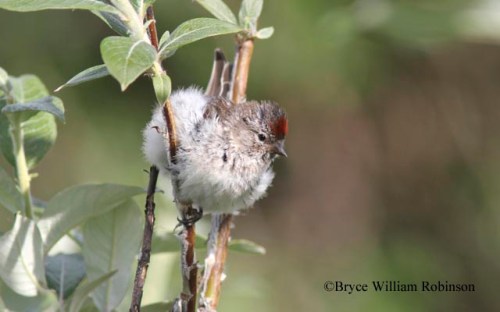
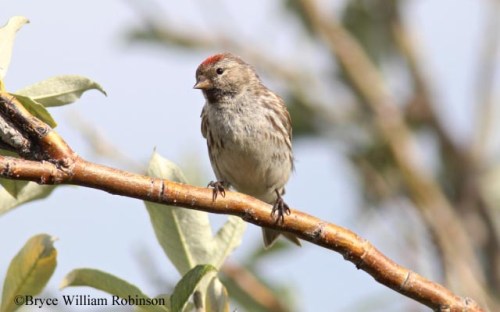
IMG_8096 copyBirders are obsessed with finding vagrants, the wayward members of any given species. They love the game of the rare encounter of a lost bird, and they love the game for good reason. I have had a year where I’ve experienced an aspect of birding quite the opposite of that game that the birders love. This year, I’ve been fortunate to be the vagrant myself, encountering many of North America’s species for the first time, but on their home grounds. This experience has been extremely satisfying, and I’d like to touch upon a few aspects of why, with one species, Carduelis hornemanni, the Hoary Redpoll.
IMG_8170 copy

On my way south from the Arctic Coastal Plain this past July, accompanied by Caitlin Davis and Richard Crossley, I resolved to experience a number of species as much as I was able. On the top of the list was the Hoary Redpoll. Luckily, both Richard and Caitlin were not in any hurry, and had the same agenda as myself. So we stopped a number of times along the Sagavanirktok River to search through the willow thickets in search of redpolls, among other species.

We were successful, as expected. One family group of redpolls were a bit cooperative, so I stood with Richard taking photos of as many individuals as I could as they passed along through the tickets. Richard and I discussed what we were seeing, and one topic of our discussions still sticks in my mind. The redpolls were not the bright white birds I had expected. Richard spoke openly about his ideas of the counterintuitive aspect of birds wearing darker, rather than our expectations of feathers fading to light. I liked his ideas, and thought it rather intuitive actually, that white feathers would degrade with age and the worn appearance would give the birds a dirty, dusky look. That certainly is what we saw with the redpolls.

IMG_8120 copy

The most satisfying aspect of seeing the Hoary Redpoll on its breeding grounds was seeing the juvenile birds in their juvenal plumage. Those birders that fail to wander to the extreme north and into the breeding range of the Hoary Redpoll will not get to see the birds at this stage, as the redpolls undergo their pre-formative molt before they depart for their wintering grounds. This was exciting for me, as I am making it an effort to experience as many bird species as possible at each stage of their lives. I want to see it all.
IMG_8112 copy

This experience introduced me to a new concept. I gained two lifers from seeing the Hoary Redpolls on their breeding grounds; of course the life bird, but also a life plumage type for the bird. As you age in your birding, you begin losing the opportunities of firsts, as far as species go, but if you supplement the experience with firsts for ages and plumage types, the list grows and the opportunity for new experiences becomes almost endless. Birding is wonderful in this regards, as it parallels the creed that in learning, the more you learn, the more you learn you didn’t know. And then the journey becomes endless, and to me, that is beautiful.