A studio for bird study

Tag: birding

The Parasitic Jaeger, An Interactive Bird

by Bryce W. Robinson
IMG_7599 copy

One of my favorite parts of working on the tundra was experiencing the breeding behaviors of the Parasitic Jaegers, first hand.  In early June, when I first arrived on the tundra, I was impressed by the number of all three of North Americas Jaeger species. Many times, I watched dramatic pursuits of shorebirds, where two jaegers would cooperatively chase and capture their prey. As winged predators such as raptors seem to fascinate me above all else, these hunting forays were captivating. I had heard, but really had no idea the jaeger was such a fierce bird.

When the snow finally melted completely, the Pomarine Jaegers left the area. The large numbers of Long-tailed Jaegers seemed to decrease drastically as well. For some reason, the Parasitic Jaegers stayed, and formed territories. Luckily, one study plot of which I frequented, had a nesting pair of Parasitic Jaegers. I interacted with these birds for the entire season, and I’d like to share some of my encounters.
IMG_3094 copy

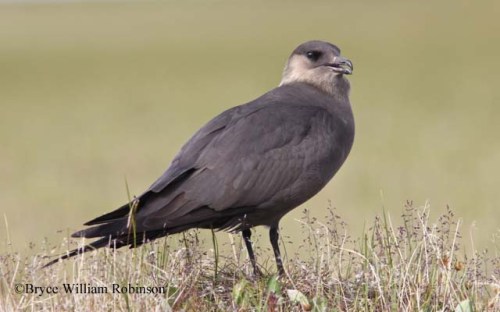
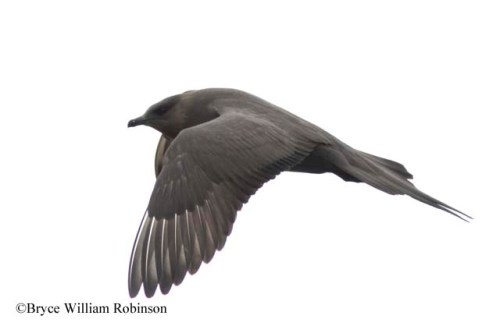
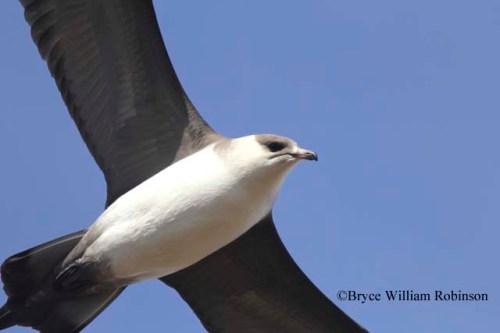
For the first few weeks, every time I walked through the jaeger’s territory, the birds would simply circle, vocalizing occasionally. This mild and cooperative behavior would soon change. In the meantime, it was enjoyable to photograph the birds, and contemplate their different plumages. The bird of which I believe is the male, sexed by behavior, is a solid dark morph. The female, is a very light and unmarked bird, quite unlike her mate.
IMG_3855 copy

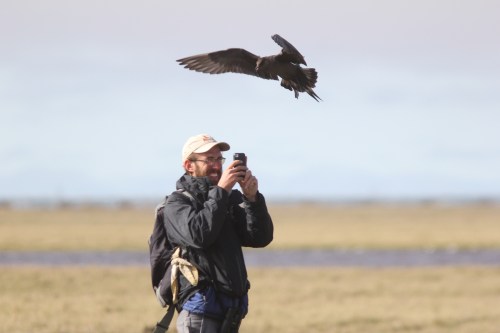
When the birds actually initiated their nest, they became highly interactive creatures. The closer I came to the nest location, the more aggressive the jaegers became. Vocalizing constantly, the birds dove at my head. It was amusing to watch the birds heading straight for my face, and drop their cute little webbed feet. If it were a raptor with serious talons, the game would have been different, but webbed feet were ultimately non-threatening, and only made me giggle.
IMG_6403

Above is a photo of me, giggling. I’m glad my girlfriend Caitlin was there with the camera to capture my elation. I think the photo shows how much this bird nerd enjoys bothering nesting Jaegers, and how much jaegers dislike bird nerds bothering their nest. In this instance, I was trying to record the experience of having birds swipe at your head. I took videos on multiple occasions, almost every time we walked through the territory, but only once was I smart enough to turn my phone and get a video formatted correctly. Below you can watch the jaegers attack me on a foggy day, and experience one of the many reasons I loved working on the arctic tundra.

New to the World, The Pectoral Sandpiper

by Bryce W. Robinson

IMG_7083 copy

I know I’ve promised photos of the chicks I’ve seen on the tundra, and have yet to share anything. I’ll admit, photographing these little things is a lot more challenging than I had imagined. They seem to never stop moving, and if you don’t keep a keen eye trained to them at all times, they hunker under some grass, no longer to be seen.

I have had a bit of luck, mainly with chicks that are a bit older. One thing I like about looking at lone chicks, is the exercise of identifying the bird. It is a bit tricky, but it forces you to pay attention to certain helpful traits, and ignore body plumage altogether. The first thing I noticed about the young Pectoral Sandpiper pictured above, is the distinctive bill. Pale at the base, dark at the tip, with a slight down curve, thinning at the end. Obviously a Pec!


Alaska Mosquitoes Are the Bane of All Existence, Even for the Willow Ptarmigan

by Bryce W. Robinson

IMG_7047 copy

What is the Alaska State Bird? Well, according to everyone I spoke to before my journey north, the Alaska state bird is the Mosquito. I’ll admit now, I understand their point. If there is no wind on the north slope, and temperatures are fair, the mosquitoes are intolerable. Luckily, one can prepare for the onslaught by bathing in carcinogenic 100% Deet and wearing cumbersome face nets.

One can prepare, if one is human. I saw first hand the other night that all blood carrying life here suffers from the miserable insects. I was watching a Sandhill Crane feeding in the short grass of the tundra. In an instant, the peaceful scene changed as two violent Willow Ptarmigan began a campaign to oust the crane from their area. I assume the behavior was due to the presence of a band of small young ptarmigans, hidden somewhere nearby.

After the crane wisely vacated the area, I took the opportunity to pair the striking summer plumage of the two ptarmigan with the golden evening sun for some spectacular photography. The Ptarmigan were cooperative. I set myself at an appropriate distance from the birds, and laid on the tundra to sit at their level. While I shot the birds, the Alaska state bird conducted its business on all of my vulnerable areas. It’s been three days, and I’m still itching.

What struck me most was the amount of mosquitoes on the head of the male Ptarmigan. The poor bird was constantly shaking the bastards off, but to no avail. He was being mercilessly bitten, and had no defense. I felt for the small feathered creature. In this instance we shared something; the misery of the mosquito, a fact of life in the north country.

IMG_7028 copy


Lost Gulls in Prudhoe Bay, Alaska

by Bryce W. Robinson


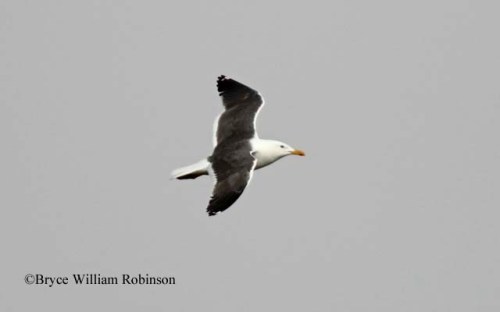
Great Black-backed Gull- Larus marinus

Great Black-backed Gull- Larus marinus

If you’ve started to read, then I’m impressed. Gulls in the title is probably a big turn off for most birders. But in all purity, this is what birders love. VAGRANTS. 

Still, Gulls? It is my opinion that the average birder is bored when it comes to gulls. Bored not at the lack of challenge, for there certainly is a challenge, but bored at the birds general appearance and habits. These are simply assumptions on my part. I actually don’t know the reason for the lack of enthusiasm, but I bet the reasons for low numbers of “laruphiles”, or gull lovers, are numerous. Still, it is undeniable that it is widely understood that gulls are not the most exciting subjects when it comes to birding. I on the other hand, have felt an itch for paying attention to this highly successful bird group.

There are only two gulls that breed on the north slope of Alaska, being the Glaucous Gull, and the Sabine’s Gull. Both birds are rather distinctive. The Glaucous Gull differs from other large gulls by having a notably pale back, with entirely pure white remiges. This look is distinctive, even at a distance, allowing any oddballs to be easily recognizable.

The oil fields at Prudhoe Bay house a large number of people. With people comes trash, so it is no surprise that the oil fields have a dump. Dumps are gull magnets, and the dump at Prudhoe Bay is no different. Knowing that anything is possible in birding, I formed the habit of scanning the hundreds of gulls that hang around the dump from day to day. The habit finally paid off two weeks ago when I noticed a dark backed gull amongst the pale Glaucous Gulls.

I hurriedly snapped photos and analyzed the bird. To me, it resembled a Western Gull, but some aspects were a bit off. I also noticed that the bird was banded. Very exciting, given the ability to read the band. Reading bands is a complicated business, and as the gull was in an area that I was unable to enter, I couldn’t get close enough for a better photo, or a way to read the band myself. I wish I had explored my options further. This was the only time I saw the gull. So, no band number. 

I’m just learning the gull dilemma. It is a challenge. There is a lot to learn, and the differences between many species are slight. With this vagrant dark backed gull, I had to get some help. I emailed a friend in high places, and he soon got back to me with a consensus, along with the opinions of other authorities. The result was GREAT BLACK-BACKED GULL. A life bird for me, and a bird I hadn’t even considered. The back just didn’t seem dark enough. Still, after taking into consideration their input and analysis, I agreed. What a bird, so far from home.

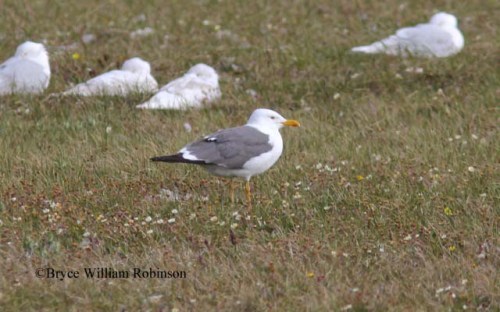
In the following days I made my rounds by the dump, in hopes of finding the gull again to catch the band number. Last week, I thought I found the gull again, but actually, I had found something more exciting, a second dark backed gull. Immediatly I caught that this gull had no retained immature remiges, and had yellow legs. I knew the bird, even though it was another life bird; LESSER BLACK-BACKED GULL!


Lesser Black-backed Gull- Larus fuscus

Lesser Black-backed Gull- Larus fuscus

Lesser Black-backed Gull- Larus fuscus

Lesser Black-backed Gull- Larus fuscus

Sometimes birding is a game of curve balls. I never knew I could get so excited over gulls, but it spoke true to one of the reasons I am a birder. I love to find birds far from home, on crazy journeys themselves. I love to wonder why, and what they’ve experienced, and simply recognize that they are here, and how strange or miraculous that is.

Birders find vagrants everyday, some, much more exciting than these gulls that passed through Prudhoe bay. Nonetheless, the gulls helped me remember; This is birding, to notice something spectacular, that is so often overlooked.

Lesser Black-backed Gull- Larus fuscus

Lesser Black-backed Gull- Larus fuscus