
A studio for bird study

Tag: birding

Buff-breasted Sandpiper- Tryngites subruficollis

by Bryce W. Robinson
IMG_5602 copy

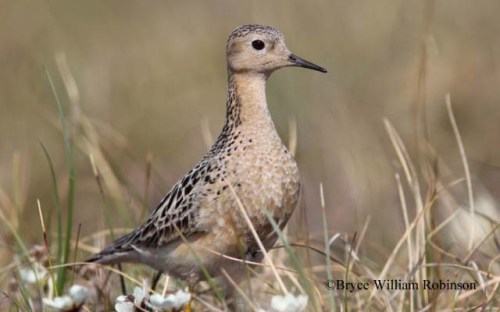
Now this is my favorite sandpiper of the tundra, I promise.

The Buff-breasted Sandpiper intrigues me to no end, and I do not know why. Perhaps it is the interesting courtship displays they employ while courting potential mates on the lek, or perhaps it is their simple yet satisfying aesthetic.

Photographing these birds has been difficult. It has been an outright failure, till I visited a nest the other day. Then, I had cooperative subject. Cooperative is not quite the best word for the subject, as it implies a certain awareness to my intentions. What I had was a very concerned and responsible parent, doing its best to draw me away from its nest, and weigh the risk of my presence.

Lately, I’ve been experiencing something new to my photography. I keep having birds too close… Too close? How is that a problem?

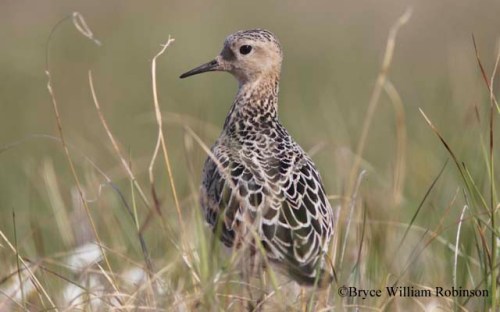
While I set myself up at the optimal distance, I’ve often had birds walk towards me, within feet, to analyze my intentions, and exhibit their distraction. Patience is a virtue in this instance. Each bird has its own style, and each species has its own technique. This Buff-breasted seemed to have a calm, silent approach to dealing with the bearded inquisitor. When I finally came too close, she was off the nest, but only to walk about, in a seemingly natural manner, foraging here, foraging there. She often came too close, but I allowed her to conduct her business.
IMG_5543 copy

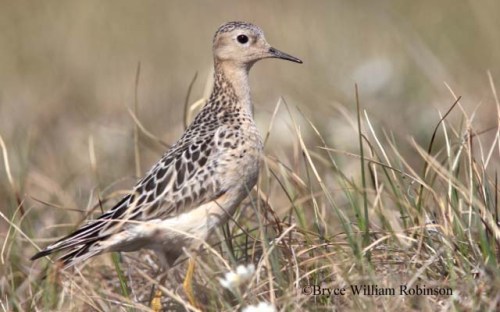
When she was too close, I enjoyed the experience. When she wandered to areas of good light and proper distance, I let the shutter go. As mentioned in my earlier post, the grass became an issue. But perhaps I’ve had a change of heart, as the habitat the bird frequents tells a story. On my belly, I capture the bird on their level, and in the tundra, the grass is ever-present and a consistent part of their world. It should be in the photo of this bird on its nesting grounds. I want my photos to be as natural as the subject they portray.
IMG_5564 copy

I made a trip back to this nest today. The eggs had many pip holes, and I could see small beaks working their way to chip and break out into the world. Tomorrow, there will be small Buff-breasted Sandpipers making their first steps into a tundra grassland full of danger and life. I hope to make it there before they wander too far for me to find.

Female Lapland Longspur- Calcarius lapponicus

by Bryce W. Robinson

IMG_5955 copy

If you understand tundra topography, then you’ll know what I’m speaking of when I refer to polygons. As everything in the tundra is a ground hugger, photography has presented a challenge. If you look at the other photos of shorebirds I’ve posted so far, you’ll notice the overwhelming presence of grass. I’ve resorted to lying on my belly, elbows on the ground, to get the low angle of the birds that creates the image I most desire. A problem has arisen, as I get low, the grass between me and my subject obscures the image. Frustrating…

I do have one ally, in polygons. The polygons are caused by water freezing and thawing on the surface soil of the tundra. When the water collects and freezes, it splits the soil, causing interesting patterns all across the tundra. Each time it thaws, the result is water troughs surrounding small, risen, dry land. Polygons… Each time the process happens, it increases the polygon effect. When I fly out of the area, I’ll try and take a photo of the polygons from above. It is an interesting sight.

There is an area near one of my survey plots that lacks the thick layer of grass typical of the tundra. It is mostly bare soil, with lichens and moss as ground cover, and some flowers. It is a beautiful area, but the main reason I like it is the deep polygon troughs that the lack of vegetation has allowed. The bare ground also allows a clear view between me and my subjects.

Today I was making my way through this area, and I came upon a group of Lapland Longspurs. The birds were very vocal, and excited. Soon I found the reason, a small but able fledgling, doing its best to avoid me. With the female nearby and very attentive, I took my opportunity and utilized the low troughs of the polygons to my advantage. The result was a collection of the best female longspur photos I have to date.

I’ve been trying for decent male longspur photos, but I keep coming away empty handed. Hopefully soon.

Stilt Sandpiper- Calidris himantopus

by Bryce W. Robinson

IMG_5385 copy

I’ve really enjoyed the opportunities I’ve had here with the birds of the tundra. I constantly find myself on my elbows with a tolerant bird, my shutter clicking away, as I try to remain calm and steady. It’s tricky working with the birds here. They aren’t quite accustomed to humans, but this can be to a photographers advantage. In fact, large creatures aren’t natural threats to these birds. Ultimately, I believe, that to the birds I resemble a creature such as the caribou. I’d like to think I am that large and powerful.

The result is a cautious, but calm subject for photography. So long as you remain calm, slow moving, and non threatening, the birds are relatively cooperative. This cooperation has given me the chance to work on composition and other skills relating to my photography. With the 60D I’ve been using, and a broken 300mm lens, (I won’t go into details why I haven’t been using my 7D, and why I’m limping with a broken lens) I feel I’ve gathered a great group of photos of some of the tundra breeders.

I’ve had a few opportunities with the Stilt Sandpiper, but today was definitely the most fruitful. As the tundra warms, the flowers have bloomed in bounty. The grass is also greening and growing, and coupled with the diverse and multicolored lichen, the tundra has become quite the setting for dramatic photography, and exceptional birding.

IMG_5363 copy

This stilt likely had a few fledglings nearby, as it was showing all of the signs of a parent in distress. Later I reviewed the photos from the day, and noticed that every time the bird opened its mouth, something seemed to be sticking out. It seemed like the birds tongue, and I’m fairly confident that is the explanation. You can see it plainly in the photo above. In other photos from other angles, it shows that the tongue is sideways. I’d love to discover what the problem is with this bird. I do hope that it is nothing serious, as this bird has a job to do raising the next generation.

There are loads of youngsters crawling across the tundra, and I’m loving every chance to experience the new life. I could string a long list of cliches to explain my feelings every time I see the young chicks, but I’ll just let the photos in the future do the talking for me. Stay tuned…


Ruddy Turnstone- Arenaria interpres

by Bryce W. Robinson

IMG_4992 copy

It’s been a real treat to see the Ruddy Turnstone on its breeding grounds. These birds have quite a story. Their name is fitting, as they are known to turn stones in search for food, but even more incredible in my eyes is a peculiar piece of their diet. The Ruddy Turnstone eats the eggs of other nests, a behavior quite unlike any other shorebird that I know. They are also quite tenacious. I’ve observed these birds chasing jaegers out of their territory, and while I was taking some time to watch and photograph a pair, they were unreserved in expressing their intolerance of my intrusion. It’s expected when I am hazed by territorial jaegers, but having a turnstone flying at my face comes rather unanticipated. It’s an experience worth having, trust me.