A studio for bird study

Tag: birding

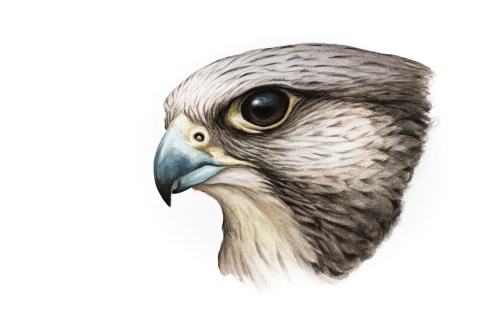
Gyrfalcon (Falco rusticolus) Painting

by Bryce W. Robinson
_MG_9407

Gyrfalcon (Falco rusticolus). 11 x 17″ Gouache on paper.

Over the past three years my study has revolved around the Gyrfalcon, as I’ve pursued my Master’s of Raptor Biology degree at Boise State University. In May I completed my degree and finished my thesis. At the moment, I’m doing field work in Alaska with the U.S. Fish and Wildlife Service on a few different bird projects across the state, but I’m also working on getting my Gyrfalcon work published. As my work gets published (hopefully) I’ll be sure to share links and a brief description of what each paper details.

While in school I did my best to be actively illustrating and painting birdlife. I’ve painted a number of different species over the past three years, but I’m left with the feeling that I did not paint my subject species enough. I suppose this feeling indicates that I’ll need to regularly return to painting the Gyrfalcon. I’d like to illustrate some of the concepts detailed in my research, but for now I decided to paint a simple head shot of the Gyrfalcon as a cessation of my “structured” work on the species. Now the page turns to a new chapter, the subject of which is unknown to me but I get the feeling it may be quite broad.

Lesser Yellowlegs Casts Pellet

by Bryce W. Robinson


I’m currently working in the Alaskan boreal forest outside of Anchorage. The focus of the work is on boreal wetland species such as Lesser and Greater Yellowlegs, Solitary Sandpiper, Short-billed Dowitcher, Olive-sided Flycatcher, and Rusty Blackbird to name a few. The time I’ve spent in the field has been rewarding on many levels, mostly because I’ve never worked in this system and I’m exposed to behaviors I’ve never seen.

Today I was in a canoe on my way to find some Rusty Blackbird nests. While slowly making my way, watching what I passed, I noticed a Lesser Yellowlegs perched on a log in the water. At the shoreline, I got out of the canoe and crept on the yellowlegs, laying down and turning on my camera. I’ve never had the chance to get great yellowlegs photos, so I took the opportunity. Meanwhile I recognized the opportunity to take some video, and as I switched over and began recording the yellowlegs expelled a pellet. This video alone, though it could be better quality, is worth an entire summer spent in the boreal. These seldom seen instances that speak to the life histories of birdlife are what I value.

Owls and raptors often get the attention when speaking about pellets in birds. In fact, many people don’t realize that most birds expel pellets. As recently as 1979, many species weren’t known to expel pellets (Below 1979). Now we understand that most species that consume insects and vertebrates cast pellets to reject indigestible material.

More description of the excellent boreal birdlife to come. I’m in heaven.

Referenced literature:

Below, T. H. 1979. First Reports of Pellet Ejection in 11 Species. Wilson Bulletin 91(4) pp. 626-628

Banding Calliope Hummingbirds in Idaho

by Bryce W. Robinson

_MG_7042

Palm release of a male Calliope Hummingbird – Selasphorus calliope

Last week I was fortunate to join my friends Jessica Pollock and Heidi Ware of the Intermountain Bird Observatory for some hummingbird banding near Idaho City, Idaho. The banding location is located in the mountains of central Idaho, consisting of healthy Ponderosa Pine forests complete with associated bird life.

_MG_7262

Last week was a bit early in the season, but we did have some luck catching Calliope Hummingbirds. We caught 7 birds, all males. Catching only males also indicates the early season, as in most species males are tasked with setting up territories before the arrival of females and are thus the first to arrive. The banding seemed to tell this story. Unfortunately the Rufous Hummingbirds weren’t around yet, but capturing a number of North America’s smallest bird was more than enough to satisfy my desire to see hummingbirds in hand.


_MG_7244

Weighing a male Calliope Hummingbird.

The whole day was excellent, but the perhaps the most exciting part of the day came with a recapture of a bird that has been captured every year for the past five years. It’s remarkable to hold proof of the resilience and livelihood of such a small and well travelled animal.

To find out more about IBO’s hummingbird work, please visit their website and get involved.

California Gnatcatcher – Polioptila californica

by Bryce W. Robinson

FullSizeRender-1

This month I found myself fortunate to have the opportunity of illustrating a “Coastal” California Gnatcatcher (Polioptila californica californica). I was asked to do an illustration for Sea and Sage Audubon in southern California, and I decided to illustrate the California Gnatcatcher because it is perhaps the most pressing avian conservation issue facing southern California.

A few decades of rapid urban development in southern California’s coastal sage scrub habitat has left California Gnatcatcher’s with shrinking suitable habitat and a fragmented range. These pressures have taken their toll on the United State’s only California Gnatcatcher populations, to a point that in 1993 the gnatcatcher received threatened status.

Today it seems that the California Gnatcatcher’s presence and future in the coastal sage scrub is that of small fragmented populations. In essence, the damage has been done, and efforts now focus on preserving what quality habitat is left and ensuring that the small populations remain.

My choice to illustrate this bird was founded on 1. maintaining awareness for the plight of this incredible bird, 2. supporting a feeling of identity for those that live in the area and invoking the California Gnatcatcher as an important part of that identity, and 3. a reminder that these birds act as a symbol for the broad impacts human development has to the ecosystem, a symbol that goes well beyond single species conservation.

For more information on the history of the conservation effort for this species, and to stay updated on current action visit:

The USFWS’s Environmental Conservation Online System page for the Coastal California Gnatcatcher.