A studio for bird study

Tag: birds

Male American Kestrel for Conservation

by Bryce W. Robinson

Male American Kestrel- Falco sparverius. 11X17" Prismacolor on bristol.

Male American Kestrel- Falco sparverius. 11X17″ Prismacolor on bristol. Copyright Bryce W. Robinson

I illustrated this male American Kestrel for a silent auction to benefit my local National Audubon Society Chapter, Golden Eagle Audubon here in Boise, Idaho. Let’s hope this illustration gleans some monetary attention.

SUPPORT YOUR LOCAL AUDUBON CHAPTER!

Peculiar Plumage of the Harlan’s Hawk

by Bryce W. Robinson

IMG_3925

I found this interesting Harlan’s Hawk today in Hagerman, Idaho. It’s overall plumage left me thinking about Harlan’s ID. I’ve heard many people describe the “distinguishing” characteristics of the Harlan’s Hawk, but I’m always left confused as most of the Harlan’s I’ve seen don’t quite fit the mold they describe. I only know of a handful of people that can properly articulate why a bird is a Harlan’s, or not. In fact, I don’t include myself in that small list. I can recognize the subspecies, but putting that recognition into words is challenging. I believe this is due to the extreme variation in these hawks.

IMG_3886

The white lores and flecking against a dark background on this bird are the only part of the body plumage that tips the filter for Harlan’s. It is not the deep black that everyone describes for the subspecies, nor is it highly contrasting. To be clear, this bird is very dark, but I’ve seen many Calurus that are highly melanistic, with deep dark brown bodies, even with light markings on the breast not unlike this bird. Many of the Harlan’s in Alaska and the Yukon Territory that I saw this past summer were soft brown, not at all high contrasting in plumage. This variability causes some confusion. So what makes a Harlan’s? As with all bird Identification, the ability to recognize a bird comes with study, exposure, and the overall impression of the bird. I have always compared bird identification to facial recognition, where multiple factors contribute to a recognizable image, without any cognizant processing. I leave the breakdown of what specific factors contribute to Harlan’s identification to the true experts, like J. Liguori.

IMG_3930

At times, there are single clinching factors that seal the deal in bird ID. For the Harlan’s, it is the iconic tail, the one mysterious trait that causes we the birder so much awe and admiration. But, I’ve seen Harlan’s with red, banded tails. Most of the birds I saw in the north last summer had extensive red in the tail. The Harlan’s tail can often be misleading. This fact, coupled with the variation in body plumage leads to the point of considering every bird as a whole.

The bizarre tail of this bird is fascinating. The central feathers are half ghostly silver, and half solid dark. The others are irregularly banded and spotted against a background of soft reddish tones reminiscent of its specific designation. After encountering this bird, I’m left with one question: Are any two Harlan’s alike?

Gadwall and a Dabbler Interaction

by Bryce W. Robinson


The other day I filmed a pair of Gadwall, and captured something interesting. The inter-specific interaction in this video is exciting (to me) and enlightening. Mallards are a larger Anas sp., and I assume they are more aggressive. Observing the Gadwall pair retreat in caution from the Mallard pair displays a “pecking” order between species. With birds such as waterfowl  that form massive multi-species flocks, it would be interesting to observe what other interactions portray the bullies and the submissive of the duck world.

Possible Red-naped X Red-Breasted Sapsucker Hybird: An Identification Dilemma

by Bryce W. Robinson

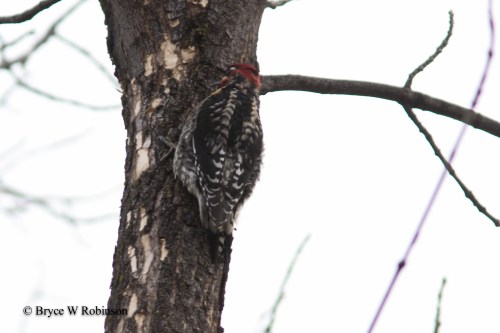
Possible RNSA x RBSA

Identifying true hybrids can be mind bending. Attempting to work out the ID can, however, provide a great opportunity to strengthen your knowledge and understanding of distributions and distinguishing characteristics between the species involved.

The bird pictured was reported a few days ago along the Boise River in south west Idaho as a Red-naped Sapsucker, possibly a hybrid with the Red-breasted Sapsucker. This morning, my friends Jay, Heidi, Mitch, and I went in search of the bird to get some photos and see what we thought of its plumage. 

Three Sapsucker species comprise the varius group, including Red-naped (nuchalis),  Red-breasted (ruber and daggetti), and Yellow-bellied (varius), which were all once considered conspecific. Now, each bird is recognized as a distinct species, yet at the confluence of each range, there is regular hybridization. The result is a confusing number of sapsuckers, waiting for the aware and inquisitive birder to work out their identification. 

The Red-breasted Sapsucker breeds on the west side of the Cascade range, continuing north into British Columbia. The area that RBSA and RNSA distributions meet is rather extensive in range, and provides the opportunity for extensive hybridization. It is then very possible for hybridization to occur in British Columbia, with birds migrating into the great basin and ending up in winter in places like Boise. Possible, plausible, but only conjecture.
Possible RNSA x RBSA

This bird shows mostly the distinctive features of Red-naped Sapsucker. 

Here is my breakdown of the bird:

1. The back pattern is typical of RNSA, having two distinctive columns of white descending down the back.

2. The lack of red in the breast, and the dark black breast patch is typical of RNSA.

3. The facial pattern and nape are where this bird strays from the typical RNSA, and why I am considering this a possible hybrid. Note the extensive red in the cheek of the bird. It continues from the throat, breaking the white cheek line, and continuing through the white superciliary. To my knowledge, this is not typical for RNSA.

4. Lastly, the black bar on the back of the nape is broken by red. Again, to my knowledge, this is not typical of RNSA.
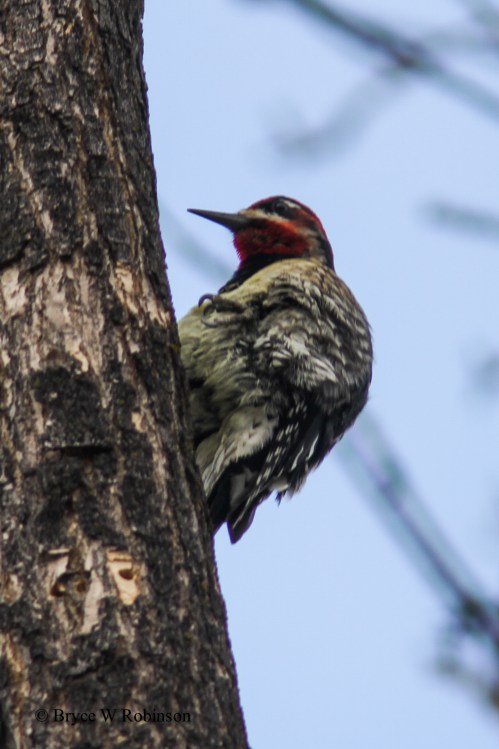
Possible RNSA x RBSA

So, is this a RNSA X RBSA hybrid? Could it be a backcross? Well, I think so, but can’t be sure. It is different, and peaks my curiosity. I’ll certainly be studying the subject more, and looking twice at all sapsuckers I come upon from here forward.

Here is a list of resources I used for this post. I welcome any comments and discussion on this bird.

1. Sapsucker Hybrids by S. Shunk. Birding May/June 2005

2. Hybridization Between Red-breasted (Sphyrapicus rubber) and Red-naped (Sphyrapicus nuchalis) Sapsuckers by J. Garrett 

3. The Sibley Guide to Birds of North America. 2000