
Juvenile “tephrocotis” Gray-crowned Rosy Finch. Brooks Range, Alaska. July
Caitlin Davis recently shared some photos with me of a small group of Gray-crowned Rosy Finches that visited her this fall at the Goshutes in eastern Nevada. The photos showed two different types of Gray-crowned Rosy Finch, one with gray cheeks, the other with brown. The photos reminded me of the flocks I saw while counting migrants there last fall. I remember seeing the two cheek colors, along with a few Black Rosy Finches intermixed in the flocks, which was exciting. My exposure to the birds did not end with the Goshutes. Over the course of the winter I saw a number of birds, and studied the differences in plumage that I observed.
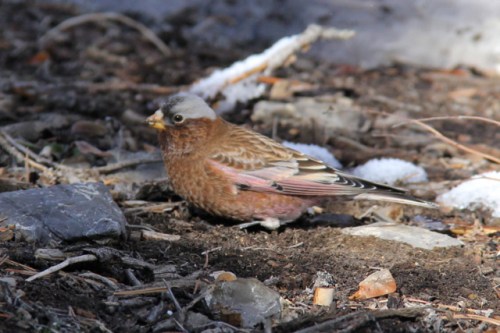
Adult “tephrocotis” Gray-crowned Rosy Finch. Goshutes Mountains, Nevada. October

“Hepburns” Gray-crowned Rosy FInch. Goshutes Mountains, Nevada. October.
The two types of plumage illustrated in Caitlin’s photos are a function of subspecies. There are six recognized subspecies in North America, most easily distinguished by the color of their cheek. Three subspecies have gray cheeks, while the others have brown cheeks. The”Hepburns”, a coastal gray cheeked group ranging from Alaska to northern California, winters in the interior west with another group, a brown cheeked bird, the nominate tephrocotis, an interior subspecies ranging from the Brooks Range of northern Alaska to the Rocky Mountains of the lower 48.
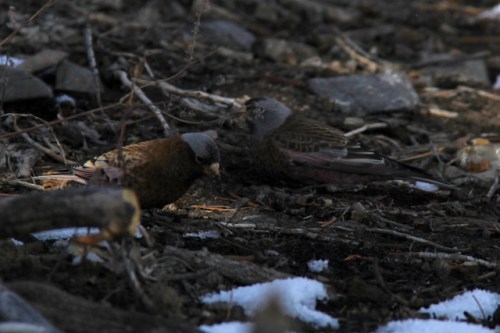
“tephrocotis” (left) and “littoralis” or “Hepburns” (right). Goshutes Mountains, Nevada. October.
I find it interesting that these birds form these large flocks, intermixed with obviously separate populations. What this speaks to is the nature of flocking in this species. I’d love to track each group, as they break apart with the onset of spring, and then form into their winter groups with the inception of fall.
After the past winter, I found an interest in the small fringillid. I spent a bit of time studying and learning parameters of the subspecies. After making plans to drive to the great north, I realized the potential of seeing the tephrocotis at the northern extent of its range. That thought was ultimately exciting, but even more so was my excitement when I actually found a small group in the Brooks Range of northern Alaska. I was only able to get photos of one cooperative juvenile, regrettably. The adults were very shy, and stayed far from range of my lens.
I plan to locate some flocks this winter, in hopes of studying the birds in the field and getting some additional photographs. What I would like to work out is the ability to sex each individual, and hopefully find a bird in its first basic plumage. I’ve learned some of the characteristics of each sex, now I just need to test those in the field.
After reviewing a photo from last winter, I noticed an aspect of the birds plumage I haven’t read about or heard of. In the photo below, the bird has a great deal of black on the cheeks, rather than brown or grey. This is worth some thought, and one of the reasons I’m anxious to find a large flock and see if there are other instances of variability. Perhaps it is an expression from a lineage closely tied to the Black Rosy Finch. After all, I’ve heard buzz of the possibility of the North American Rosy Finches being once again lumped as a single species. It would be fun to really get to the bottom of how different each population truly is.

“Hepburns” Gray-crowned Rosy Finch, exhibiting a great deal of ashy black on its cheek. West Desert of Utah, January.
Maybe, if I have some luck this winter and really get to know this species, I can illustrate what I’ve learned about how to distinguish individuals to age, sex, and subspecies. And the intellectual journey continues.
Referenced information:
Macdougall-Shackleton, Scott A., Richard E. Johnson and Thomas P. Hahn. 2000. Gray-crowned Rosy-Finch (Leucosticte tephrocotis), The Birds of North America Online (A. Poole, Ed.). Ithaca: Cornell Lab of Ornithology; Retrieved from the Birds of North America Online:http://bna.birds.cornell.edu/bna/species/559 doi:10.2173/bna.559 Accessed 11/10/2013

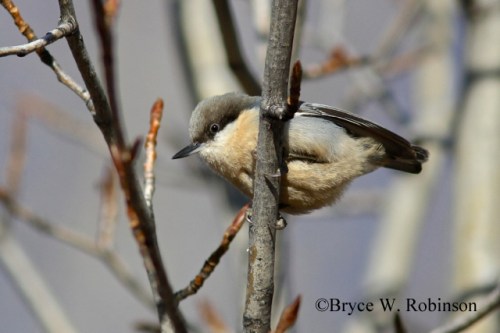
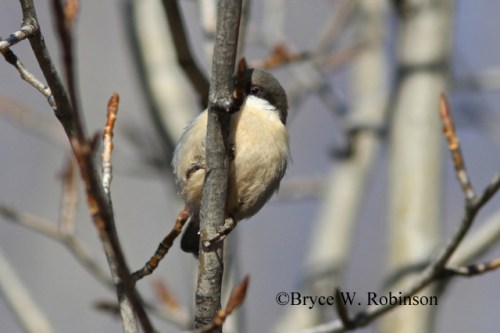 I think my interpretations of the birds behaviors are a little anthropocentric, but still, they seemed shy but inquisitive. Because of their size, appearance, and personality, I find them one of the funnest birds to interact with in the high pine forest.

 ornithologi.com