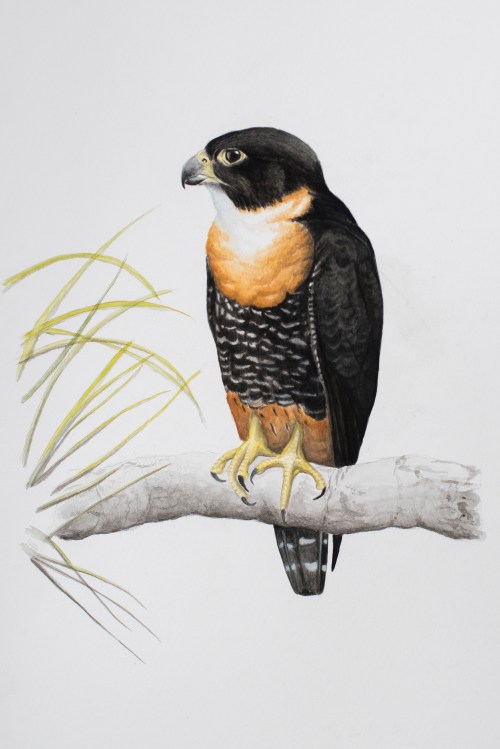
In a short time I’ll be heading south to northern Central America (primarily Belize and Guatemala) to research Orange-breasted Falcons (Falco deiroleucus). I’ll be working with The Peregrine Fund on their Orange-breasted Falcon project. My main focus will be assessing occupancy at historical territories, investigating potential territories, nest monitoring, banding nestlings, and assessing nest success. All work that I’m familiar with, but in a completely different system.
With the new system comes new opportunities to start fresh and learn. As a birder, my mouth is watering from the anticipation of learning new birdlife to a degree I have yet to experience. Field work with the falcon will be a great vehicle for learning this new bird life, as I’ll be immersed in the system daily, always paying attention to what is around me.
Alaska is an exciting place for an ornithologist, because it is still somewhat a frontier in our basic understanding of some of its birdlife. The Neotropics are similar, but to a greater degree. Due to the nature of the system, and the magnitude of its biodiversity, there is much work still to be done to fill in gaps in our basic understanding of the natural history of some species. This frontier is where I want to be, so I consider myself quite fortunate to begin a potentially five month stint in a place where so many opportunities lay.
I’ll be blogging birdlife along the way, including videos, photos, field sketches and stories. It’ll be a content heavy time, and I’m looking forward to it.
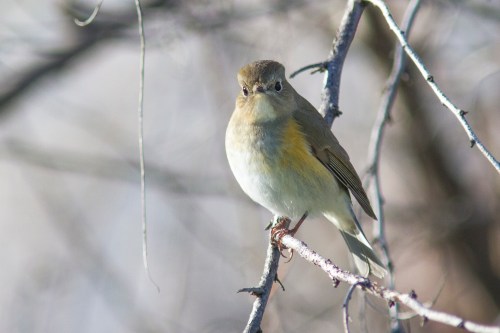
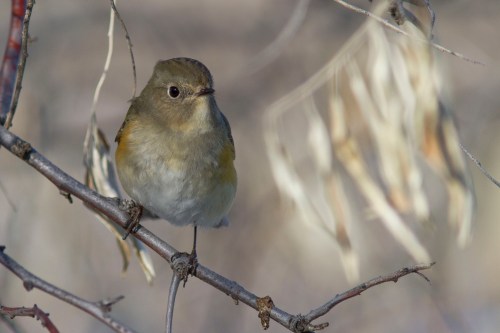
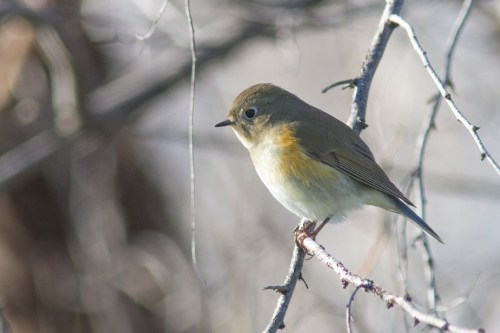
On 31 December 2016 I made the five hour trip from Boise to Lewiston to see Idaho’s first record of Red-flanked Bluetail (Tarsiger cyanurus). On arrival, the bird already had a crowd watching it forage along the Russian Olives that bordered the river.
It was a sunny and relatively warm morning, and the bird was actively foraging. It would appear on the tree edge and making foraging sallies to the ground. It looked like the bird was eating the Russian Olive fruits, but one of my photos show it with an arthropod in its bill as well.
It made its way foraging between four trees along the river, heading south to the last tree and then returning north. Occasionally it would disappear low in the trees along the rivers edge, and return to foraging within a few minutes.
My favorite aspects of this bird were its subtle hues in the plumage, particularly the blue throughout and the white throat patch. I also enjoyed its behaviors, such as the constant tail dabbing. The bird was extremely cooperative, providing all watching with excellent views. At times when it would come to the ground to forage, it would do so only feet from the birders. I’d say it was behaving about the best anyone could hope for concerning a high profile vagrant.
I spent some time attempting to capture video of the bird perched on a limb, tail dabbing. I mostly was unsuccessful, but did manage the following clip that is poor quality. It’s worth sharing just to show the birds behavior.
The Red-flanked Bluetail was a great end to 2016, which was a bummer of a year for so many reasons, but was incredible and profitable regarding birds. Hopefully 2017 will match or exceed. Happy New Year.
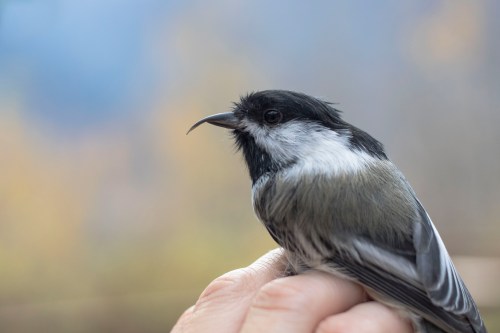
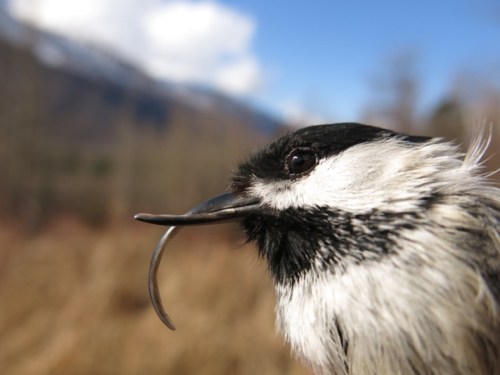
Photo 1. Female Black-capped Chickadee (Poecile atricapilla) with bill deformity.
I recently had the pleasure of spending a few days with my friend Rachel Richardson of USGS trapping birds in the Eagle River Valley of south-central Alaska. We captured a few species such as Black-capped and Boreal Chickadees (Poecile atricapilla and P. hudsonicus, respectively), and Red-breasted Nuthatch (Sitta canadensis). USGS has been trapping in these areas for years with the main focus of monitoring bill deformities, the prevalence of Avian Keratin Disorder, and the prevailing causes of a new found virus, Poecivirus.
The Alaska Science Center of USGS in Anchorage is part of a team of researchers, including the California Academy of Sciences, and the University of California San Francisco that have been investigating the causes of Avian Keratin Disorder for over ten years. Avian Keratin Disorder was first documented in Alaska in the 1990’s by Colleen Handel of USGS who leads the research team at the Alaska Science Center. In an article in Molecular Biology that came out in July 2016 (Zylberberg 2016), the team reports on the discovery of a new virus they termed Poecivirus, which may be responsible for the bill deformities.
Appropriately, the discovery is receiving a good deal of press. Below are a few links to national and international articles that detail the work and the discovery. All are worth a read (or a watch):
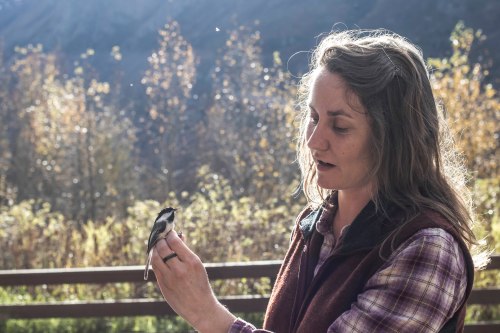
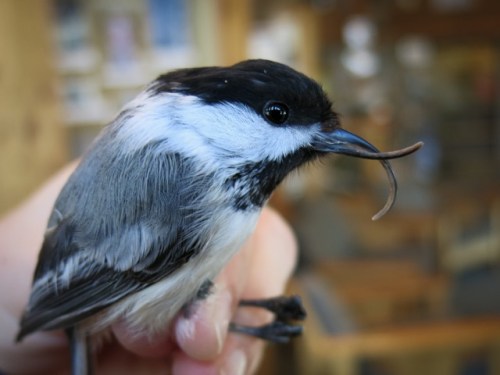
Photo 2. Rachel Richardson of the USGS Alaska Science Center holding a female Black-capped Chickadee (Poecile atricapilla) with a bill deformity.
On the day I spent with Rachel in the field trapping birds, we only had one Black-capped Chickadee show up with a deformity. However, the one bird had an interesting story. This female (Photo 1) was first captured in 2015 and had no signs of any deformity. This year she obviously has a developing deformity. Her bill grew 5.1 mm in one year, a 70% increase in length. Whether or not this developing deformity will impact her ability to forage, preen, or even breed and provision young is yet to be determined. There are reports of deformed birds successfully rearing offspring, however it is without question that the deformities present a handicap that will ultimately reduce the individuals fitness.
It is important to track the rates and severity of deformities across the world. Because of this, the Alaska Science Center has developed a submission form for anyone to report their sightings of deformities. Please contribute to this effort and submit details of any sightings of elongated bills, including photos and location along with any other evidence for Avian Keratin Disorder at the following website:
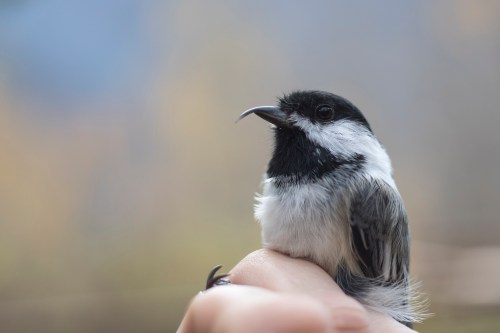
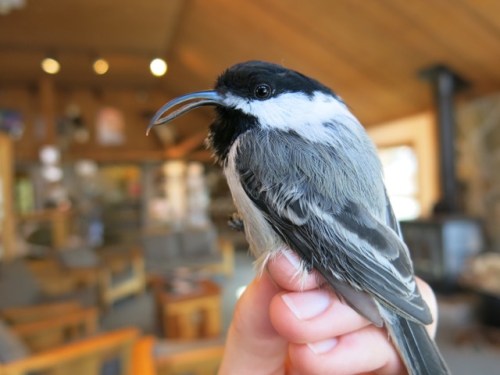
Photo 3. Female Black-capped Chickadee (Poecile atricapilla) with bill deformity.
Below are additional examples of AKD in Chickadees that have been captured as part of the Alaska Science Center’s efforts near Anchorage. These individuals unfortunately have more developed deformities than the chickadee we caught while I was tagging along.
Photo 4. Black-capped Chickadee (Poecile atricapillus) with bill deformity. Photo copyright Rachel M. Richardson.
Photo 5. Black-capped Chickadee (Poecile atricapillus) with bill deformity. Photo copyright Rachel M. Richardson.
Photo 6. Black-capped Chickadee (Poecile atricapilla) with bill deformity. Photo copyright Rachel M. Richardson.
It’s excellent to have a breakthrough and a step forward. However, the problem still remains as well as the daunting task of discovering the correlation between Poecivirus and bill deformities, the causes of both, and what role humanity plays in the prevalence and transmission of either. I’d like to tip my hat to those who have done so much great work on this issue thus far. Keep up the good work.
Referenced Literature
Maxine Zylberberg, Caroline Van Hemert, John P. Dumbacher, Colleen M. Handel, Tarik Tihan and Joseph L. DeRisi. Novel Picornavirus Associated with Avian Keratin Disorder in Alaskan Birds. mBio, July 2016 DOI: 10.1128/mBio.00874-16
Video 1. Dan Ruthrauff photographs passing Fork-tailed Storm Petrel as the tide comes in. Bristol Bay coast, Alaska. September 2016.
Over my time on the Bristol Bay coast near the village of Egegik on the Alaska Peninsula, I was privy to one of the most incredible experiences I’ve ever had with birdlife. The experience is captured in video 1, which shows Dan Ruthrauff kneeling on tidal flats at low tide photographing passing Fork-tailed Storm Petrels at close range. I’d never heard of anything like this for any pelagic bird. It turned out to be a regular occurrence, but still appears quite novel so far as we understand Fork-tailed Storm Petrel foraging behaviors.
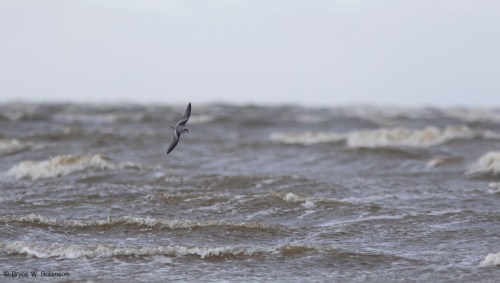
Photo 1. Fork-tailed Storm Petrel arcing down amidst a dynamic soar in high winds. This photo was taken from the shoreline at high tide. Bristol Bay coast, Alaska. September 2016.
Typical experiences with Fork-tailed Storm Petrels are like the image above: A dynamic soaring Hydrobatid at relatively close range. It’s very exciting, but nothing like walking through tidal flats surrounded by the birds.
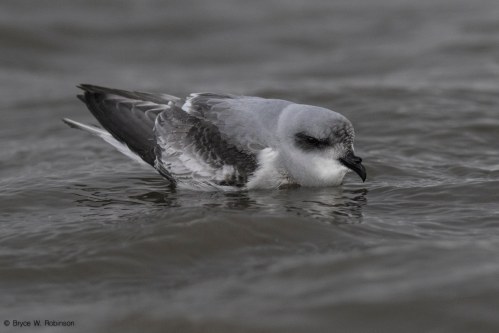
Photo 2. Fork-tailed Storm Petrel at rest on the water. I was standing in ankle deep water when this photo was taken. Bristol Bay coast, Alaska. September 2016
Other more typical experiences can provide observations such as the above photo, where calm water and resting birds near a boat might provide great views. Photo 2 is a bird that I stood near in ankle deep water. This bird was taking a moment to rest from foraging and seemed non-plussed by me. I’ve never heard of anything like it.
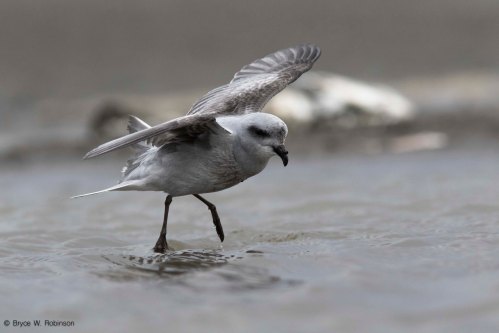
Photo 3. Fork-tailed Storm Petrel (Oceanodrama furcata) dabbing on water. I was lying on my belly when this photo was taken. Bristol Bay coast, Alaska. September 2016
The experiences continued for the entire two weeks I was on the Bristol Bay coast. After reading through the literature, the behavior seems undocumented and may warrant publication as a note. I’m excited to organize, avail myself of the literature, and share this experience with a crowd more knowledgeable and literate than myself. For me, experiences like these make field ornithology one of the best things about life.
 ornithologi.com