A studio for bird study

Tag: birdwatching

Bar-tailed Godwit Observations – Learning in the Field

by Bryce W. Robinson
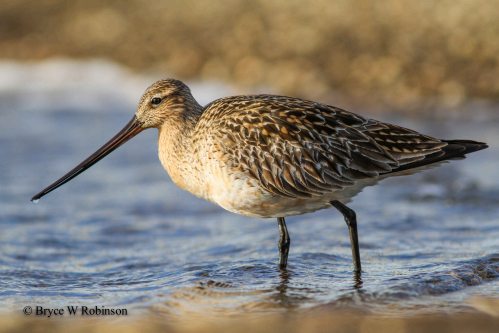
Female Bar-tailed Godwit

I really appreciate instances where I learn in the field, from first hand observations rather than reading in a book. It seems my bird related knowledge is skewed a bit to the latter, so that when I observe something for the first time in the field, I usually have an understanding of it from previous reading. I’d like to measure myself as a young ornithologist by what I recognize in the field, and later read in a book. I’d like to say, “hey, I saw that last week when I was watching that Arctic Warbler, just as so and so wrote here in this account”. To me, this skill means that I have the observation tools necessary for proper bird study, and I’m up to par with my contemporaries and those who have studied before me, or at least developing the skills needed to reach that point.

Male Bar-tailed Godwit

Well, I’m happy to report that one such instance occurred recently, as I was observing and photographing a pair of Bar-tailed Godwits – Limosa lapponica. I’ve had very little exposure to these birds, a fact of which I’m working to rectify at the moment. The two birds I found the other evening were recent arrivals, and very keen on replenishing the reserves they had just spent on the long flight from Australia, or thereabouts.

Bar-tailed Godwit - Male and Female

I sat with the birds for an hour, maybe more, and shot away with my camera. While doing so, I was struck by the dramatic size difference between the male and the female. The male, being an impressive cinnamon color, was much daintier than his female companion. The light bodied female was at least 1/3 larger than the male, by my estimation. Also, her bill was noticeably longer. So, my first observation learned from the experience was that this species exhibits “Reversed Sexual Dimorphism”, or that the female is larger than the male in size and attributes. Of course the birds are sexually dimorphic in alternate plumage, which makes identification easy during the breeding season, but my observation in size dimorphism was exciting nonetheless.

My second observation came later as the birds wandered closer and I was able to see their behaviors in greater detail. Both birds were feeding, sticking their bill fully into the soft sand and pulling out all sorts of wriggling worm-like animals, the classification of which is certainly unknown to me. When the worm critters were extracted, I noticed some flexing in the upper mandible of the bill. Later, as the birds became more full, they’d stop to preen and stretch. During one of these idle moments, I noticed some extreme flexing in the upper mandible. AHA! Rhynchokinesis! My first personal observation of this trait in birds.

Not the best photo, but look at that upper mandible flex!

Not the best photo, but look at that upper mandible flex!

Although these observations are not novel, nor are they difficult to observe, it was still an exciting moment in my field education. I noticed two traits belonging to Bar-tailed Godwit that were unknown to me beforehand. The fact that Rhynchokinesis exists in this long-billed species makes absolute sense, but observing the trait first hand was a moment that sums up exactly why I study birds. The satisfaction of recognizing these traits is rich, and causes one to push on and observe other species in greater detail. The more you look the more you see, and in the future I hope experiences like these become more frequent as I learn how to truly look at birds. I feel like my education is only beginning!


ZEISS Optics Supports The Gyrfalcon Project and Conservation

by Bryce W. Robinson

Photo copyright Neil Paprocki

Photo copyright Neil Paprocki

ZEISS Optics has been kind enough to offer a gesture of support by providing optics for my work here in Arctic Alaska. Without a doubt, this equipment will help ensure a successful season and minimize our time and effort during searching and monitoring nests. It helps so much to have brightness and clarity while assessing behaviors or nest status.

I’m very impressed with ZEISS, not only for their products which are truly the top of the line, but with their willingness to support my work, and in turn conservation. A company interested in helping organizations like The Peregrine Fund deserves special recognition.

Photo copyright Neil Paprocki

Photo copyright Neil Paprocki

The optics I’ll be using this summer are the Diascope 65 T FL spotting scope set atop a carbon fiber tripod with a solid and smooth head, and the Conquest HT 8×42 binoculars. The minute your hands touch this equipment you know they are quality. Field work is very hard on optics at times, but I’m confident that my daily tasks will cause no harm to the binoculars or the scope. They are durable. They are quality.

Photo copyright Neil Paprocki

Photo copyright Neil Paprocki

Stay tuned over the summer. I’ll be posting digi-scoped photos of Gyrfalcons and nestlings, along with other western Alaska specialties. I’ll also write some reviews towards the end of the season on how the optics handled the harsh Alaska tundra, and helped complete the work.

Thanks again to ZEISS Optics for making Gyrfalcons visible.

A Communal Roost of the Great Horned Owl

by Bryce W. Robinson


I’d like to share this video of a solitary roosting Great Horned Owl to introduce a story and celebrate a career goal accomplished for both Caitlin Davis, and myself.

In December 2012, Caitlin and I were conducting Golden Eagle surveys in the west desert of Utah. One evening on our survey route near the border of Nevada and Great Basin National Park, we came upon a roosting pair of Great Horned Owls. These owls sat in a small string of trees about 30 m in length. Soon after we discovered the roosting pair, we noticed an additional four owls in the same tree line. A total of six owls sat together in close proximity, and soon after we counted the birds, I knew the significance of what we had found.

Because I knew that Great Horned Owls are extremely territorial, I looked into the literature hoping to find any reports of similar roosting behavior. After what seemed to be an exhaustive search, I had found no reports of any communal roosting behavior for the Great Horned Owl, or any other Bubo species.

I discussed the idea of reporting the findings with Steve Slater, Shawn Hawks, and Markus Mika at HawkWatch International. They were supportive of the idea, so with little hesitation I wrote a short report of the roost and submitted it for publication to the Journal of Raptor Research.

The report was accepted, and has now been published in the latest issue of the JRR. Caitlin and I are extremely grateful to everyone who helped us get the word out in the proper fashion by talking out ideas, and revising the manuscript. It was a fun process, and I look forward to repeating it again in the future.

Read the article here:

Robinson, B.W. and C. M.  Davis. 2014. A communal roosting of the Great Horned Owl (Bubo virginianus). Journal of Raptor Research 48(1) 88-89

Short-eared Owl at Dusk

by Bryce W. Robinson

I’ve wanted to share this video for some time, but I simply haven’t.

Last winter while conducting Golden Eagle surveys for HawkWatch International across the western half of the state of Utah, I came upon my first Short-eared Owl for the season. It was a tolerant bird, letting me film it for some time. I was happy to capture its nervous movements, as it scanned about for threats and prey. This was the start of a winter full of Short-eared Owls and a memorable season in the open lands of the Great Basin.

Folks don’t often see owls, even those that bird regularly. For those that haven’t seen an owl for some time, or even ever, let your eyes fall on this bird until you find another.