A studio for bird study

Tag: birdwatching

A Zonotrichia Christmas Bird Count

by Bryce W. Robinson
GCSP

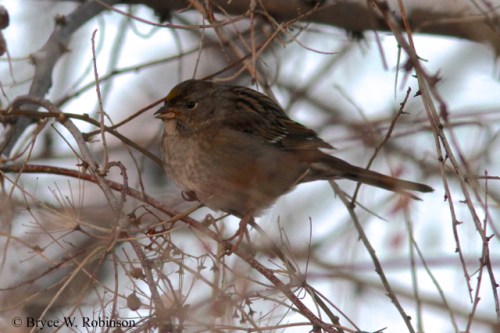
First-cycle Golden-crowned Sparrow- Zonotrichia atricapilla

Yesterday I joined Jay Carlisle, Heidi Ware, and a number of other folks for the Nampa Christmas Bird Count in south western Idaho. The day started out right. We began at Caldwell Ponds before sunrise for an attempt at turning up a few owls. Sure enough, a few Barn Owls hunted the fields, trying to squeeze in a meal before light.

When it was light enough, we started working the thickets for sparrows. Flocks of White-crowned Sparrows were sounding off, which is always promising, as they often hold something special in their ranks. Sure enough, Jay called out two Golden-crowned Sparrows. The Golden-crowned Sparrow is hard to come by in Idaho, but each year Jay and Heidi have participated in the Nampa CBC, they have found a GCSP at Caldwell Ponds.

I stayed behind with the sparrows to attempt some photos. The birds were rather tolerant before the sun rose. I managed a decent photo of one GCSP, but in poor light. When the sun finally rose, the birds seemed to avoid me, and although I spent ten minutes stalking the birds, I never managed  a photo in the golden morning light.
HASP

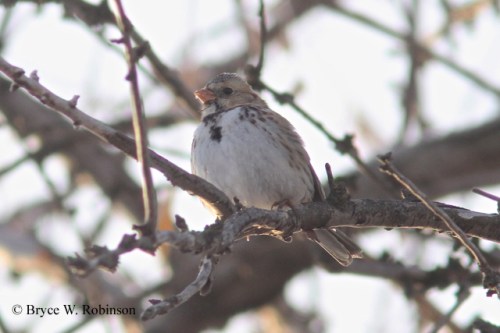
First-cycle Harris’s Sparrow- Zonotrichia querula

When I caught up to the group, they were working a thicket, sifting through another healthy flock of White-crowned Sparrows. I went around the group to head off some outside individuals. While sorting through a small group, I spotted a recognizable pattern deep in a bush. I didn’t want to cry wolf, so I held my tongue for a bit. Soon enough, the bird popped up onto the top of the bush, and showed itself. I alerted the group, Harris’s Sparrow!, our third Zonotrichia species for the hour.
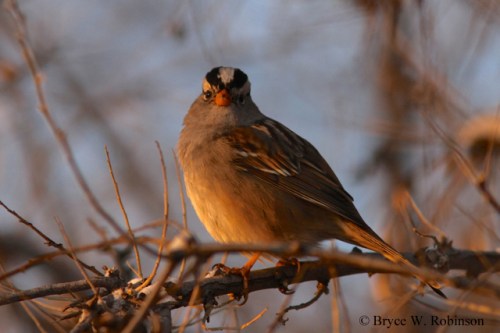
"Gambel's" White-crowned Sparrow- Zonotrichia leucophrys gambelii

“Gambel’s” White-crowned Sparrow- Zonotrichia leucophrys gambelii

I soon realized that after getting the hardest Zonotrichia, the GCSP, so early in the day, seeing all four was a distinct possibility. All we needed to find was the White-throated Sparrow, an uncommon bird for winter in Idaho. The bird is uncommon, but multiple individuals are found every year. In fact, I had found one two weeks ago in Boise. The reality of reaching the goal was there.

Later in the day, I split off from the group with Heidi. We were charged with checking a few hotspots, and we both had one bird on our mind. Heidi has never seen all four Zonotrichia in a day, so the goal was looking sweet to her eyes as well.

For the rest of the day we sifted through sparrow’s with no sign of the fourth Zonotrichia. We turned up other good birds, Savannah Sparrow, Lincoln’s Sparrow, and two Bewick’s Wrens. But by the end of the day, as the sun set and we continued to look through White-crowned Sparrow flocks, we came away without our prize.

Well, we almost “pulled a Zonie”! I kept telling Heidi I was going to make “a Zonie” the term for seeing all of North Americas Zonotrichia species in one day. It’s a worthy goal, and a respectable badge, that deserves some title, even if it is a bit dorky.

I didn’t realize how doable a Zonie is for Idaho, but it sure is. I’ll be after that goal now. I have heard and seen photos of a man in southern California that had all four at his feeder one day. That is remarkable. So now I have a new goal on the horizon, to see and photograph all four of North America’s Zonotrichia sparrows in a day, or simply, to pull a “Zonie”. Let’s hope it doesn’t turn into a nemesis goal, or white whale, or whatever you might call it.

Here’s the bird that got away.
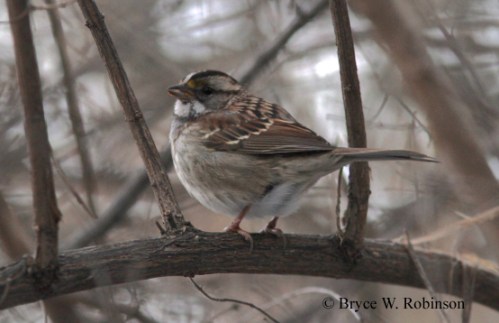
WTSP

Adult White-throated Sparrow- Zonotrichia albicollis

The Christmas Bird 2013: American Tree Sparrow- Spizella arborea

by Bryce W. Robinson

treesparrowetsy

Every year I illustrate a bird for the holiday season. This year, I’m a bit early, but only because I wanted to open the Christmas Bird for purchase as a print. You can visit the ornithologiart store, and purchase a print. Available are 4×6″ for $8.00, 5×7″ for $12.00, and 5×7″ matted for $15.00. Click the photo to purchase, or simply follow the link: ornithologiart.

The American Tree Sparrow is a breeder of the high north Taiga lands. It migrates to the lower parts of North America during winter, and is a favorite feeder bird of many. I chose the American Tree Sparrow because I feel it captures the spirit of the season, and is emblematic of the winter solstice. This is a great holiday gift for any birder.

From both Caitlin and I, Happy Holidays, Merry Christmas, Happy Hanukkah, or Happy Solstice. However you choose to celebrate the season, we hope you have a great time with family, friends, and of course, birds.

Pacific Loon, a Load of Feathers

by Bryce W. Robinson

PALO

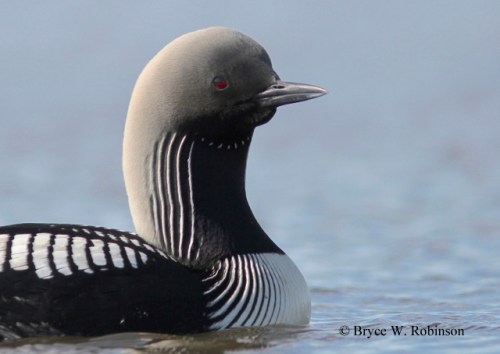
I’ve seen Pacific Loon in all states of plumage. I’ve always been impressed by a loons looks, but this summer I had the chance to get very close to many Pacific Loons, and really gain an appreciation for their feather composition.

I think that most consider tropical birds to be among the most decorated, and striking in plumage. Colors that come from the tropical regions of the world are truly unique, but I consider some birds of the northern hemisphere to be equally exotic, and equally striking.

The Pacific Loon in full breeding plumage is breathtaking. At close proximity, you notice the velvet appearance of the throat, and its iridescent qualities enhanced. Purple, on an Arctic bird, is awe inspiring. The ghostly grey of the head and nape always leaves me mesmerized. I think that the numerous, dense, and fine quality of the feathers gives the bird a shape and form unlike any other feathered creature. In fact, the form does not even seem feathered at all.

The patterns of the loon are of note, as they are unlike any pattern I’ve ever seen in a creature. The fine lines and stripes are neat, organized, and crisp. This sharp appearance matches well with the behaviors of the bird. It holds its head high, glances about with confidence, and dives with absolute grace. In fact, the regality of the Pacific Loon impresses me, as I admire all creatures who frequent this world in confidence and style.

In winter, it interests me that the bird seems more sleek, and thin. I’ve yet to get close to a wintering Pacific Loon. When I do, I hope to study the difference in feathers and shape, and compare and contrast the two looks of the same bird. It fascinates me, that evolutionarily, two molts have evolved for this bird, and the two resulting plumages are dramatically different.

I can’t explain my fascination with the bird any further. As I’m scheduled to frequent the Arctic summer again for the next two years, I’ll be seeing breeding loons once more. At every opportunity, I’ll record the behaviors and appearance of each individual, and communicate their beauty the best I can. As I’ll be in Western Alaska, there is a great chance I’ll happen upon the Arctic Loon. It will be fascinating to compare my images between the Arctic and the Pacific, two birds that are very similar. I suppose I’ll have to wait and see what comes about, but when it does, I’ll be sharing.


Northern Hawk Owl- Surnia ulula

by Bryce W. Robinson

Yesterday, I travelled well out of my way with Caitlin Davis and Heidi Ware in search of a wayward Northern Hawk Owl. The journey to Moscow, Idaho from Boise is very long. Really, it’s too long if you don’t have a solid guarantee to see your target. We weren’t guaranteed, but it was a promising bet, enough to make us shoot for it.

Only minutes after arriving in town, we had located the owl. It was impossible for me to set the scene with my camera, given my 300mm lens and lack of any alternatives. I’ll have to attempt to paint the picture using words. It’s important, as the experience was quite peculiar.

For whatever reason, this hawk owl had decided to settle in the middle of town, to hunt an overgrown irrigation ditch next to a shopping center. The irrigation ditch is now unused. The area has succumbed to commercialization, with a shopping mall to the north, and what appeared to be a doctors office of some sort, and more store fronts to the south. Now the ditch serves as a remnant of a natural area, with a jogging path running alongside, so pedestrians can feel a bit of nature as they pass through the community. Here, the hawk owl felt enough nature to sit and hunt, for a few days at least. What a strange creature.

I’m captivated by bird behavior. Of all places, this bird felt comfortable enough to hunt along a busy roadside, in the middle of town. Optimal hunting habitat is not limited in the area surrounding Moscow. It’s quite rural there, with the surrounding farmlands likely boasting a host of mammalian prey.

I can come up many reasons why the bird felt comfortable here, related to presence of prey and a lack of predators, but I still think any explanation falls a bit short. It was simply one of those instances in life, a peculiarity. I’m thankful someone was aware enough to notice the strange looking bird, perched on a wire above the road.

The bird seemed to ignore we the birders, and kept about its business. It seemed focused. I was surprised by how active its hunting was. While we were watching the bird, about forty five minutes time, it switched perches over and over. It watched the ground, and would seem to come off perch in pursuit, only to fly to another perch. Sometimes, it would go to high light poles, or power lines, and then it would come low to a small tree top. There were even times it sat on the street signs.

I’ve always been intrigued with how animals interact with human society and infrastructure. This bird seemed to act as if it were a part of its daily life, to continue on its natural tasks, in the midst of a rather unnatural setting, as if it had always done so.