A studio for bird study

Tag: california

The Possibility of a Ladder-backedXNuttall’s Woodpecker Hybrids in Southern California

by Bryce W. Robinson
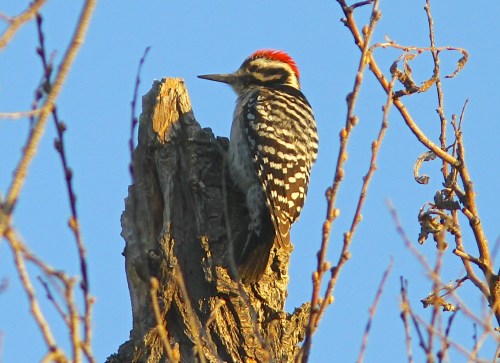
A possible male Nuttall'sXLadder-backed cross.

A possible male Nuttall’sXLadder-backed cross at Big Morongo Canyon Preserve.

Recently I went birding with some friends at the Whitewater Preserve on the edge of the desert in southern California. My friend Dan Williams is more experienced with the birds in the area, and has a great ear. He picked up on something that I’ve been paying attention to since.

The Whitewater Preserve is located in an area that is the meeting point for the ranges of two very similar woodpeckers, the Ladder-backed and Nuttall’s. The Ladder-backed Woodpecker is a species of the southwest that frequents semi-arid landscapes. The Nuttall’s is a California coastal species, preferring riparian areas. Very similar in appearance and habits, it is easy to confuse the two when in an area where it is unclear which is expected, such as the transition zone between the two.

We heard a woodpecker fly overhead calling. Dan recognized the call as a Nuttall’s, but when it landed it resembled a Ladder-backed in appearance. This began my inquiry into the occurrence of hybridization in the region. I found many discussions on the topic, with no clear or definitive conclusion of how, if, or where this really occurs.

I returned later to the Whitewater preserve in hopes of recording and photographing as many woodpeckers as I was able. I failed, but I did get to know the woodpeckers of the region a bit better. I found many birds, and one female that supported the idea that these birds are hybridizing in the area.

Last night I went birding in the Big Morongo Preserve. It was great birding. The Summer Tanagers have returned in good numbers. I kept tuned to finding woodpeckers in this area, as it is not far from the Whitewater preserve. I finally found a male woodpecker, and sure enough, it showed characteristics of both species.

First, I heard the woodpecker. In my mind, it sounded just as the Ladder-backed Woodpeckers sound across the southwest, but when it landed, I noticed a few things that were unlike the Ladder-backed.
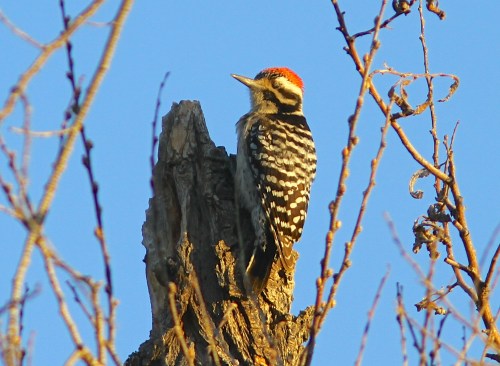
Possible Nuttall'sXLadder-backed Woodpecker. Note the dark black patch on the upper back, and extensive red of the crown, two contradictory features.

Possible Nuttall’sXLadder-backed Woodpecker. Note the dark black patch on the upper back, and extensive red of the crown, two contradictory features.

1. The Ladder-backed Woodpecker has striping that extends to its neck. The Nuttall’s has a patch of black on the top of its back. This bird resemble the Nuttall’s in this regard.

2. The male Ladder-backed has red on his crown that extends forward above the eye. The Nuttall’s red is less extensive, and sits on the back of the head. This bird resembles the Ladder-backed in this regards.

3. The Facial pattern of the Ladder-backed is dominated by white. The black markings are rather thin. The Nuttall’s facial pattern is dominated by black. Thick black lines swallow up the face. This bird is tricky, it looks much like a Nuttall’s, but the white above the eye and to the back of the head is rather prominent. I included an image of a Ladder-backed I photographed in Texas last month with a facial pattern much like the bird from Morongo.
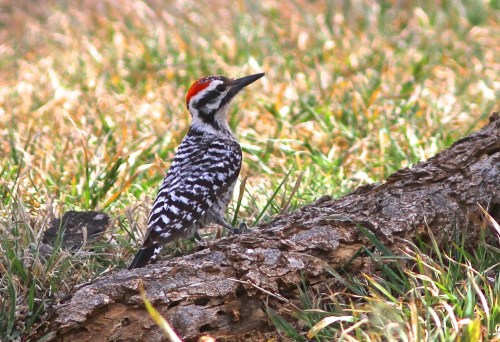
IMG_7592


There are other nuances separating the two species such as the pattern of the outer retrices, spotting or streaking on the flanks, cream color or white of the pale parts, bill shape, etc. All of these aspects are learned through exposure, in my mind. The more you see both species, the more you will recognize the minutia that separates the two.

If anyone stumbles on this post that has any information on the subject, knowledge, or experience with both birds, I would love to hear your ideas. In my mind, the evidence is fairly clear indicating that this bird is likely a hybrid, or cross back. That makes the possibility or regularity of this occurrence rather high in my mind. You just have to be in the right place. Or maybe I just got lucky.


Beatnik Birding: The Southern California Desert

by Bryce W. Robinson

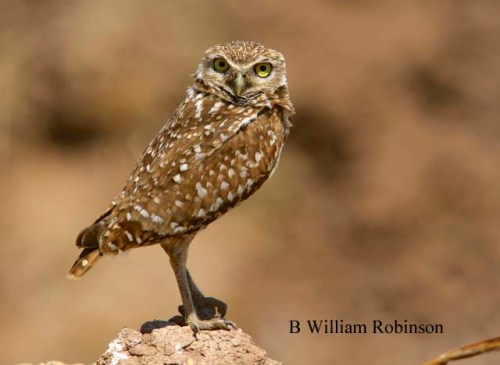
Burrowing Owl- Athene cunicularia

Burrowing Owl- Athene cunicularia

I’ve made a stop in the California Sonoran to conduct nesting bird surveys for a bit. This will be the end to the southwest tour of the beatnik birder. The roads I have travelled and the places I have seen… These times will be remembered.

My time here is brief, but long enough to once again experience the nesting season of the Sonoran. I’ve already had some amazing experiences with nesting birds, and found some of the most delicate lifeforms I’ll ever encounter.

The photo I share today is of a dedicated Burrowing Owl on the south end of the Salton Sea, standing watch over his tiny kingdom. He was so serious, I’ll have you understand. He took no notice of my vehicle as I encroached on his business. He was about a higher task, to ensure his legacy. He did not bother with me, for which I was fortunate. Soon I was too close for my lens to focus, so I stopped with my intrusion. It was a blessing to encounter such a stubborn owl, so I did not take anything for granted. After taking my fill of photographs, I simply watched.

I could have watched, and filmed, and taken notes, and drawn, and continued to pore into the world of this owl. But I left him to his task. There he remained, watching his land, diligent and dedicated. It is my hope that there he will forever be.

A Start to Beatnik Birding: California Coast Beginning at Big Sur

by Bryce W. Robinson

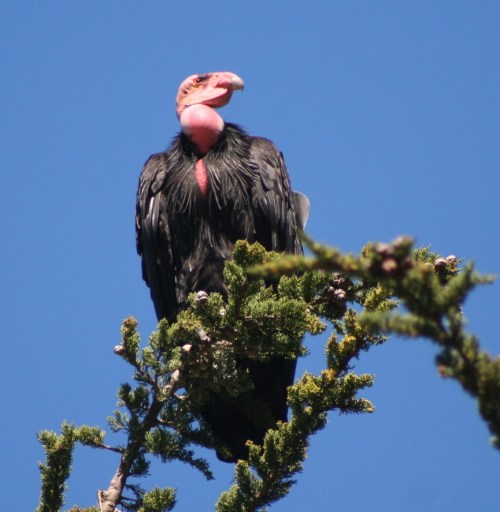
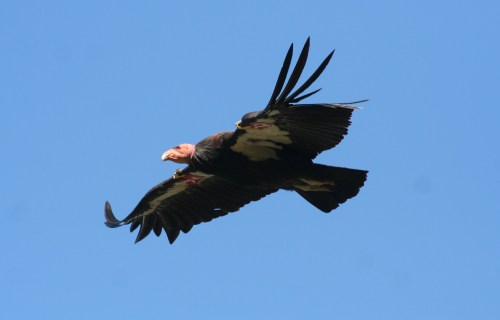
California Condor- Gymnogyps californianus

I left the desert the other day, and set my heading west. My plan is to take the PCH, highway 1 as far north as I desire. So far the journey has been phenomenal. Truly phenomenal, for I cannot describe in words the sights I have seen and the feeling that they have stirred. My main focus for heading through Big Sur was to see the monsterous California Condor. The other night I camped on the southern end of the area known as Big Sur. I had not seen many birds, but I certainly was pleased with the place I called home for the night. I looked out my tent to an ocean view.

Looking north in Big Sur

I had yet to find the condors, but I knew that I had plenty of time to search. I hit the road with wanting eyes. I told myself that the top priority above any else was to find the condor. I couldn’t help my urges to stop and take in the scene as I wound along the cliffs of the ocean front. My mind had let go of its preoccupation with finding the condors, for the distraction of the scenery was too much.

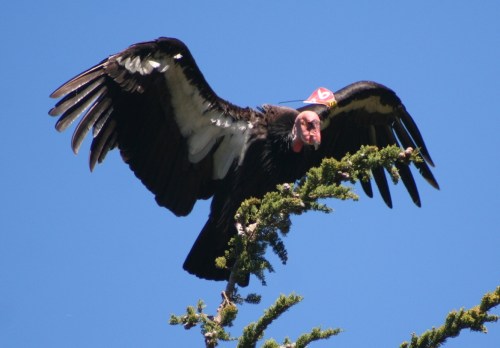
My eyes caught a glimpse of orange as I wound a corner coming upon a roadside grove of tall conifers. I was in disbelief. Immediately my mind registered the possibility that I had already found my prize. Sure enough, sitting atop a tall tree, overlooking the endless pacific, were two of the largest winged creatures I have ever seen.

California Condor- Gymnogyps californianus

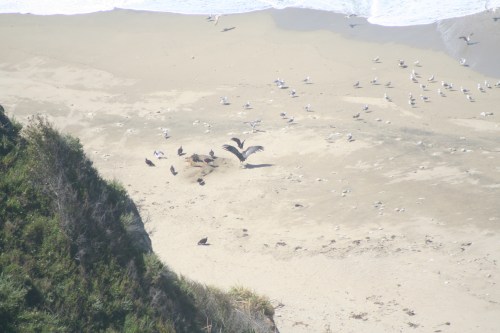
The two birds were very tolerant of me and my camera. I watched them as they sat preening, content with the passing cars and occasional passersby. After nearly an hour, one of the birds left the tree, soaring slow and strong towards the coast. Nearly five hundred feet below the road, the bird landed on the sand. Through my binoculars, I saw a number of birds gather around a large corpse. Gulls and Turkey Vultures yielded their meal to their superior. Every bird backed away as the condor fed upon a decaying elephant seal.

California Condor- Gymnogyps californianus

California Condor arriving at Elephant Seal carcass.

I didn’t expect such a sight for my first time with the California Condor. I noticed another bird below, too large to pass for a vulture. Indeed a juvenile condor soared along the beach. Three condors seemed overly generous for my diligent effort, but I would not complain nor squander the opportunity. I remained for a great deal of time.

The road called to me, and soon I answered. Pulling from the place where I first met the condor, I looked ahead to a long road forward with many birds to come.

Color and the California Quail

by Bryce W. Robinson

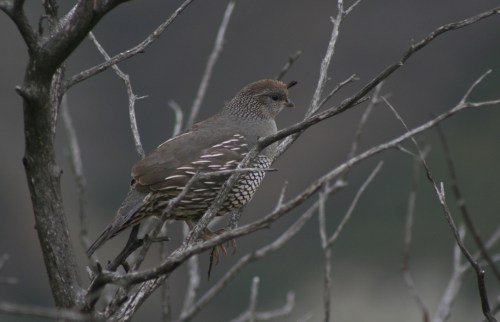
Female California Quail- Callipepla californica

At times I am fortunate enough to work outside of the desert. Today I was able to head west to the chaparral hills of southern California to check some nests. It was an overcast day, which I have not experienced for months. I was glad to see little sun and enjoy the cool temperatures.

The birds of course were different than the now normal species I see in the desert. In the desert there are Gambel’s Quail, but once you climb out of the desert, the niche is filled by the California Quail. I saw many today, and was able to photograph one female sitting still on some dead and bare branches. I couldn’t help but notice the dull color scheme of the photo. With relatively low light, it seemed the scenes of the day were all very mellow. This photograph captures that mood precisely, gloomy but beautiful. I am often in awe at these type of images. Nature is master of color schemes only the most accomplished of artists know how to manage.

I watched a Bushtit nest for a while today. There were a number of Bushtit moving around through the brush, occasionally stopping to wonder at me. I was unfortunately unsuccessful at capturing any worthwhile images of these birds, but it truly was a joy to watch their busy purposeful activities.

Here’s to another week of paid birding.