A studio for bird study

Tag: environment

Just Published: Applied Raptor Ecology: Essentials from Gyrfalcon Research

by Bryce W. Robinson

cover-final-400px

The Peregrine Fund just released a new book, “Applied Raptor Ecology: Essentials from Gyrfalcon Research”. This book serves as a techniques manual geared towards providing early career researchers with information and a stepwise guide for conducting various research on raptors. This information is also supplemented by mock data, and R code to help the researcher begin to form skills in R and analysis.

Although I am the clown in orange on the cover, my true contribution is found inside the book. I contributed as an author of a chapter – Quantifying Diet; an appendix – Guidelines for Conducting a Camera Study of Nesting Raptors; and as coauthor of an appendix – A Photographic and Morphometric Guide to Aging Gyrfalcon Nestlings.

For more information and to purchase the book, go here:

http://science.peregrinefund.org/applied-raptor-ecology

*PDF’s of each chapter will be available January 2018

Published in Western Birds: First Record of Eastern Phoebe Breeding in Alaska

by Bryce W. Robinson

48-2s-01 copy.jpg

My latest publication, and my first in the excellent regional journal Western Birds (Western Field Ornithologist’s), details the first documentation of successful breeding of Eastern Phoebe in Alaska. You can find the pdf on my Researchgate profile. It’s short and to the point, and worth a read for anyone interested in the birdlife of North America.

Last year, while working in Alaska with the US Fish and Wildlife Service’s Migratory Bird Program, I caught word of an Eastern Phoebe documented near Nome. I’m very familiar with Nome, since it is where I studied the Gyrfalcon for my master’s degree. I’ve birded the area heavily in the spring and summer months. There aren’t many Eastern Phoebe records for the state, so a bird showing up in Nome on the western coast is that much more exciting. I planned to be in Nome the following month to work with Red Knots, so I crossed my fingers that the bird would stick around long enough for me to see.

Surprisingly, a second Eastern Phoebe was documented soon after. Then came documentation of nest building, followed by nesting behavior and ultimately confirmed egg-laying and incubation. On my arrival at the start of July, I joined my friend Lucas DeCicco to see the pair on the outskirts of Nome. Since July is a time when the flow of birders ebbs in Nome, no one had checked on the nest for some time.

Sure enough, we found the birds feeding nestlings. After we had photographed and observed, Luke and I resolved to return regularly to document the success or failure of the pair.

In the end, the pair was successful. It was the first documented case of the species successfully breeding in Alaska, and on top of that in a location quite inhospitable and atypical of the species. The coast of Nome is not known for mild weather.

I told Luke that I thought it important to document this novel event in a publication, and he agreed. So we resolved to report the record, and asked for the help of those that originally found the first phoebe in June.

Thanks to Luke for his help with this seemingly simple publication. It wouldn’t be so clear, simple, and clean without him. Also, a big thanks to my co-authors who first found these birds – Aaron Bowman, Scott Hauser, John Wright. Thanks for the help with cleaning up the publication, and of course documenting the birds that led to this record.

Sulphur-rumped Flycatcher (Myiobius sulphureipygius) Foraging in the Dark Understory of Southern Belize

by Bryce W. Robinson

2L3A8821

I’ve been in Central America for nearly two months, and I haven’t had the time or energy to post any stories, images, or illustrations from my experience thus far. There are of course many stories to tell.

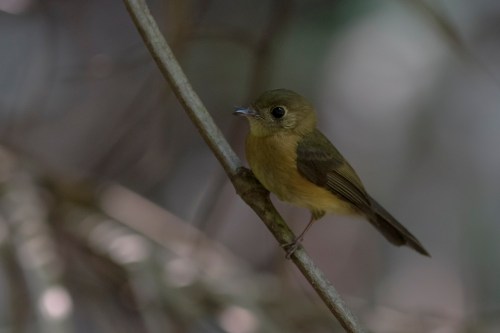
Flycatcher (Family: Tyrannidae) diversity in Central America is very high. Getting to know this diversity has been an excellent challenge. I’ve had a lot of luck seeing most species that I might encounter in Belize, and among my favorite have been the small and endearing flycatchers of the rainforest, such as the Sulphur-rumped Flycatcher (Myiobius sulphureipygius).

2L3A8855.jpg

I’ve seen the bird only a few times. It sits low in the understory of the rainforest, near relatively open areas and perch hunts for insects. Its large eyes are obviously engineered to spot prey, and it tactfully watches and waits until it sees an opportunity. This can be for a minute or more.

These birds don’t seem to mind my close proximity when I’m watching and photographing, and seem only focused on its task of procuring food.

2L3A8794.jpg

Contrasting this seemingly patient and calculated technique with another small flycatcher, the Ruddy-tailed Flycatcher (Terenotriccus erythrurus) has been enlightening. From what I have observed, these birds are constantly making attempts at captures, and hardly sit still for more than a few seconds. It’s difficult to tell if these many attempts are all successful, because the insects it is after are much too small to observe at any distant.

Hopefully I’ll be able to capture both foraging techniques on video. There’s always another way to describe the behavior, whether it be writing, illustration, or video. I’d like to blend all three for these birds.

Published in the Wilson Journal of Ornithology: First record in birds of nestling relocation following nest collapse

by Bryce W. Robinson

IMG_0787.jpg

Photo of a female Gyrfalcon holding a surviving nestling following partial collapse of the nest. Photo published in Robinson, B. W., N. Paprocki, D. A. Anderson, and M. J. Bechard. 2017. First record of nestling relocation by adult birds following nest collapse. Wilson Journal of Ornithology 129 (1) 216-221 

Since I’ve been hard at work in central America for the past month, I haven’t had the time to share a recently published article from my Gyrfalcon work. The article details the behavioral response of a female Gyrfalcon following the partial collapse of a nest. The photo above shows her holding the only surviving nestling following the partial collapse of their nest on a cliff side in Alaska. Just moments later, the female took the nestling to safety at another ledge farther down the cliffside. This behavioral response to threat is the first documented case in altricial birds!

Read the full article: 

Robinson, B. W., N. Paprocki, D. A. Anderson, and M. J. Bechard. 2017. First record of nestling relocation by adult birds following nest collapse. Wilson Journal of Ornithology 129 (1) 216-221