A studio for bird study

Tag: environment

Barred Owl (Strix varia) Hunting at Mid-day

by Bryce W. Robinson


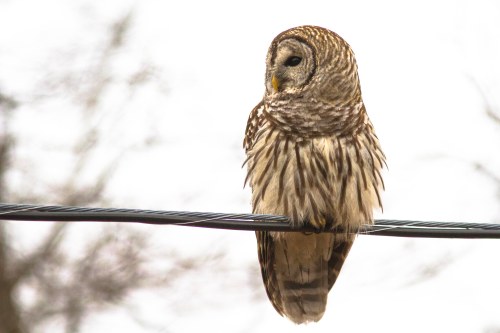
While out for a day of birding Maryland natural areas, Caitlin and I saw a Barred Owl perched on a power line along a two lane highway. I was shocked to see the bird on the line in the open, but more shocked at its alert behavior. The bird was hunting the road edge and it was mid-day.

I’m relatively uneducated about the Barred Owl. I thought these birds were strictly nocturnal and rarely active during the day. After doing some research, I’ve learned they occasionally hunt in daylight, however mostly in the first hour following sunset (Mazur and James 2000) . Despite some tendency towards daytime activity, it stills seems shocking this bird would actively hunt a road edge in the daylight. Either way, I thought I’d share.
_mg_4891


Referenced literature:

Mazur, Kurt M. and Paul C. James. (2000). Barred Owl (Strix varia), The Birds of North America (P. G. Rodewald, Ed.). Ithaca: Cornell Lab of Ornithology; Retrieved from the Birds of North America: https://birdsna.org/Species-Account/bna/species/brdowl

Gyrfalcons in Flight Print: A Gift for the Falcon Enthusiast

by Bryce W. Robinson

GYRF_Plate.jpg

Gyrfalcons in Flight. From left to right, juvenile gray morph, adult gray morph, and adult white morph. 10×20″ Giclee print comprising three Gouache paintings by Bryce W. Robinson. Purchase this print in the store. $40 + shipping and handling.

If you’re looking for a gift for a falcon or raptor lover, or even for the general bird lover, consider this print available in the ornithologi shop. This print details three Gyrfalcons that I painted while working in Alaska in the summer and fall of 2016.

2nd ABA Record of Common Scoter (Melanitta nigra) in Oregon

by Bryce W. Robinson


I had a great weekend. A few friends and I made the short road trip from Boise to the Oregon coast to see the ABA areas second record of Common Scoter (Melanitta nigra). The Common Scoter breeds across Europe and Asia, and most closely resembles the Black Scoter (Melanitta americana). The first record for this species was surprisingly only last year in Northern California.

We had no trouble finding the bird when we arrived, because there were already many birders on location. We were lucky though, it was high tide and the bird had come up river to preen and feed. I stood on a bridge with the bird nearly directly below me and took photos and video.

_MG_4118.jpg

Male Common Scoter (Melanitta nigra). Second ABA record, Lincoln City, Oregon. November 2016.

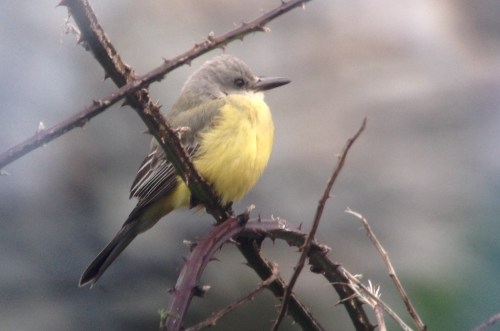
We birded the area after getting our fill, including sea watching which never disappoints folks from inland. We also bagged another lost bird, a Tropical Kingbird a few miles down the road from the scoter stake-out. Overall it was an excellent trip with good friends.

FullSizeRender-1.jpg

Digiscoped photo of a Tropical Kingbird (Tyrannus melancholicus) in Lincoln City, Oregon.

A Green Heron GIF to illustrate Tail Flicking Behavior

by Bryce W. Robinson

GRHE.gif

While photographing a vagrant juvenile Green Heron (Butorides virescens anthonyi) along the Boise River in early November, I noticed a behavior I wasn’t aware of for this species. When I would get a bit too close the heron would notice me, stop foraging, and flick it’s tail while it slowly walked away, as if it had a nervous tick.

Tail flicking is a behavior that many species exhibit. A recent study with the Black Phoebe found support for the explanation that tail flicking was a sign of vigilance to predators, a topic I’ve written about here. When the bird flicked its tail, the predator got the cue that the bird was aware of its presence and the predator had lost the advantage of surprise. This seemed to make sense in explaining the behavior of the Green Heron I stalked on the Boise River. Each time it began flicking its tail, I’d let off until it relaxed and continued to forage.