A studio for bird study

Tag: environment

An Illustration of a Few of the Larger Eagles (Family: Accipitridae)

by Bryce W. Robinson

Eagles-online-01

Eagles – 18×24″ gouache on paper. From top left: Harpy Eagle (Harpia harpyja), Crowned Eagle (Stephanoaetus coronatus), Bateleur (Terathopius ecaudatus), Martial Eagle (Polemaetus bellicosus), Bald Eagle (Haliaeetus leucocephalus), Steller’s Sea-Eagle (Haliaeetus pelagicus), Golden Eagle (Aquila chrysaetos), and Verreaux’s Eagle (Aquila verreauxii).

I appreciate commissions because they provide the opportunity to paint something that I likely wouldn’t otherwise. The above painting of eagle heads is a great example. I have always enjoyed illustrating raptor heads floating alone, but I’ve never tried painting multiple on one canvas. My friend Mike Lanzone reached out to me to make a request for an eagle painting, so I was pushed to put together the concept and paint multiple birds in one place. It was a challenge for sure, but quite rewarding in the end.

Mike wanted the painting to gift to his wife Tricia Miller. Mike and Tricia are excellent biologists that work with many of the species in the painting. Mike is the CEO of Cellular Tracking Technologies, an awesome company that outfits wildlife researchers with the technology necessary to study movement ecology. Tricia is the Executive Director at Conservation Science Global Inc. Needless to say, they’re quite the power couple and I really look up to them. Among many great research projects, they are integral in Project Snowstorm, a research project aimed at understanding irruption and interannual movements of Snowy Owls. I’m honored to provide them with an illustration for their home that will help capture and celebrate the great work that they do.

If you like this image, you can buy prints here:

http://ornithologi.bigcartel.com/product/11×14-limited-giclee-print-eagles
Prairie Falcon Painting – In Flight

by Bryce W. Robinson

PRFA-flight-01

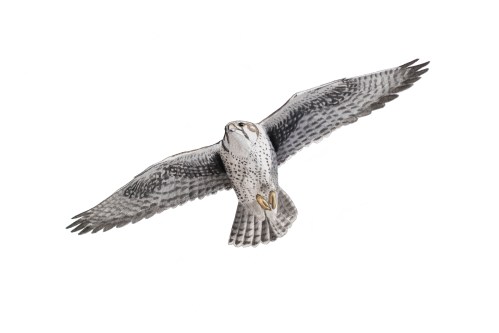
Prairie Falcon (Falco mexicanus) in flight. 12×16″ Gouache on watercolor board.


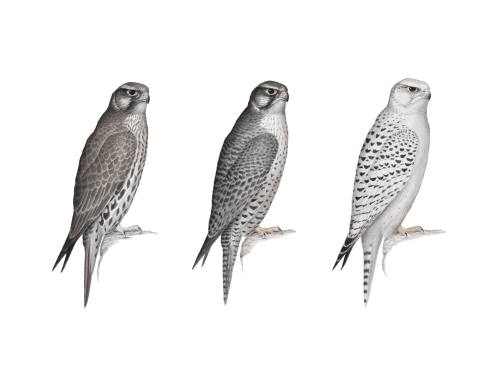
Gyrfalcon (Falco rusticolus) Plate

by Bryce W. Robinson

Gyrfalcon_Plate_2017-11-03-online-01

My friend Kenneth, a Gyrfalcon researcher in Norway, is perhaps the most enthusiastically obsessed Gyrfalcon lover I know. I really appreciate his passion for the bird. Next week he is traveling to Salt Lake City for the Raptor Research Foundation’s annual conference. He asked me to paint a Gyrfalcon portrait for him, so I decided to take the opportunity to illustrate some perched birds to populate the plate I’ve been putting together. I going to produce some giclee prints of this plate, but I’m limiting it to 20 prints. If you like this image, and would like to purchase a print, it is available in the shop!

It’s taken me some time to paint birds that I’m pleased with enough to put into plate form. I’m still a bit at odds with these birds, but I think the above image best fits what I’m going for in creating the plate. My next step will be to paint some different postures and explore which best fills the gap in understanding the different positions and appearances that a Gyrfalcon may take on, in varying conditions. Additionally, the plate needs multiple different in flight postures, and some other age and plumage morph descriptions. Progress has been made either way, and I’m excited!

Below is the painting that I did for Kenneth, as it will look to him. I’ll be traveling to Salt Lake City myself, with this painting alongside me. Thanks for the opportunity Kenneth!

GYRF_Perched-online.jpg


Orange-breasted Falcon Plucking Prey

by Bryce W. Robinson


For the Orange-breasted Falcon whose diet consists primarily of avian prey, to eat requires a great deal of work. First, the birds must capture a food item. They specialize in above canopy surprise and pursuit capture, a technique that blends a bit of skill and luck. When the two align and the bird finally captures a meal, they then must prepare it. Falcons prefer to ingest little amounts of feather from their prey items, and thus need to efficiently remove the extraneous feathers to access the muscle. To remove these feathers, they pluck their prey nearly clean. Plucking can be beautiful, as I found with the Orange-breasted Falcon in the video above as it prepared a Great-tailed Grackle. Perched on a limb high overlooking a deep river valley, the bird plucks. The observer can easily recognize the bird’s technique of rip and flick, as it efficiently carries out its daily ritual and feathers calmly drift away in the hot Central American air.