
Differentiating Immature Dark Western Red-tailed Hawks from Immature Dark Harlan’s- A First-hand Experience
by Bryce W. Robinson
My time at the Goshutes Raptor Migration sight has come to a close. Never have I been witness to the magnitude and diversity that I observed in the three months that I lived on the nine thousand foot island in the sky. I came away with a large collection of spectacular photos far surpassing, in quality and content, anything I have ever gathered. Even more, I came away with a great understanding and appreciation for the phenomenon of the fall raptor migration. Field work is immersive in nature. The opportunity to learn and magnify my study in this situation is truly unmatched.
I find my interest intensely involved in the genus Buteo. Specifically, I am enamored by the polymorphism present in this group. Of these birds, none matches the diversity and allure of the Red-tailed Hawk. The Harlan’s Hawk is quite possibly my favorite bird at the moment. I was obsessive about analyzing every Red-tailed Hawk that passed. Finally, near the end of October, I began seeing the birds of the great north. The banding station was hard at work, capturing and banding all that they could. Every morning I gave them my good luck speech about the inevitability of catching a Harlan’s on that day. Finally, they came through, trapping a dark juvenile Harlan’s Red-tailed Hawk.
Luck seemed to be on my side that day. I spent the majority of the season bothering the banders for pictures to document the diversity of the species. Earlier, hours before the Harlan’s was trapped, they caught a beautiful dark western bird. I was able to get photos of this bird. The result is my ability to show, with photos, the differences between the immature dark Harlan’s, and the immature dark Western Red-tailed Hawk.
I will first introduce and discuss the dark immature Buteo jamaicensis calurus:

Immature Dark Western Red-tailed Hawk- Buteo jamaicensis calurus
It is rare to find a solid chocolate immature Western. This bird is a nice, almost solid bird, however there is still a somewhat mottled appearance on the breast and wing linings. Dark western birds are a beautiful chocolate brown. On dark birds, the upper-tail coverts appear the same as the color of the scapulars and mantle. They do not have the contrast of the whitish upper-tail coverts that a light morph usually has. Sadly, this photo does not adequately display this feature. Of course most immatures have a heavily banded tail that is not the indicative brick red of adults, and they possess the obvious pale primaries giving the appearance of what is referred to as wing windows. The tail often reflects the color morph of the bird, as seen in this bird, having a color that matches the dark solid brown of the body. It is hard not to get too in-depth discussing color morphs of the Red-tailed Hawk. As this is not a discussion on the particulars of each morph, I will discuss the important features to contrast with those of the Harlan’s.
It is important to note that the features I discuss are not always reflected in identifying these birds. As diverse as the Red-tailed Hawk is, it often lacks or reflects certain traits that may throw ones identification into a confusing headache. As in most bird identification, it is necessary to incorporate many factors into an I.D.
For the dark immature western, first note the solid color of the upper-wing coverts, scapulars, and mantle. Also, the head of this bird lacks any mottling, or white markings. Pay particular attention to the area around the eye. As seen in the front view photo, the remiges are banded. The banding is not in heavy contrast with the general color of the wing. This factor is also present on the tail. One factor in contrast with an immature Harlan’s Hawk are the dark emarginated outer primaries. In most Harlan’s, these primaries are banded. I recently learned from Jerry Liguori that this feature is usually only reflected in immature birds. Adult Harlan’s often have solid outer primaries, much like western birds.
Here is the dark immature Harlan’s Red-tailed Hawk- Buteo jamaicensis harlani:

Immature Dark Harlan’s Red-tailed Hawk- Buteo jamaicensis harlani
Separated by the text from discussing the western, it might seem difficult to truly compare the two. Below I have included some comparison photos that can be referenced following the discussion. For now, pay attention to the factors of each bird exclusively. Getting to know the face image of a bird, rather than the nit-picky particulars of individual characteristics will better aid one in identification.
First, Notice the banding on the emarginated primaries of this bird. It is obvious on the front view of the bird, not so much on the backside. Although still a dark brown, this bird is obviously highly melanistic. Harlan’s are often severely dark, even black. This bird is not as dark as some, but it is obviously darker than the chocolate color of the western. The physiological reasons for this are extremely interesting, but for another discussion.
The most obvious feature of this bird, in conjunction with the dark coloration, is the presence of mottling across the body of the bird. This creates a bird of high contrast, which is a feature that might possibly be the reason for my addiction to the aesthetic of this Alaskan wanderer. The mottling is present on the breast, belly, and wing lining of this bird, however, this feature is not exclusive to the Harlan’s. The area to focus on in relation to mottling is the backside of the bird. Notice the heavy mottling present on the upper-wing coverts, scapulars, and mantle. This feature adds to the other factors that make the bird a Harlan’s. Also, notice the presence of white on the face and crown.
I note in the video below that the tail is heavily banded, and the presence of the contrasting white and dark in the tail is unique. These factors do not necessarily add to the identification of a Harlan’s, but it is interesting to note. The tail of the Harlan’s is quite different from the Western. The bands are thicker, and contrast more with the coloration of the rest of the tail. Take the time to see the bird in the video. I briefly discuss all the factors that make the bird a Harlan’s, but the video is really valuable to present the bird in a comprehensive way.
The following photos illustrate a visual to aid in intellectualizing the differences between the dark immature Harlan’s and Western.

Dark Western(top) and Dark Harlan’s(bottom) bottom-side
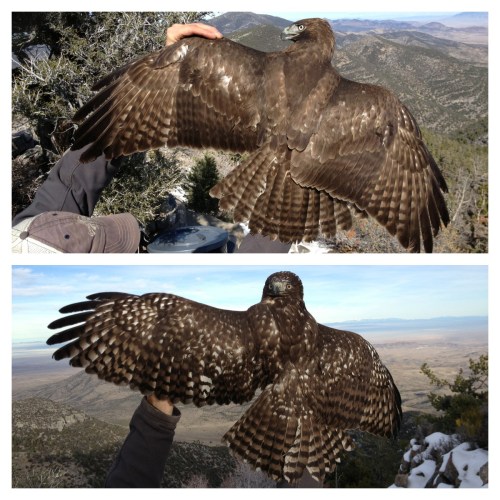
Dark Western(top) and Dark Harlan’s(bottom) topside
The experience I had this season left me with some impressions and ideas in relation to the Red-tailed Hawk. Much discussion and disagreement is present in the raptor world in relation to the status of the Harlan’s. I have some insight into the issue, provided by exposure to the number of birds I observed this fall, coupled with conversation, and personal study of the bird.
The plumage diversity present in the species Buteo jamaicensis is vast. I observed that the birds of the desert of southern California appear to have plumage differences from those that I observe in the great basin. Also, across the course of the season I documented through photography, the differences in the birds that traveled past the migration sight. I can say, through personal experience and observation, that there is so much diversity in the species that it becomes difficult to differentiate morphs, and at times, even supposed subspecies. The debate in the bird world in regards to the Harlan’s is whether or not it deserves a status as a separate species. I feel that the debate is arbitrary given the knowledge we have about these northern birds.
I even question the status of subspecies in regards to the Harlan’s. The parameters that factor into substantiating subspecies status are particular, however it is my impression that there is not enough known about the breeding ecology of the Harlan’s Hawk to definitively term it a subspecies. Perhaps the Harlan’s is a color morph, an exemplification of variation in plumage, not as geographically tied as we believe.
It ultimately comes down to my lack of knowledge and really, the lack of the collective knowledge of the raptor community. What needs to be done is a comprehensive study, documenting the movements and breeding ecology of Harlan’s Hawks. Through a well crafted scientific study, we can once and for all discover the knowledge that will lift us past what is now only a discussion in speculation.


 ornithologi.com