A studio for bird study

Tag: journal

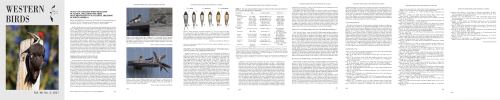
Published in Western Birds: First Record of Breeding Eurasian Barn Swallows (ssp. gutturalis) in North America

by Bryce W. Robinson

Fig.3.jpg

My friend Luke DeCicco and I published a paper in the Western Field Ornithologists journal Western Birds that details an observation I made during my last hours of the 2016 field season in Nome, Alaska. I happened upon four recently fledged Barn Swallows being provisioned by two adults, that were obviously white-bellied Eurasian birds. I couldn’t spend much time with them due to my departing flight, but I did my best to document everything in haste. The flight back to Anchorage was fun, as I sat there with my mind buzzing thinking of how to report this observation in the literature.

I asked my friend Luke be on the manuscript for a few reasons. First, Luke had identified a white-bellied bird in the same location (Nome DOT utility yard) a few days prior while we were loading our storage container. As such, I had my eyes open while traveling through the area when I spotted the birds being provisioned. Without his initial observation, I may have been effectively asleep at the wheel and may have missed the birds entirely. Birding was not the reason I was in the utility yard. Second, Luke has an impressive handle of the birdlife of Alaska, along with the connections necessary to expeditiously investigate the historical status of the species in the state, and to assess the potential that this record was indeed a first. In the end, he brought forward and engineered the aspect of the paper that is perhaps the most useful, an update on the status of Eurasian subspecies in AK, along with a summary of records of vagrant subspecies. The result is an article that will be very useful for folks in the future as they put their own observation into context. I feel really fortunate to have Luke’s contribution to this publication.

This publication represents a few firsts for me. Primarily it represents crossing a threshold in my career, as it is the first publication of mine where I have incorporated my passion for ornithological illustration. I painted a rendering of the differences between the subspecies discussed in text in the form of museum specimens. I’m very pleased with the figure, and I’m excited to continue to make illustration integral in my work.

The paper is worth a read for anyone interested in Alaska’s birdlife, and bird distributions in North America.

Click the image below and give it a read!
Untitled-1-01.jpg

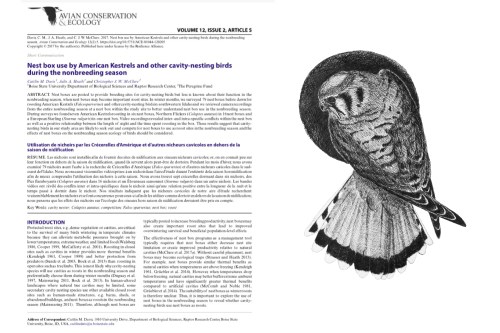
Just Published in Avian Conservation and Ecology: Nest Box Use During the Non-breeding Season

by Bryce W. Robinson


_MG_6507-01.jpg

Caitlin just published an excellent paper detailing nest box use in the non-breeding season in Idaho.

This publication is an important contribution because it discusses patterns in nest box use during a period that has received little attention. Additionally, because nest box programs are engineered to supplement natural cavities to saturate an area with nesting habitat geared to benefit species, a full understanding of its impacts throughout the yearly cycle is important. This paper not only reports how nest boxes are used in the non-breeding season, but illustrates some possible negative impacts as well. Such impacts are primarily associated with the variable thermodynamic nature of nest boxes relative to natural cavities, resulting in deaths at temperature extremes.

The paper also details some inter and intraspecific interactions in nest boxes, and patterns of use in other cavity roosting species such as the Northern Flicker and European Starling. With this discussion comes supplementary video of some such encounters, and excellent inclusion to add further context.

WATCH THE VIDEOS (CLICK HERE)

READ THE PAPER (CLICK HERE) 

Just Published: Applied Raptor Ecology: Essentials from Gyrfalcon Research

by Bryce W. Robinson

cover-final-400px

The Peregrine Fund just released a new book, “Applied Raptor Ecology: Essentials from Gyrfalcon Research”. This book serves as a techniques manual geared towards providing early career researchers with information and a stepwise guide for conducting various research on raptors. This information is also supplemented by mock data, and R code to help the researcher begin to form skills in R and analysis.

Although I am the clown in orange on the cover, my true contribution is found inside the book. I contributed as an author of a chapter – Quantifying Diet; an appendix – Guidelines for Conducting a Camera Study of Nesting Raptors; and as coauthor of an appendix – A Photographic and Morphometric Guide to Aging Gyrfalcon Nestlings.

For more information and to purchase the book, go here:

http://science.peregrinefund.org/applied-raptor-ecology

*PDF’s of each chapter will be available January 2018

Published in Western Birds: First Record of Eastern Phoebe Breeding in Alaska

by Bryce W. Robinson

48-2s-01 copy.jpg

My latest publication, and my first in the excellent regional journal Western Birds (Western Field Ornithologist’s), details the first documentation of successful breeding of Eastern Phoebe in Alaska. You can find the pdf on my Researchgate profile. It’s short and to the point, and worth a read for anyone interested in the birdlife of North America.

Last year, while working in Alaska with the US Fish and Wildlife Service’s Migratory Bird Program, I caught word of an Eastern Phoebe documented near Nome. I’m very familiar with Nome, since it is where I studied the Gyrfalcon for my master’s degree. I’ve birded the area heavily in the spring and summer months. There aren’t many Eastern Phoebe records for the state, so a bird showing up in Nome on the western coast is that much more exciting. I planned to be in Nome the following month to work with Red Knots, so I crossed my fingers that the bird would stick around long enough for me to see.

Surprisingly, a second Eastern Phoebe was documented soon after. Then came documentation of nest building, followed by nesting behavior and ultimately confirmed egg-laying and incubation. On my arrival at the start of July, I joined my friend Lucas DeCicco to see the pair on the outskirts of Nome. Since July is a time when the flow of birders ebbs in Nome, no one had checked on the nest for some time.

Sure enough, we found the birds feeding nestlings. After we had photographed and observed, Luke and I resolved to return regularly to document the success or failure of the pair.

In the end, the pair was successful. It was the first documented case of the species successfully breeding in Alaska, and on top of that in a location quite inhospitable and atypical of the species. The coast of Nome is not known for mild weather.

I told Luke that I thought it important to document this novel event in a publication, and he agreed. So we resolved to report the record, and asked for the help of those that originally found the first phoebe in June.

Thanks to Luke for his help with this seemingly simple publication. It wouldn’t be so clear, simple, and clean without him. Also, a big thanks to my co-authors who first found these birds – Aaron Bowman, Scott Hauser, John Wright. Thanks for the help with cleaning up the publication, and of course documenting the birds that led to this record.