A studio for bird study

Tag: journal

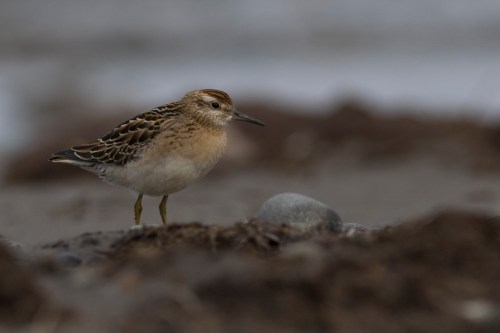
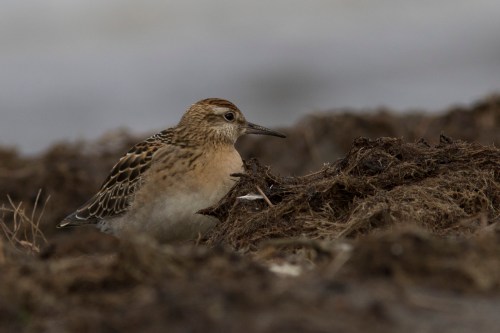
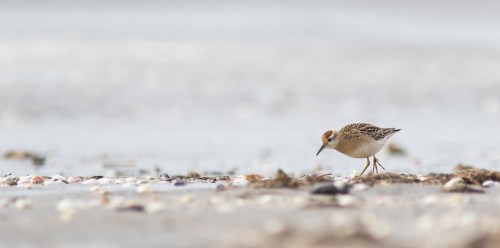
Sharp-tailed Sandpiper (Calidris acuminata) on the Alaska Peninsula

by Bryce W. Robinson

2l3a0673

The Sharp-tailed Sandpiper (Calidris acuminata) breeds in eastern Siberia and winters in the south Pacific, but a large portion of the juvenile cohort pass through western Alaska on their first fall migration. While I was on the Alaska Peninsula waiting for Bar-tailed Godwits (Limosa lapponica) in September, I got to see a few late moving juvenile Sharp-tailed Sandpipers mixed in with massive Dunlin (Calidris alpina) flocks.

2l3a0629

At high tide each day our group would hide in the elymus grass and watch shorebirds come into the high rack line to roost. On one occasion, I noticed the opportunity to photograph a juvenile sharpie, so crept on my belly towards the roosted flock. Once I was close enough to take quality photos, I raised my camera. At the same time the flock took to the air and my chance seemed ruined. I thought it odd though, because the roosting Dunlin are usually tolerant if you are careful and move slowly. I looked around and saw a Bald Eagle passing overhead, which was certainly the reason for the panic. I cursed a bit and looked around to see when the flock might return to roost. As I scanned around, I noticed a lone bird still roosted in the rack line. It was the sharpie, which hadn’t pushed to the air with the Dunlin flock. It’s an interesting note, and something I’ve observed with the few Rock Sandpipers that were associating with the Dunlin flocks as well. On few occasions, the other species opted to stay put despite the flock erupting into flight.

2l3a0611

I’d love the opportunity to get to know Sharp-tailed Sandpipers better. Like other birds of the region, the juveniles represent one of the excellent species along the migratory route of the west coast of Alaska that make the place so unique and alluring.

Fork-tailed Storm Petrel (Oceanodrama furcata) Foraging on Tidal Flats: Part 2

by Bryce W. Robinson


I captured too many images from my recent experience with Fork-tailed Storm Petrels (Oceanodrama furcata) along the Bristol Bay coast of the Alaska Peninsula. Given that our observations warrant a full report in a journal, I’ll maintain some brevity for now. However, I think it is helpful in the interim to share supplementary video and images that set the stage for the publication. The rest will come out with the article sometime in the coming year.

2l3a1345

Stuart Fetty walks towards a resting Fork-tailed Storm Petrel as the tide rises.

We had a few days where the birds lent themselves to close proximity photography. They were all around us, and didn’t seem to understand or comprehend the concept of a terrestrial predator. In one instance, we walked as close as a meter or so to a bird sitting on the water with no response. Whether this was an ill or a healthy bird resting, I can’t be sure. We do however have some indication that these birds were healthy, but these are details that will be discussed in publication.

2l3a1170

Fork-tailed Storm Petrel kiting in an onshore wind. Note the fish carcass in the foreground, an attractant for the birds to this location.

The past six months have been full of unique encounters with bird life in Alaska, and have produced a nice list of potential publications that I’ll be working on throughout the winter. I’ve taken a lot of satisfaction in working in a place where the birdlife is still relatively understudied, a place where paying attention, taking good notes, and diligent photography all support the opportunity to add to our basal knowledge of natural history of the less understood species of North America.

A Crested Auklet as a Prey Item in an Inland Gyrfalcon Nest as Detailed in Marine Ornithology

by Bryce W. Robinson

Fig-1-Crested-Auklet-insert-in-a-Gyrfalcon-nest-as-captured-by-a-motion-activated.png

Photo 1. Image of a Crested Auklet that was delivered to a Gyrfalcon nest, located over 100 km from the nearest coastline. Image published in Marine Ornithology 44(2) 229-231.

The fist publication from my Gyrfalcon research is now available online:

Click to access 44_2_229-231.pdf

The account (Robinson and Anderson 2016) published in Marine Ornithology details a strange prey item, an adult Crested Auklet, delivered to one of the Gyrfalcon nests I had placed a camera in during the summer of 2015. All details are in the paper, so be sure to give it a read.

More Gyrfalcon publications to come!

Referenced literature:

ROBINSON, B.W. & ANDERSON, D.L. 2016. Crested Auklet Aethia cristatella as a prey item in an inland Gyrfalcon Falco rusticolus nest. Marine Ornithology 44: 229–231.

From the Field Journal- Golden Eagles at the Goshutes

by Bryce W. Robinson

Two full weeks have passed at the Goshutes, and already I have accumulated many incredible stories. Life on the mountain is as close to heaven as I can get at the moment, I am sure. I’ve decided to chronicle my time here in a field journal. I will share my experiences from the journal by posting particularly interesting accounts. What follows is an entry I made last week, after observing one of the most spectacular wildlife events I have ever witnessed.

August 21st, 2012

Early August has been fairly bird-less as far as migration goes. Although birds haven’t been moving through, a great host of local raptors are keeping me entertained. I have many stories and experiences to tell of a whiny young Goshawk, pestering Sharp-shinned Hawks, bold and curious buteos, and countless others. For now, I’d like to tell of an experience I had today on my observation post. Jerry and Deneb were helping me with the count, as my co-counter Steve had yet to arrive on the mountain. Jerry and Deneb are old friends of seasons past here at the Goshutes. It was rather enjoyable to listen to their banter as they interacted as old friends often do. Jerry helped pass the time, taking it upon himself to teach me the tricks and tips he has accumulated from some thirty years of experience counting migrating raptors. Needless to say the lack of birds was made up for with teaching, chatter and humor. 

About mid-day, the three of us, steeped in some conversation of trivial matters of the world, were rocked as an intense sound of friction filled the air. Looking above towards the source of the sound, we saw two large air masters pass directly overhead. In fact, what we observed were two large adult Golden Eagles engaged in a dramatic and deliberate stoop, heading directly east with conviction. Excited and in awe, we watched the birds descent. By sight and sound, the large Aquila birds resembled two fighter jets in arial pursuit. Near the bottom of the canyon, the two birds abandoned their stoop, spreading wings, slicing the air with legs hanging, a posture of aggression. As we watched, we realized their intention. Picking up a third bird, we saw the eagles close on a soaring buteo, an adult Red-tailed Hawk.

The unsuspecting buteo realized the danger just in time. It began evasive maneuvers to avoid the slashing talons of the eagles. The menacing eagles made pass after pass at the fleeing buteo. I was astonished at the sight of their cooperative offensive. Such slow soaring raptors had turned on their agile abilities, and it became apparent that these birds are masters of the wind and sky. The dog fight continued, and the skilled buteo somehow remained untouched by the merciless eagles. Finally, finding a bubbling thermal, the Red-tailed Hawk lifted swiftly in the air. The heavy eagles slowly pursued, but were unable to match the rising speed of the fleeing buteo. I was in awe at the violence I had witnessed. Such raw experiences rip away the feeling of fluffy beauty nature often promotes. The natural world is wild, harsh, and unforgiving. This time the hawk had evaded the eagles, and peace returned to the air. 

As we stood recounting the natural marvel we had just witnessed, our reflection was rocked by the majestic image laid out before us. To the east, against the expansive backdrop of the salt flats of western Utah, another Red-tailed Hawk joined the soaring victim of the eagles. Separated by hundreds of feet, two buteos above, two eagles below, raptors alike soared in unison, circling in the calm afternoon air. Taken aback, I again and for the hundredth time that week, voiced my feelings for the place. Full of magic and natural wonder, even before the migration has truly begun, the Goshutes has captured my heart, and I am truly at peace in this place. There is no where I would rather be, as I sit on a mountain top, feeling as close to heaven as is possible.