
Dark-eyed Junco Subspecies in Idaho’s Winter
by Bryce W. Robinson

For the Junco lovers that like this image, you can purchase a print by clicking on the image above.
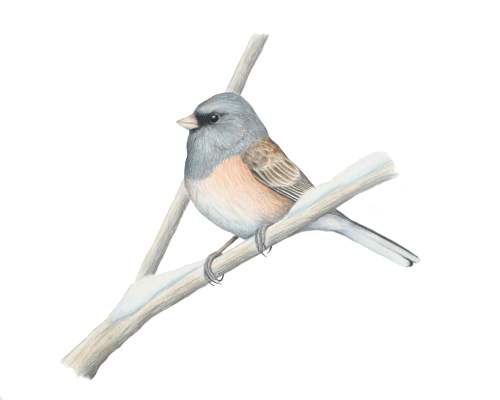
Above is an illustration I just completed of some select subspecies of one of my favorite birds, the Dark-eyed Junco (Junco hyemalis) – Male and female “Oregon” (J. h. oreganus), “Pink-sided” (J. h. mearnsi), “Cassiar” (J. h. cismontanus), and the nominate “Slate-colored” (J. h. hyemalis). I think the junco is a favorite because it is polytypic, with some excellent variation in phenotypes throughout its range. I particularly am drawn to the Cassiar Junco because it is both difficult to diagnose (separate from Slate-colored X Oregon intergrades, if they even are different!) and little understood. For more information on this taxon, check out these links:
http://ebird.org/content/nw/news/dark-eyed-junco-races-oregon-slate-colored-and-cassiar/
http://nwbackyardbirder.blogspot.com/2011/04/not-slate-colored-junco-cassiar-junco.html
Here is information on its current and past taxonomic status:
https://avibase.bsc-eoc.org/species.jsp?avibaseid=DED1C8F9EE711FCF
I also like the Dark-eyed Junco because from what we understand regarding it’s phylogenetics, it is a very recent radiation. Speciation well in process! See this article for an explanation:
Click to access POSTPRINT%20Mol%20Ecol%2025(24)%206175-6195%20(2016).pdf
Further, be sure to educate yourself with the Junco Projects great film – Ordinary Extraordinary Junco. I included a chapter of the film below that discusses the diversification of the species.
My illustration comprises the candidate subspecies that make up Junco flocks here in western Idaho. I chose to illustrate the male and female Oregon because they are by far the most common and provide the point with which to contrast and compare any outliers. The others are males, so as to provide simple examples of the other subspecies. Of course first-year and female types of these taxa can blend in appearance with the rest, which makes things much more challenging and fun.
Here I’ve included a rough and disorganized compilation of some information on what we currently understand about the Dark-eyed Junco and its sister species. There is a lot more out there, so if you love this as much as I do then be sure to explore more.
Here is a link and a few references to investigate.
Milá, B., P. Aleixandre, S. Alvarez-Nordström and John McCormack. 2016. More than meets the eye: lineage diversity and evolutionary history of dark-eyed and yellow-eyed juncos. In Snowbird: Integrative biology and evolutionary diversity in the junco. Ellen D. Ketterson and Jonathan W. Atwell (Eds.), Chicago University Press, Chicago.
Miller, A. H. 1942. Speciation in the Avian Genus Junco. The American Naturalist 76:211-214
 ornithologi.com