
Singing House Wren on the Boise River
by Bryce W. Robinson
I recorded a singing House Wren (Troglodytes aedon) today while banding birds along the Boise River with the Intermountain Bird Observatory (note the bird is banded!).
Although spring migration hasn’t hit in its entirety at this site, the House Wrens seem to have arrived in full. There are at least three different individual males singing in the area, and I’ve noticed an additional four individuals in the area as well. The House Wren population at this site seems to be healthy.
Unfortunately the video I recorded does not capture the song of the House Wren. I wasn’t too far from the wren, but I believe the inability of the phone to capture the song is related to the masking of other noises in the environment (and the iPhone’s lack of a directional mic). First and foremost it was a windy day, which I believe is the main contributor to the masking. On top of the wind was the noise of the busy highway, the noise of the Boise River, and nearby construction (all large bandwidth, but mostly low frequency). With both natural and anthropogenic noise, I wonder how House Wren territory distributions differ between an area like this and a relatively noiseless area such as a remote forest location away from a river.

House Wren (Troglodytes aedon) banded at the Intermountain Bird Observatory’s Boise River site on the east end of Boise, Idaho.
Despite the heightened noise, the wrens in this area seem to be thick and continuing with life as they would. A study may enlighten us on the human noise impacts coupled with natural noise (rivers, etc.) on bird territory distributions like in this case, but if I were to hedge a bet I’d say the House Wren is one species that seems to weather the added impacts of humanity enough to maintain a regular and healthy population within human disturbance areas.
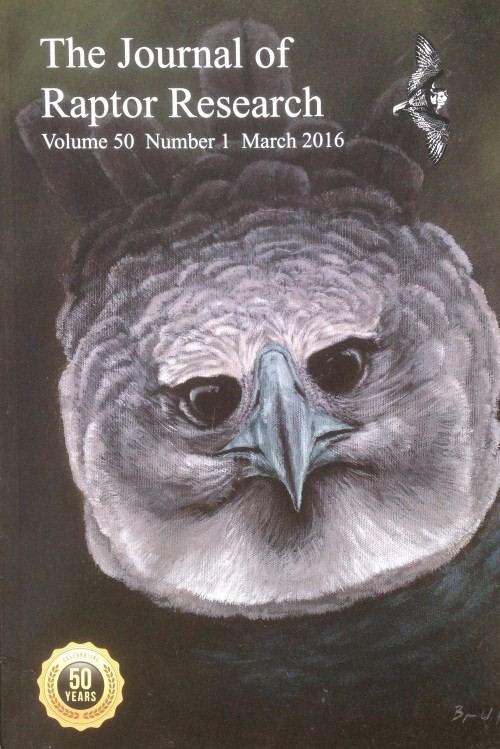 I’m honored and thankful for the opportunity to have painted the cover art for issue 1 of the 50th anniversary of the RRF’s Journal of Raptor Research. The issue features an article from The Peregrine Fund’s Harpy Eagle work, along with an article detailing a friend’s master’s work on Burrowing Owls, an excellent article on Gyrfalcon movement’s, and a lot more. I’m so happy for the opportunity to add to an organization that does such incredible work and carries the tradition of raptor studies forward.
 ornithologi.com