A studio for bird study

Tag: nature

Late Changing Plumage of Rock Ptarmigan

by Bryce W. Robinson
ROPT

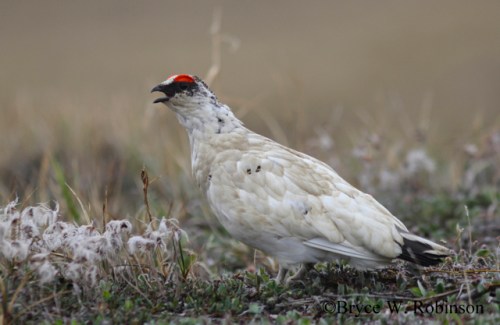
Male Rock Ptarmigan- Lagopus muta, still in basic plumage. June 21, 2013. Prudhoe Bay, Alaska

My exposure to Ptarmigan this past summer was not limited. Although I haven’t been able to track down the White-tailed Ptarmigan, I have had a lot of experience with both the Willow and Rock Ptarmigan.

Without hesitation I’d say that the easiest way to distinguish the two species is by call. This is very helpful in early summer, when males are traipsing around the open tundra, full of hormones, calling and chasing one another constantly. But what about later in the season, when birds are more cryptic? What about females?

The differences in plumage are subtle, and so far I feel I could only distinguish females in alternate plumage if they were side by side.

Shape is a helpful tool. Richard Crossley asked me how I distinguish between the females of the two species. My response was head shape, but he persisted and exposed my lack of confidence with the parameter. I feel like I have head shape down, but I’ll need more practice this coming summer as I chase the Gyrfalcon around the Seward Peninsula.

I chose to share the above photo as it shows a Rock Ptarmigan in late June. In late may, male Willow Ptarmigan already have full reddish necks, as they have started their pre-alternate molt. Interestingly, male Rock Ptarmigan do not begin their pre-alternate molt until early July. This makes for a simple identification tool. I’ve yet to research any answers to this difference in timing of molt between the two species. I of course, encourage any discussion on the matter.

A Highlight of Birding- Breeding Sabine’s Gulls

by Bryce W. Robinson

IMG_7996

I can write a book about how many birding highlights I had this past summer on Alaska’s north slope. It seemed every day I had a memorable experience that will last a lifetime.

I’ve mentioned before that Richard Crossley came to Prudhoe Bay on my last week of work in the region. I agreed to guide him around the oil fields for a day and show him where I had seen particular species. He, of course, had an agenda, and I was tasked to help him out.

We had a hell of a day. I think we started around 8 in the morning, and by midnight, I was still wandering around the tundra photographing birds. He was very keen on finding the Sabine’s Gulls, a bird of which I had seen little. Still, I had a reliable spot that would likely turn up a few gulls, in the least. Just after midnight, we headed that way.

We stopped near the spot I planned to check, only to photograph a small group of Semipalmated and Pectoral Sandpipers. While Richard took photos, I scanned about. I then saw a single Sabine’s some yards away. I alerted Richard. After scanning about a bit, we found a dozen more.

Excitedly we approached the group of gulls and began photographing. The gulls would lift off, and take turns harassing us. Such behavior is typical of breeding birds, defending their young. I took advantage of their tenacity and let my shutter fly. After gathering more photos than necessary, I began the search for the young. Soon enough I found a single bird across a pond, sitting with an adult. It was nothing more than a single ball of grey fluff. So adorable, and so vulnerable.

Our intrusion lasted only a moment. We recognized the stress we were causing the birds, and left. It couldn’t have been better; finding Sabine’s, which I’d barely seen, and having the opportunity to see both adult and young at such close proximity. The experience will stick with me for my lifetime.

The tragedy comes with the benefits of digital photography. Through some glitch, I lost nearly all photos from that evening. Luckily, I have one. It is a photo in the striking midnight sun of the arctic, of a bird I will never forget, and hope to see again, somewhere on the open arctic tundra.


The Pygmy Nuthatch

by Bryce W. Robinson

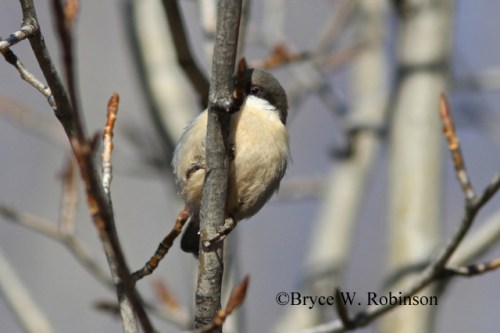
Pygmy Nuthatch

I’ve been very fortunate to bird as often as possible while I’m busy in grad school. The semester is nearing a close, which means the work load has increased, exponentially, it seems. Luckily, I’ve managed my time such that I have been able to bird one day every week.

I’ve found myself part of a great birding crew. It’s been a blast, as we seem to find something notable every time we go out. Yesterdays star bird was a Little Gull, an incredible bird for central Idaho. It was very distant across Cascade Reservoir, so no photos. I did, however, manage to fulfill a photography goal I’ve been after for a while

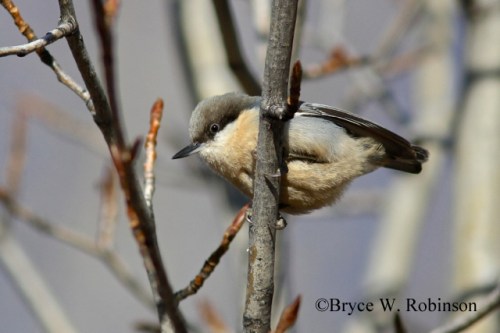
Until yesterday, it seemed that I’d only seen the Pygmy Nuthatch- Sitta pygmaea, at the very top of tall conifers, out of reach even for my 300mm with a 1.4 tc attached. Any shot appeared a small dot on a tree, which of course does not honor the small nuthatch in the way it deserves. I consider the Pygmy Nuthatch to be one of the cutest birds of the forest. They are small and vocal, full of personality. With my photography, I’d like to capture that personality.

While checking the outflow of Cascade Reservoir yesterday, we found a small group of very vocal “Piggies”. They were low in the trees, feeding and flitting about. Fortunately, they’d pause and take note of me, allowing for some quick snaps of my shutter. Finally, I’d caught the personality of the little piggies.

IMG_0852 copyI think my interpretations of the birds behaviors are a little anthropocentric, but still, they seemed shy but inquisitive. Because of their size, appearance, and personality, I find them one of the funnest birds to interact with in the high pine forest.


Prairie Falcon- Falco mexicanus

by Bryce W. Robinson

Prairie Falcon- Falco mexicanus. 18x24" prismacolor on bristol

Prairie Falcon- Falco mexicanus. 18×24″ prismacolor on bristol

Of all the raptors I illustrate, it seems falcons give me the most trouble. I’m not entirely sure why, but the fact that I struggle with the family is a bit disheartening, as it is likely to be a group I spend a considerable amount of time studying for the rest of my life. Perhaps with time, I’ll work out the bugs in my inability to adequately illustrate the birds.

Falco mexicanus is a significant illustration for me. I’ve conducted a great deal of field work in the west, primarily in the flats of the great basin, and I’ve had many experiences with the sandy brown assassin. Get yourself lost on lonely dirt roads of the remote great basin in midst of winter, and you will undoubtedly come upon a Prairie Falcon perched on some high point, surveying for prey.

I remember last year, I was searching for eagles on the edge of the salt flats of north western Utah. I had pulled over to glass a mountain top, and found myself watching a perched Golden Eagle, some two kilometers away by my estimate. While I watched the bird, I notice a fast approaching figure headed straight for the large raptor. The figure was in fact the Prairie Falcon, come to conduct its business of bullying the large eagle. The tenacious bastard kept at it for nearly five minutes, until finally the eagle had enough of the dodging, and fled from the persistent falcon pest.

My success with illustrating this bird is fortunate, and gives me the courage to start a project that will be focused on gleaning some much needed extra funding for my work with the worlds largest falcon this summer. Stay tuned as this idea develops and materializes.