A studio for bird study

Tag: nature

Beatnik Birding: Madera Canyon, AZ

by Bryce W. Robinson
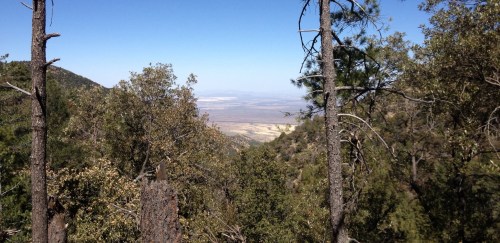
IMG_0012It’s no secret that Madera Canyon, AZ is one hell of a spot. What I didn’t expect was to climb out of the desolation of the desert into a cool and lush sky island, full of wildlife. After becoming a bit desert dreary, I felt refreshed entering the high woodlands in search of some new birds. I decided I’d go as high as I could, and start hiking from there.

I’ve become quite entranced by the myths of Trogons that can be seen in this part of the country. I held high hopes for this journey up the canyon, but I came away empty handed. What I did find were a good number of birds that I were firsts for me. Long story short, it was a really great morning in Madera Canyon. The place didn’t disappoint bird-wise.

Yellow-eyed Junco- Junco phaeonotus

Yellow-eyed Junco- Junco phaeonotus

Of the throngs of birds I was able to find, I only photographed a few. One of my favorite new birds was the Yellow-eyed Junco. I found a few small flocks, acting just as any junco species does, picking around the ground through the understory. They would notice me, flit to a nearby perch, and look around nervously. These juncos sound quite different than their dark eyed relatives, so when I initially heard them, I knew I was in for something new and good.

Arizona Woodpecker- Picoides arizonae

Arizona Woodpecker- Picoides arizonae

I was really focused on one bird in particular. I love woodpeckers, and the Arizona Woodpecker is a specialty of these parts that I couldn’t wait to find. I heard the bird first, tippy tapping its way around a small Ponderosa Pine grove. It didn’t take long to locate the brown bird. I think the hikers that passed me wondered why I was elated by this brown woodpecker. I’m sure some understood, but others gave me quizzical glances. I giggled a bit, there’s nothing wrong with that.
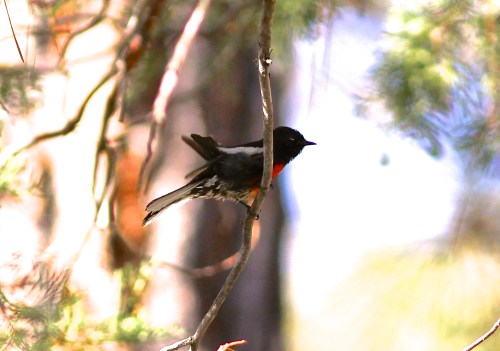
Painted Redstart- Myioborus pictus

Painted Redstart- Myioborus pictus

Another bird to delight both my eyes and my ears was the fire chested Painted Redstart. These birds were all over the riparian areas of the canyon. I really paid attention to their song, and I think I may have it down. Maybe the next time I hear this bird, I will be able to know what I am listening to.

I can say that Madera Canyon was more than I hoped for. On my way out, I stopped by some feeders and saw a brilliant crimson bird that I immediately knew, although I had never seen. Hepatic Tanager! That is what I said aloud, again receiving concerned looks from the general tourists.

I have yet to have any truly in depth and interesting human interactions. I am hoping I meet a like minded birdnerd soon. I’m headed over to the Patagonia-Sonoita Creek area next, where I’m sure I will run into some other nut jobs. I’ll be keeping an eye out for the Elegant Trogon in that area. Hope I find it!

Beatnik Birding Again: Tubac, AZ

by Bryce W. Robinson

REJOICE!

I am on the road and without a home once again!

For the next few months, I will be wandering and watching birds. I’m calling myself beatnik once again for many reasons. I’m traveling, unkempt and without a home, to ride the rhythms of life and honor them. I will be living out of my humble vehicle, which I must say is a good home.

I’m writing at the moment from Tubac, a small town just north of Nogales, in southern Arizona. For birding and many other reasons, this is a very special place. I’ve noticed that I am likely the youngest man in this town, as this is a destination for the seasoned, or retired members of society.

IMG_0011

The Tubac Raptor Migration Site

After deciding to hit the road once again, I received council from my friend Jerry Liguori that the spring migration in Tubac was not to be missed, so this became my destination. He planned to go as well. Upon my arrival, I met up Jerry and his wife Sherry, to watch this migration that flows up the river system through town. It was a bit of a surprise to find many others watching as well. As I found out, Bill Clark was leading a workshop with Tuscon Audubon. Meeting him was interesting…

It was nice to be with Jerry watching migrating raptors again. These were different birds however, and I was tasked with learning. Jerry, of course, is the best to learn from. He took the time to share his impressions, and kindly correct my misidentifications. Trial and error, and keen interest in learning is how one becomes a better birder. BUT, with Jerry’s help, my learning curve has been reduced significantly.  I still need to watch and soak in each bird for myself, and there is one particular bird that has been a bit difficult to identify at a distance.

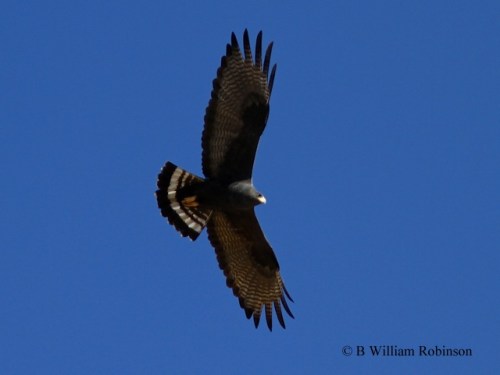
Zone-tailed Hawk- Buteo albonatatus

Zone-tailed Hawk- Buteo albonatatus

The Zone-tailed Hawk flies with exaggerated dihedral, just like the Turkey Vulture. From afar the two are nearly identical, but as I watch more, the differences are becoming noticeable. I also saw a few other raptors that are new to my eyes. The number of Common Blackhawk that go through this town in spring is the reason for the hoards of birders. It was a great bird to see, and is rather distinctive at a distance.

Gray Hawk- Buteo nitidus

Gray Hawk- Buteo nitidus

The first few days I had a some distant glimpses at the Gray Hawk, but today a pair was displaying, in courtship, over the trees. The patterning and shape of this bird is so interesting to me. After watching all three hawks, I started to speculate as to why the three desert denizens might have black and white barred tails. I haven’t decided on any conclusions, but my mind will remain on the subject until I do.

Of course there are other birds here besides the raptors, and most are new to me. Birding in the trees near the river, and in the hills outside of town, has been spectacular.

CBTH

Curve-billed Thrasher- Toxostoma curvirostre

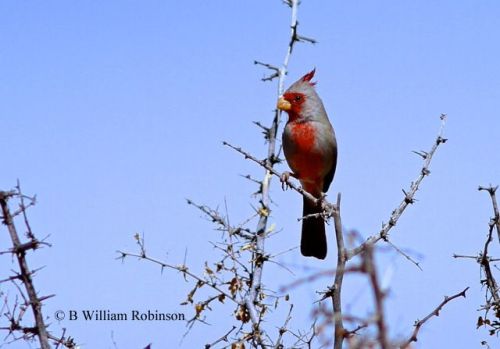
Pyrrhuloxia- Cardinalis sinuatus

Pyrrhuloxia- Cardinalis sinuatus

As my journey continues I am sure I will have many more things to share, besides the birds. People of the road are part of the journey, and I hope to meet and make many friends. As I wander, watch for me. As always I am heavily bearded, and an obvious example of what is a beatnik birder.

New HawkWatch International Shirts, Featuring My Artwork

by Bryce W. Robinson

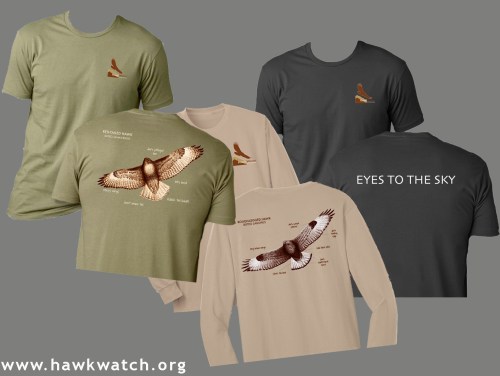
HWI new shirts

HawkWatch International recently released a few shirt designs featuring artwork of mine. My friend Mike Shaw had the great idea for a design that took a field guide type format, and put it on the shirt. The shirts feature two Buteos, the Red-tailed Hawk- Buteo jamaicensis, and the Rough-legged Hawk- Buteo lagopus. These illustrations feature callouts that give the viewer a few key tips at identifying the bird. I love the idea, and the shirts turned out great.

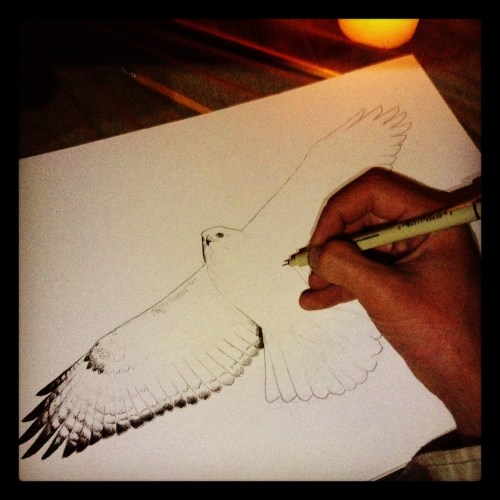
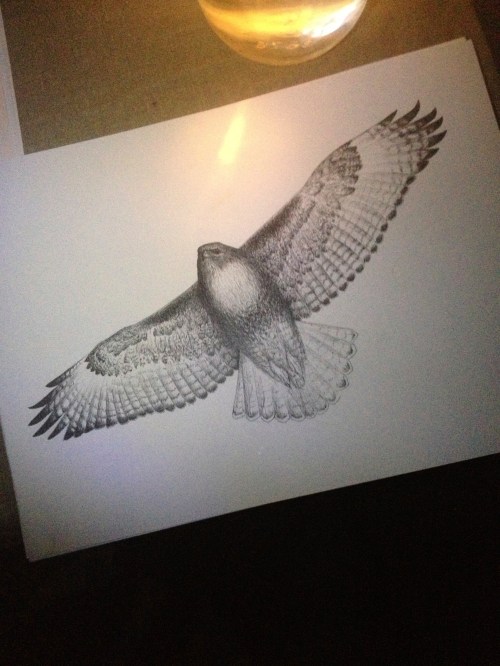
A little background on the development of one shirt, the Red-tailed Hawk, might be interesting to some. I really love this illustration for its purity. While counting the raptor migration last fall on the Goshutes Raptor Migration Site in eastern Nevada, I had plenty of time in the evenings to sit by candle light and draw some of the things I saw that day. This illustration was done at nine thousand feet, on the top of a mountain, in the middle of the magic of migration, by candle light. It makes it more special to me, and I hope those that now know where that illustration was born, might enjoy it all the more. I love things with a story attached.

Here are a few images of the illustration on the mountain:

The inception of the illustration

The inception of the illustration

The result, with a splash of the candle light that helped create the image

The result, with a splash of the candle light that helped create the image

If you would like to check out the shirts, or would like to buy any HawkWatch International merchandise follow the link below:

New Shirt Designs Featuring the Art of B William Robinson

HawkWatch International is an incredible organization. I encourage you to support them by purchasing one of their new items. To be transparent, I do not benefit financially from the sales of these shirts. I simply want to see more people joining conservation initiatives. It would be neat to meet someone on the road that I didn’t know from Adam, garnished in one of these shirts, supporting and spreading the good will of conservation, and of course the knowledge and fun of raptor ID.

The Muddy Ruddy

by Bryce W. Robinson

IMG_5414_edited-1

The Ruddy Duck is a unique character in appearance. They are not all too uncommon in areas I frequent lately, but I always enjoy finding them and watching their behaviors. The Ruddy duck dives for its food. It digs through the mud on the bottom of the freshwaters, returning to the surface after a successful mudding, to look about, swim some distance, and dive again. The fun of  the divers is to see a submersion and watch for the bird to reappear.

I was watching a Ruddy, about its business, in a freshwater estuary of the highly saline Great Salt Lake. As it dove and resurfaced, I began noticing that each time the bird came up, its broad bill was soiled with silt from where it had been feeding. The mud added to an aesthetic I enjoy immensely among diving waterfowl. So often, they resurface with beads of water across their back, and semi-saturated feathers on their face and crown. Their breast often appears glossy. Watching closely always rewards me with a detailed view of textures and details overlooked from quick glances or distant views.

Birding is rewarding on so many levels. I can’t help but respect it all.