A studio for bird study

Tag: nature

When Work is More than Worth It

by Bryce W. Robinson

The desert gets old. I’m comfortable saying that, but days like today remind me how lucky I am to be working doing what I love. Two active nests and a life bird make my desert wanderings of the day more than worth it.
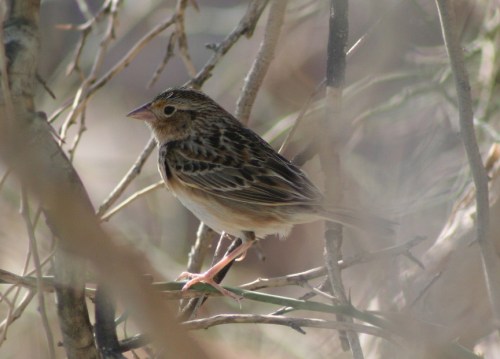
Grasshopper Sparrow- Ammodramus savannarum

This Grasshopper Sparrow was hidden low in a Palo Verde. As a wayward migrant, I assume it was fatigued from a night flight en route to its breeding grounds along the California coast. It sat relatively still, avoiding me by staying low and well hidden in the shrubbery. I was excited as it was a life bird for me, and was very cooperative with camera.

I had luck on my side as far as nest finding goes. I myself found two active Black -tailed Gnatcatchers. I have seen these birds all season, performing territorial and courtship displays. Today was the first time I had seen the result of such behavior, birds in nests. The Gnatcatcher nest is incredible. It is a tall, tightly wound teacup. The birds sit squished, exposing only their tail and beak. I noticed the first nest from only ten feet away. I was giddy, but held back my vocal celebrations as not to stir the bird.
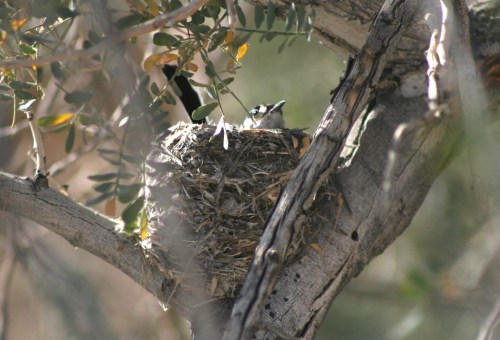
Black-tailed Gnatcatcher- Polioptila melanura

This first bird is a male. I noticed the black cap in the other photos I took, not shared due to the poor quality, but worthy of keeping for the information gleaned. Many species share the burden of incubation. I was glad to finally seem something for myself rather than learning by reading. Oh the benefits of field work. Only half an hour later I found  my second Black-tailed Gnatcatcher nest with an incubating female.

Black-tailed Gnatcatcher- Polioptila melanura

It has been quite the experience seeing this bird go through the exercises of creating life. I hope to see more, as the birds make their efforts to produce the next generation of bold scolding Black-tailed Gnatcatchers.

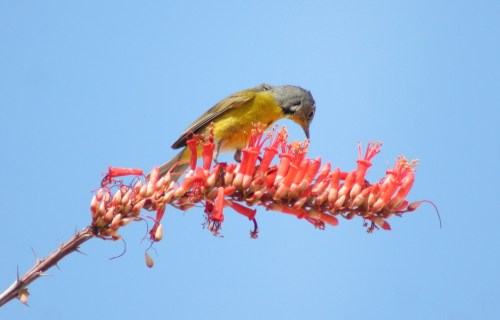
Nashville Warbler- Oreothlypis ruficapilla

by Bryce W. Robinson

Nashville Warbler- Oreothlypis ruficapilla. 11x15" colored pencil on bristol.

I’ve started a study of Warblers. I am seeing quite a few in the field, as we are in the full swing of spring migration. The warblers are a large group of birds. I feel an appropriate way to make sure I learn the ins and outs of these birds is to not only actively search them out, but illustrate them and really study each species. The first time I saw the Nashville Warbler, I thought it might be a MacGillivray’s. After seeing it a few more times, and really spending some time in my guidebook, I learned the difference. The red crown of the Nashville males is often hidden. I have only seen it once so far. The most helpful tip to quickly separate the Nashville from the MacGillivray’s is the throat. Nashville is yellow, MacGillivray’s is grey. There are other factors separating the two, but I feel that the throat is the most helpful tip. I have still not seen the MacGillivray’s, but I will and when I do, I will illustrate it as well.

Youth in the Red-tailed Hawk

by Bryce W. Robinson

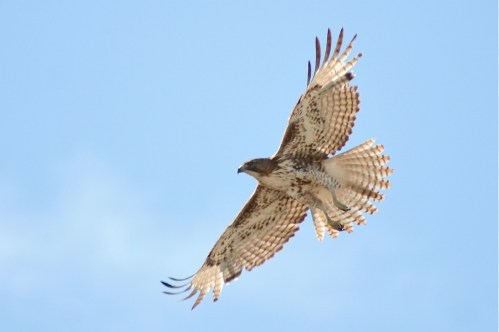
Juvenile Red-tailed Hawk- Buteo jamaicensis beginning its first molt into adult plumage

*REVISION* Originally I had posted this photo, claiming that it was a young  juvenile fresh in the world. I’ve since been corrected, and feel very embarrassed for missing an obvious sign that this bird is indeed a first year undergoing its first molt. Notice the primaries with the dark edge. These are new adult feathers. I am not an authority, and make mistakes often. I want to stress that if anyone reading my posts catches an error, or has any critiques, please feel free to correct me or bring up your point. After all, I am only a student, and need the help to learn. Thanks to Jerry for being a friend and making sure I’m headed in the right direction. Certainly, this is not the best photo, but I thought it worthy of sharing. This bird is probably on its first or second week out of the nest. Note the pale iris, semi-translucent primaries, and neatly banded tail, all features indicating a juvenile bird. This youthful creature was not sure what to think of me as I approached and let the shutter sing. He hardly knew what humans meant, but as with all animals, I’m sure he will learn.

What I See When I Work

by Bryce W. Robinson

Male Costa's Hummingbird- Calypte costae

I have an incredible job. I birdwatch for a living…

Today I had multiple opportunities with cooperative birds. I just thought I’d share what are daily birds where I work.

Nashville Warbler- Oreothlypis ruficapilla

Nashville Warbler- Oreothlypis ruficapilla

I’ve been noticing a great deal of Nashville Warbler’s moving through. The last two weeks were full of Orange-crowned Warblers. I didn’t see any today. Their migration peak for the area is most likely on its tail end.

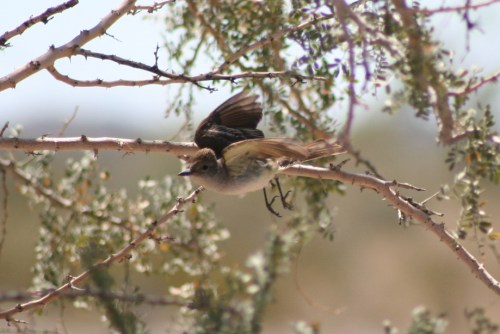
Ash-throated Flycatcher- Myiarchis cinerascens

I see many Ash-throated Flycatchers. They are very timid birds, always hard to photograph. Today I lucked out with a semi-decent shot. I’ll take what I can get with this bird. They are great, charismatic birds. I love starting in the morning, hearing many birds, and among them the familiar coach whistle call of this Tyrant.

I really am blessed with an incredible job. Can’t wait till tomorrow.