A studio for bird study

Tag: nest

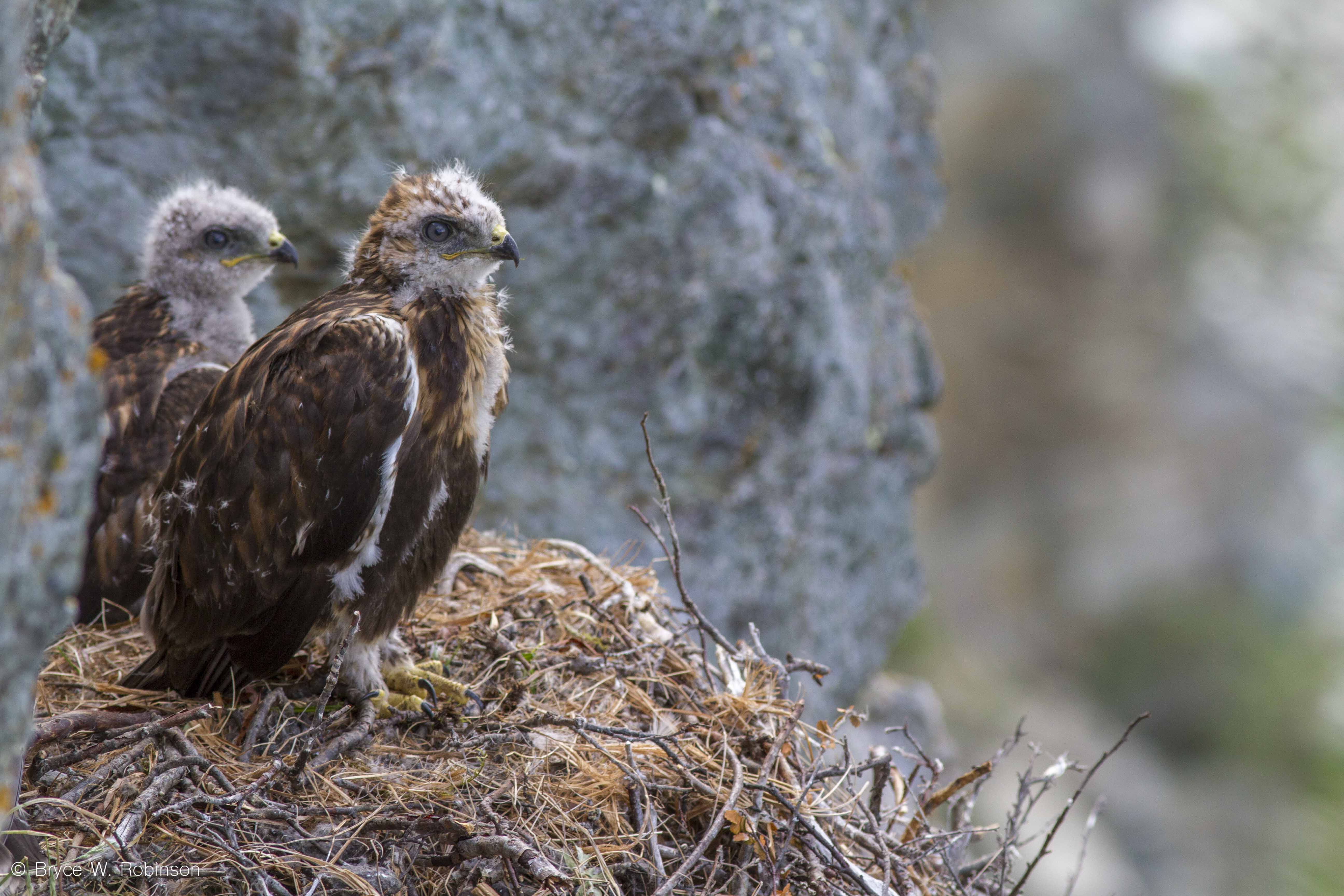
Rough-legged Hawk Nestlings

by Bryce W. Robinson

Rough-legged Hawk Nestlings

I was surprised the first time I saw the proximity of nesting Rough-legged Hawk and Gyrfalcon. It was my first summer in Alaska. I was along the Dalton Highway peering through a scope at an incubating white Gyrfalcon. Only 100 meters down the cliffside was an incubating Rough-legged Hawk. Now that I’ve gained an in depth experience with cliff nesting birds of the Arctic, I see why these birds tolerate one another. There simply aren’t enough locations to be choosy.

These eyes were watching me as I pulled out one of my Gyrfalcon nest cameras the other day. This is on the extreme end of Gyrfalcon – Rough-legged Hawk nest proximity. These nests are only about 10 meters apart, and given that these young Roughies are about to fledge, they will both be successful. Almost every cliff I’ve worked in this summer has had a nesting Rough-legged Hawk pair. Some cliffs have had two, along with nesting Raven and Cackling Goose (yes, they nest in cliff nests often). Real estate is limited, so all suitable sites are usually occupied given enough food in the area.

Rough-legged Hawks are a favorite. I gained a familiarity with them during past winters in Utah, and it was always a dream of mine to see them on their breeding grounds. Each time I’m around a nest, I remember my current place and business in life, something that is not to be taken for granted. I’m living a personal dream, and I’m happy.

Banding Nestling Gyrfalcons in Western Alaska

by Bryce W. Robinson

Gyrfalcon Nestlings

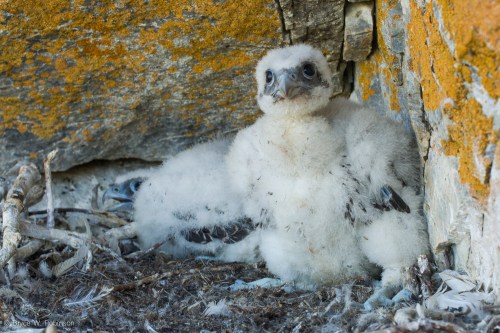
Photo 1. Gyrfalcon nestlings just after seeing their very first human being. One nestling is attempting to hide, while the other looks boldly into the eyes of the onlooking researcher.

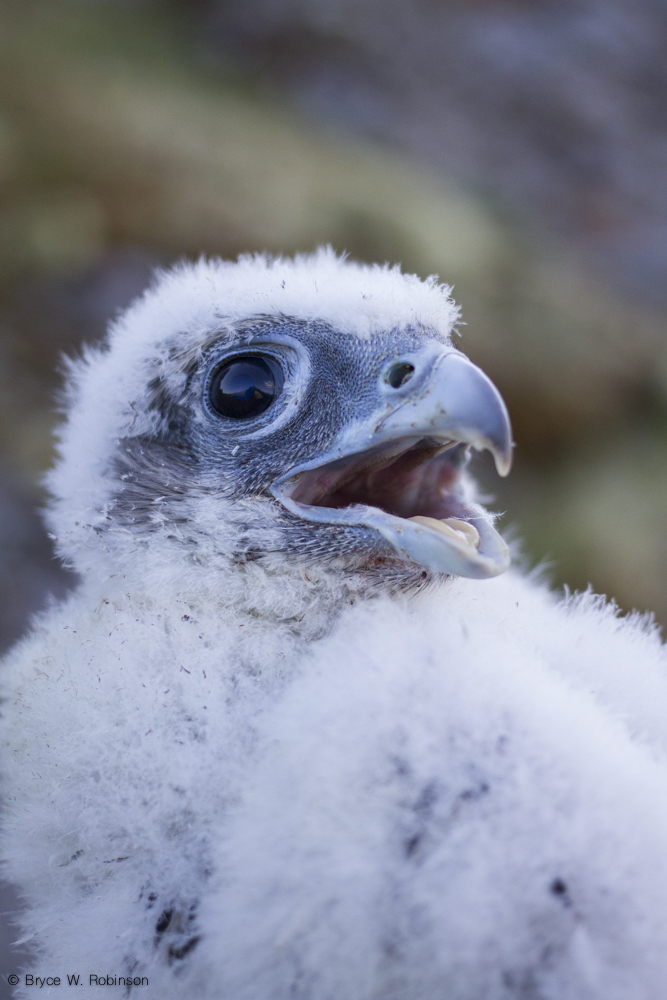
The best part of working on a project focused on nesting Gyrfalcons is interacting with the nestlings. I can’t help but spend a moment or two to admire them each time I get one in my hands. They are young, yet full of personality and intelligence. I lose the ability to articulate the experience of dropping into a nest, and being the first human these nestlings have ever seen. Their response is remarkable, as they recognize me as an intruder and prepare to fight. There is, however, a certain degree of curiosity in their eyes. What impresses me most is their confidence, seen in their posture and stare.

Female Gyrfalcon Nestling

Photo 2. A tenacious young female Gyrfalcon, age 25 days. She is full of fight and intelligence. This attitude will serve her well after she leaves the nest and needs to learn to hunt and kill to survive.

We schedule our second round of nest entries when the nestlings are 25 days old. At this point their legs have fully developed, so we can outfit them with aluminum USGS leg bands. These bands give them a unique identification number, so that if the bird is caught or found researchers can tell where the bird came from, and where it went.

Banding Gyrfalcon Nestlings

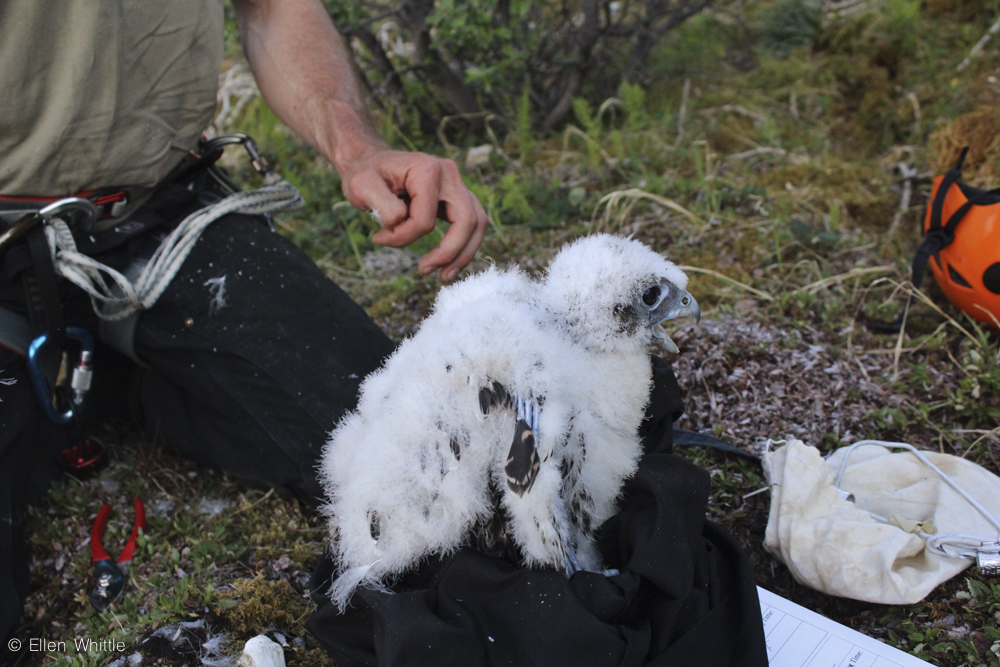
Photo 3. Crimping the “lock-on” band. Most Gyrfalcons take band size 7B. We put bands on the right leg, and crimp a metal fold-over to ensure this piece of leg jewelry stays with the bird for its entire life.

As the nestlings grow, they begin to realize the tools that evolution has provided them to hunt, kill, and defend themselves. When we enter the nests to band, the nestlings have developed into fighters. They bite, rip, and use their talons to lash at intruding researchers. Because of this newly developed tenacity, working with them takes its toll.

Part of the Work

Photo 4. A hand weathered by tenacious Gyrfalcon nestlings. This is part of the work. The young are held in a way that they are unable to bite the hands of the researcher, but they are intelligent and talented. Often, they figure a way to make us pay for the important data we collect.

It’s great to see youngsters that have so much fight. This aggressiveness will translate into behaviors necessary for their survival. Although the most aggressive young are not the most enjoyable to handle, it means the birds have what it takes to be a large falcon in the Arctic.

weight

Photo 5. Weighing a young Gyrfalcon. We weigh the nestlings to help calculate a general age, if unknown. Weight also helps us determine the health of the nestling.

Apart from banding, we have a number of other tasks to complete while handling the young. We take DNA samples, weights, wing and tail measurements to estimate age, and check for parasites. After each nestling receives its treatment, we switch out batteries and memory card in the nest camera. We will not come back to the nest until the young have left, so it’s important to make sure the camera continues taking data until the end.

So far, we’ve been to three of our twelve nests. Our hands have a lot more abuse ahead of them, but we are excited to continue nonetheless. More pictures and stories to come.

Thanks to Ellen Whittle for the photos of the work

Field Notes on Nesting Golden-crowned Sparrow

by Bryce W. Robinson

GCSP

Figure 1. Female Golden-crowned Sparrow – Zonotrichia atricapilla.

One of the perks of conducting research on Gyrfalcon’s in western Alaska is the time in the field to experience and study Alaska’s unique and diverse avifauna. I had never found the nest of a Golden-crowned Sparrow (Zonotrichia atricapilla) (Figure 1 & 3) until recently. The nest was at the base of a small willow shrub on a sparsely vegetated hillside dominated by lichen covered tundra. It was constructed of grass, was situated on the ground, and contained five eggs (Figure 2.). The egg color was a greenish blue with reddish brown splotching evenly spaced, but densely concentrated on the broad end of the asymmetrical elliptic egg (Figure 2).

GCSP_nest

Figure 2. Golden-crowned Sparrow nest. Note the Musk Ox guard hair in the bowl of the nest.

One thing I missed in the hurried attempt to photograph the nest and leave quickly was the hair in the bowl. It appears that the sparrow used the coarse guard hair of Musk Ox to line the nest bowl. Nests display the architectural and creative genius of birds. I am fascinated to see materials such as Musk Ox hair used in a nest, particularly in only one section such as the bowl. The area where I found the nest was covered with the fine wool from a Musk Ox, termed Qiviut. Why the bird did not use this fine wool, and chose coarse guard hair is enough to wonder upon.

GCSP

Figure 2. Female Golden-crowned Sparrow – Zonotrichia atricapilla.

While I was investigating the nest, the female remained close. I was impressed by her vigilance. She was anxious to continue incubating her clutch. I took her vigilance as a signal that my presence needed to be short, so I recorded the information I needed and quickly retreated. It’s an invaluable opportunity to be in such a place, where many unique and understudied birds are nesting all around. Truly, I’m in a field lab ripe for study, and I can’t take that for granted.

Alaska Birds are Gathering for Growth

by Bryce W. Robinson

Wilson's Warbler - Cardellina pusilla

In early July, Alaska birds are gathering for growth. I’ve been very focused on Gyrfalcon diet lately, but it too reflects the general trend of the season here. My eyes have been turning to the thickets lately, as the passerine nests have hatched out in large part. In the past week I have rarely found a passerine without a mouthful of assorted small insects.  The feeding frenzy is in full swing as hungry nestlings require massive amounts of food to fuel their rapid growth.

I appreciate the fast change here in the extreme north west of North America. It’s a great dynamic because it forces you to focus on the moment, as everything is fleeting. Soon, the adults will be joined by an abundance of juvenile birds to watch and study. I sure look forward to that!