A studio for bird study

Tag: owl

Flamms in the Future

by Bryce W. Robinson

Flammulated Owl- Otus flammeolus. 11×14″ colored pencil on bristol

It looks like I will be doing some work with the Flammulated Owl again this summer. I am very excited. I’ve missed this bird. With flam on the brain, I decided to put some effort today into illustrating my first colored pencil Flammulated Owl. About halfway through the illustration I was pleased with what was turning out, but I could feel myself getting a bit tired. Instead of taking a break and finishing the bird later, I continued. Needless to say the bird turned out a bit sloppy. I’m not too upset that the illustration didn’t turn out as well as I had hoped. I will return time and time again to paint, draw, or sketch this particular owl. It is such a fun species to work with. Overall, lesson learned. If I feel tired or burnt out, it is always better to take a break rather than soldier through.

Desert Peregrine

by Bryce W. Robinson

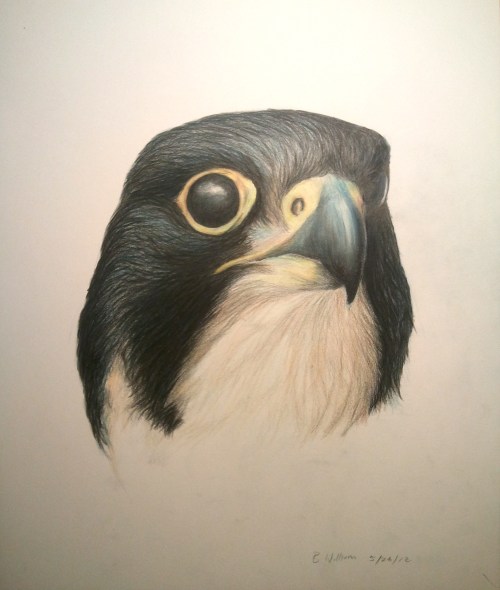
Peregrine Falcon- Falco peregrinus. 11×14″ colored pencil on bristol

At times I am asked to check on and re-assess the activity of raptor or raven nests on transmission towers here in the desert. This task requires me to sit vigil to the nest for at least a four hour period, or until I see activity in the nest. Last week I was asked to check on a Red-tailed Hawk nest in a particularly sandy and desolate section of the desert. The first hour was uneventful, until I noticed a bird sitting on the edge of the nest. I hadn’t seen the bird fly in, and so assumed it was a raven that had jumped up to stretch and take a rest from incubation. The bird was dark, and small, but when I looked through the scope, it was not a raven that sat in the nest. The unmistakable face pattern of the Peregrine falcon left me excited and confused.

For the next twenty minutes I tried wrapping my brain around why a Peregrine Falcon, a cliffside nester, would inhabit a Red-tailed Hawk nest in the middle of the desert. They have been documented using old hawk nests, but surely not in the middle of this desert, entirely out of their range. These falcons feed primarily on birds, and this portion of the desert is certainly lacking any bird activity that would sustain a single falcon, let alone a family. The only thing that made sense was that the bird made the daily trip some thirty miles east to the Colorado River to hunt. This seems highly unlikely. After fifteen minutes, the bird hunkered down into the nest. I could hardly believe what I was seeing. Soon after, the bird left the nest, circling high, riding thermals, and making a straight line fly for the south east. I was perplexed. Certainly this bird was not nesting on the tower. I expect it was passing through, and took advantage of the only shaded roost for miles, only to rest. Still, what an enigma.

This mysterious bird is the only Peregrine falcon I have seen all season. It makes sense as they are not seen often in the desert, and certainly do not nest or winter in the area. It is out of their range. I love when birding presents the unexpected. As birds have wings, they certainly can turn up anywhere.

I have been meaning to illustrate this falcon for some time. Today I decided that given last weeks experience, I ought to put forth the energy towards illustrating that distinctive face that left me puzzled and surprised. The bird was very far away, so I couldn’t use my camera get a decent photo. I did make an attempt to use the scope and my phone to get a photo. Certainly there is no mistaking it. The bird was not a Prairie Falcon, a bird that frequents the area I was in. I cropped the photo substantially to make sure the bird was shown clearly.

I also thought I would include another digi-scope attempt I made as I watched a family of Burrowing Owls. These guys were a blast to watch. I only wish I could have used my camera to get some better pictures. Maybe the opportunity will present itself soon. The Burrowing Owl is such a charismatic bird. I love every chance I get to watch them and their antics.

Western Screech Owl

by Bryce W. Robinson

Western Screech Owl- Megascops kennicottii. 11×14″ colored pencil on bristol.

A few weekends back I had the good fortune of finding myself on an Audubon ranch in southern California. Starr Ranch is an incredible coastal forest tucked behind a large gated community in Orange County. I came to the ranch to band owls.

The night was incredible. We had a few Big Brown Bats find their way into the nets, providing me the experience of seeing these winged mammals up close. I have never seen teeth so delicate yet fierce. We did have luck with capturing owls. Our first owl of the night was a beautiful female Barn Owl. I was able to take her from the net and band her. Having this ghostly creature in hand, staring into its dark marble eyes, is an experience I will never forget.

We also had four Western Screech Owls caught in the nets. I love the small owls, and was looking forward to the chance of banding one of these birds. The small birds are so endearing. Cute fits them perfectly, they are so full of fight and life. Returning the bird to the night was spectacular. I walked to the woods and perched the bird on my fingers. It sat for a while, not certain of its ability to flee. After a minute or two, the bird took to the night air and disappeared into the dark.

Today I spent my afternoon illustrating a headshot of the Western Screech Owl. I thought it appropriate to revisit this subject, given my recent intimate interaction with the bird. Every time I finish the owl, I feel a bit dissatisfied with the outcome. For whatever reason, I can never get the owl quite right. I would have probably loved this illustration if I would have left the ear tufts tucked back. I feel I drew them a bit too long. Still the exercise was rewarding, and I’m sure I will come out with a screech owl I am happy about if I only keep trying.

Northern Spotted Owl- Strix occidentalis caurina

by Bryce W. Robinson

Northern Spotted Owl- Strix occidentalis caurina. 11x15" watercolor on paper.

I’ve never seen a Spotted Owl in person. I’m sure the day will come, whether it be the Mexican Spotted Owl, Californian, or Northern, I’m sure it will be incredible. I’m currently working on a job with a guy named Jeff, who has spent the greater part of the last eight years in northern California working with the Northern Spotted Owl. He tells endless stories of his nightly wanderings amidst the redwood giants of Humboldt County. I love telling my own stories of wilderness wanderings, but even more, I love listening to others.

The other night over some beer, Jeff showed me a number of videos he took of Spotted Owls. I couldn’t believe the footage, and the narrative he provided with each clip. It made me anxious to get out and find the bird. After some time went by, I realized I had to paint an owl for Jeff. I respect his work, and truly envy the time he has spent working with this creature, so the next day I sat and painted the Norhtern Spotted Owl. I gave it to Jeff to thank him for sharing his passion.

Currently the Spotted Owl is facing a new threat. We all know of the controversy between environmentalists and the logging industry about the removal of old growth forest timber so important in the lives of the Spotted Owl, but this new threat is not man. The Barred Owl- Strix varia, has now moved into the territory of the Spotted Owl. As the Barred Owl is more adaptable, and outcompetes the Spotted Owl, concern has risen that the fate of the Spotted Owl is again reaching a critical state. The topic is very complicated, as all things ecological are. Managers are now discussing the possibility of shooting the Barred Owl to eliminate it from the area. Such an ardent management policy is of course highly controversial, and requires a great deal of discussion and contemplation.

I would love to research the topic more thoroughly, and make an actual report and analysis of the issue. I have my own opinion, however I will admit it is not a truly educated opinion. In the future, I will gather some research papers and some background on how the Barred Owl has come to the areas of the Spotted owl, and what I think should be done in attempt to solve the problem. Until I complete that essay I’ll have to stay away from forming a public opinion. I would, however, love to hear how people feel about the issue.