A studio for bird study

Tag: painting

Painting the Red-tailed Hawk- Buteo jamaicensis

by Bryce W. Robinson

Often on art blogs and websites I see the step by step process of the artist’s latest work. I have never done such a thing, and for personal reasons, however I decided to give some insight into how I go about putting together a watercolor painting. For my latest work I decided to paint the most well known hawk in North America, and a personal favorite, Buteo jamaicensis.

For B, every painting begins with a pencil, no matter the medium. I sketch the contour of the subject, solving any problems with proportion and placement before laying down anything permanent.
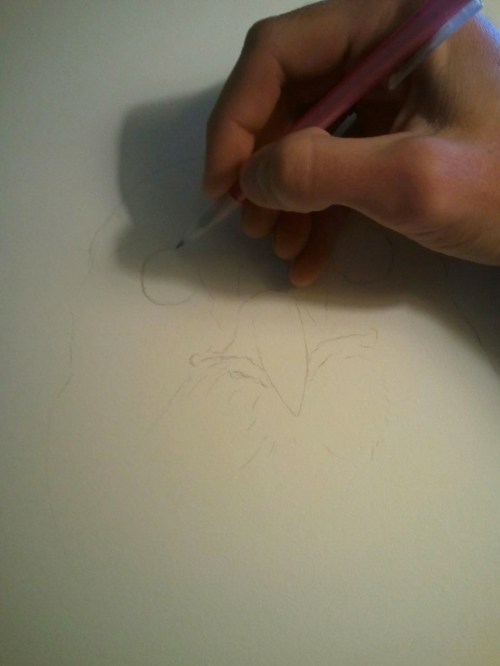
After I am pleased with the form of the piece, and my excitement and vision for the end product begins to bud, I begin laying down light paint layers to establish the base for color and depth.
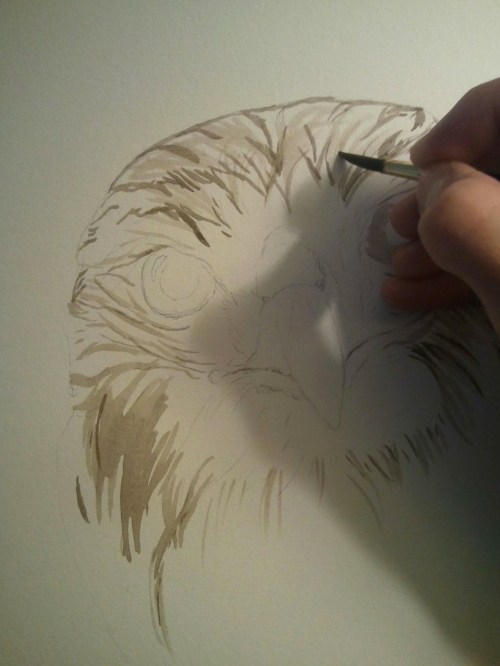
I get extremely excited when the painting begins to gain depth. By bouncing around the painting, I get into a great rhythm and keep the formation of the picture balanced.

The eyes are always my favorite to begin working with. After the first layers of the eyes are drawn, the bird has some semblance of life. I can then begin analyzing the particulars of where to add and shape to create a natural looking bird. Also, I always make sure to have the catch light in the eye, positioned properly with balance in both eyes. This is certainly a challenge, and can make or break a painting. With practice it becomes intuitive, as is the case with most things.
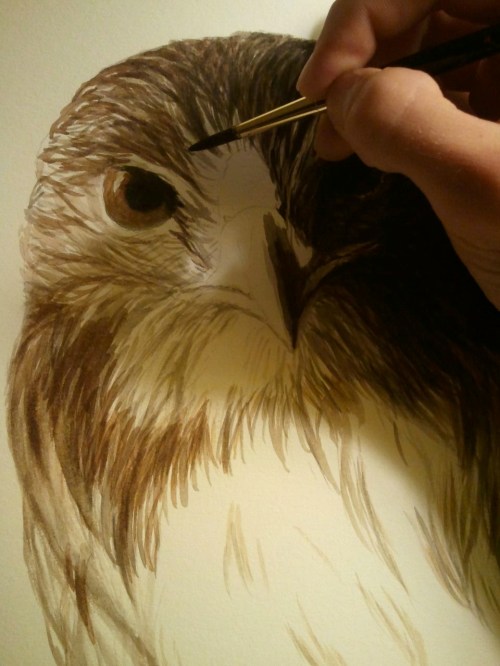
The process of painting with watercolor is different from oil and acrylic. With the latter two mediums, you start dark, building out the light. In watercolor, you start light and build in the shadows. I am not sure which process is easier, or which I like better, but at the moment, I am loving the watercolor. I tend to keep the painting bland and monochromatic as I build the depth. When I get a bird that looks in place, I then begin adding the colors that are the highlights, such as the eye color and beak in this bird. Once these colors are added, the home stretch begins as I meticulously scrutinize the detail until I am satisfied with the ending. Often, I am not satisfied, but I recognize that if I continue to try and manipulate the painting to my liking, I may ruin it beyond repair. It is a fine balance between knowing when to stop, and going to far. This is a problem I am working on at the moment. Always something to learn.

Red-tailed Hawk- Buteo jamaicensis. 11x15" watercolor on paper.

Currently at work here in the Mojave, I am watching a few Red-tailed Hawk nests. Today I noticed that one female has started to incubate, and in a months time, 28-32 days to be precise, chicks will hatch. This painting is in honor of the cyclical ritual of life, and a symbol of luck to the prospective parents of the hatchlings.
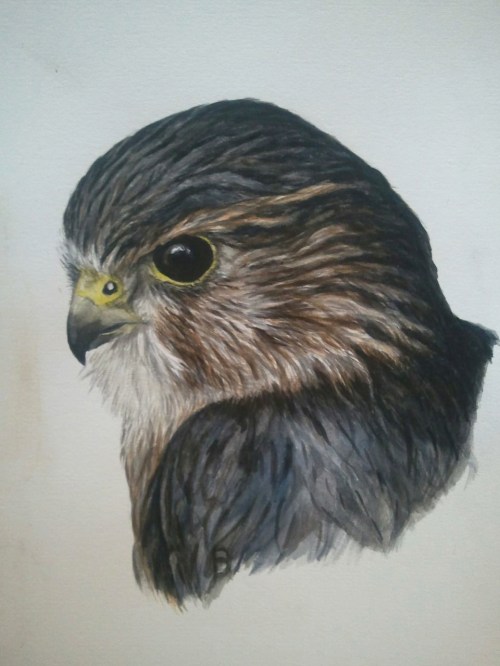
Merlin- Falco columbarius

by Bryce W. Robinson

Merlin- Falco columbarius. 11x15" watercolor on paper

The Merlin is an extremely interesting falcon. Three distinct subspecies split the Merlin; the Taiga, the Black or Pacific, and  the Prairie. Each subspecies exhibits a particular plumage type, a fact that undoubtedly adds to my obsession with the bird. Most commonly seen is the Taiga. The males are a beautiful slate blue, with orange hues on the breast. The female is a paler version of the male, with brown tones replacing the blue, and lacking the orange hue. I have had many encounters with the Taiga this winter, and I am sure there will be more before the seasons end. I have also had a few opportunities this year to see the Prairie Merlin. The Prairie is a very pale version of the Taiga, easily distinguishable. The final subspecies is the Black Merlin. True to its name, the Black is a dark Merlin. Captivating for the onlooker I am sure, but alas, I have never personally seen a Black Merlin. I am sure that with diligent effort that fact will change. For whatever reason the Merlin is a favorite of mine, and I find every encounter a blessing. I look forward to meeting the bird time and time again, photographing, watching, and painting the bird thousands of times over.

Female Juvenile Northern Harrier- Circus cyaneus

by Bryce W. Robinson

Female Juvenile Northern Harrier- Circus cyaneus. 11x15" watercolor on paper.

In honor of the delicate beauty of everything female, I painted the Northern Harrier. Although common, I find myself enamored and entranced with every view of this bird. The young females seem especially vivacious, with the teetering wander to hunt for prey and the dainty image while perching to preen. My goal with the female juvenile harrier was to capture the youth and liveliness in  character, portraying femininity common to all creatures, yet remaining true to the birds identity and wild nature. Perhaps a lofty goal, but worthy of the effort nonetheless.

Adult harriers are sexually dimorphic, but differences can also be seen in juvenile birds as well. Typically, a juvenile Northern Harrier is a cinnamon brown with a beautiful reddish breast. The difference between the male and female is seen in eye color. It becomes a challenge to sex juveniles in the field, as you often see harriers on the wing, and hardly perched. When the chance arises that you find a tolerant youngster, take note of the eye color and any other differences that stand out. I remember a day while photographing harriers with Jerry Liguori, when we were taking shots of what we thought to be an adult female. After reviewing the photos and seeing a few key details, namely eye color, Jerry recognized that the bird was in fact a young male. These particulars can add more fun and excitement to the challenge of raptor ID.

This painting was created while listening the musician Lisa Hannigan. I suggest coupling the visual with a like artist. It is sure to enhance the experience. Enjoy.

Swainson’s Hawk- Buteo swainsoni

by Bryce W. Robinson

Swainson’s Hawk- Buteo swainsoni. 11×15″ watercolor on paper

In anticipation of the northward return of one of my favorite raptors I felt the need to illustrate a portrait shot of the rufous morph Buteo swainsoni. I have two goals in my future artwork: First, to strengthen my illustration skills for reference to identification or in explaining other technical topics such as molt, morphology, anatomy, etc. and second, to enhance my ability to convey the birds in an artistic manner straying from a realistic portrayal. The above watercolor is an attempt at the latter. I hope that the approach will speak to the intelligence of winged creatures, appealing to those that may identify with the bird’s beauty, otherwise unrecognized by most. The hawk above is a major migrant, peering outward towards the viewer with marble eyes that have reflected more lands in one season than any eye of humanity will in a lifetime. The life of this bird inspires awe, and this painting is my homage.