A studio for bird study

Tag: painting

Dark-eyed Junco Subspecies in Idaho’s Winter

by Bryce W. Robinson

Juncos_ID-online-01.jpg

For the Junco lovers that like this image, you can purchase a print by clicking on the image above.

Above is an illustration I just completed of some select subspecies of one of my favorite birds, the Dark-eyed Junco (Junco hyemalis) – Male and female “Oregon” (J. h. oreganus), “Pink-sided” (J. h. mearnsi), “Cassiar” (J. h. cismontanus), and the nominate “Slate-colored” (J. h. hyemalis). I think the junco is a favorite because it is polytypic, with some excellent variation in phenotypes throughout its range. I particularly am drawn to the Cassiar Junco because it is both difficult to diagnose (separate from Slate-colored X Oregon intergrades, if they even are different!) and little understood. For more information on this taxon, check out these links:

http://ebird.org/content/nw/news/dark-eyed-junco-races-oregon-slate-colored-and-cassiar/

http://nwbackyardbirder.blogspot.com/2011/04/not-slate-colored-junco-cassiar-junco.html

Here is information on its current and past taxonomic status:

https://avibase.bsc-eoc.org/species.jsp?avibaseid=DED1C8F9EE711FCF

I also like the Dark-eyed Junco because from what we understand regarding it’s phylogenetics, it is a very recent radiation. Speciation well in process! See this article for an explanation:

Click to access POSTPRINT%20Mol%20Ecol%2025(24)%206175-6195%20(2016).pdf

Further, be sure to educate yourself with the Junco Projects great film – Ordinary Extraordinary Junco. I included a chapter of the film below that discusses the diversification of the species.


My illustration comprises the candidate subspecies that make up Junco flocks here in western Idaho. I chose to illustrate the male and female Oregon because they are by far the most common and provide the point with which to contrast and compare any outliers. The others are males, so as to provide simple examples of the other subspecies. Of course first-year and female types of these taxa can blend in appearance with the rest, which makes things much more challenging and fun.

Here I’ve included a rough and disorganized compilation of some information on what we currently understand about the Dark-eyed Junco and its sister species. There is a lot more out there, so if you love this as much as I do then be sure to explore more.

Here is a link and a few  references to investigate.

Speciation mechanisms in the Junco radiation

Milá, B., P. Aleixandre, S. Alvarez-Nordström and John McCormack. 2016. More than meets the eye: lineage diversity and evolutionary history of dark-eyed and yellow-eyed juncos. In Snowbird: Integrative biology and evolutionary diversity in the junco. Ellen D. Ketterson and Jonathan W. Atwell (Eds.), Chicago University Press, Chicago.

Miller, A. H. 1942. Speciation in the Avian Genus Junco. The American Naturalist 76:211-214

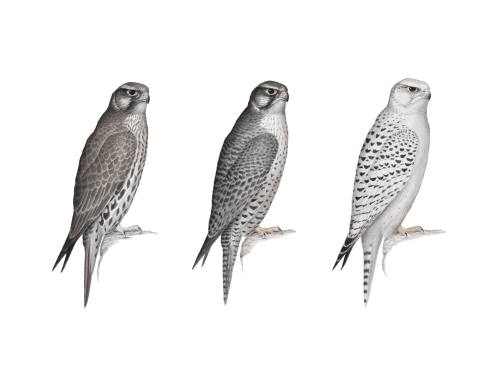
Gyrfalcon (Falco rusticolus) Plate

by Bryce W. Robinson

Gyrfalcon_Plate_2017-11-03-online-01

My friend Kenneth, a Gyrfalcon researcher in Norway, is perhaps the most enthusiastically obsessed Gyrfalcon lover I know. I really appreciate his passion for the bird. Next week he is traveling to Salt Lake City for the Raptor Research Foundation’s annual conference. He asked me to paint a Gyrfalcon portrait for him, so I decided to take the opportunity to illustrate some perched birds to populate the plate I’ve been putting together. I going to produce some giclee prints of this plate, but I’m limiting it to 20 prints. If you like this image, and would like to purchase a print, it is available in the shop!

It’s taken me some time to paint birds that I’m pleased with enough to put into plate form. I’m still a bit at odds with these birds, but I think the above image best fits what I’m going for in creating the plate. My next step will be to paint some different postures and explore which best fills the gap in understanding the different positions and appearances that a Gyrfalcon may take on, in varying conditions. Additionally, the plate needs multiple different in flight postures, and some other age and plumage morph descriptions. Progress has been made either way, and I’m excited!

Below is the painting that I did for Kenneth, as it will look to him. I’ll be traveling to Salt Lake City myself, with this painting alongside me. Thanks for the opportunity Kenneth!

GYRF_Perched-online.jpg


American Kestrel Painting – Male and Female

by Bryce W. Robinson

AMKE_Pair

I’ve painted the American Kestrel multiple times, and each is an improvement. But, all I see are the mistakes here. I struggle with being overly critical with myself, but I try to remember that the process and the growth are most important in my work. I learn a lot from each painting, about the birds structure, etc., but also about the process of painting. As I struggle with focusing on my faults, I’m working to stay focused on my growth, while recognizing the mistakes constructively. Hell, this exercise probably translates to everything in life, not just painting birds.

I’m going to make limited prints of this American Kestrel pair, so if you’re a kestrel lover click on the image and purchase a print.

Charadrius Plate

by Bryce W. Robinson

2L3A7578-2-01

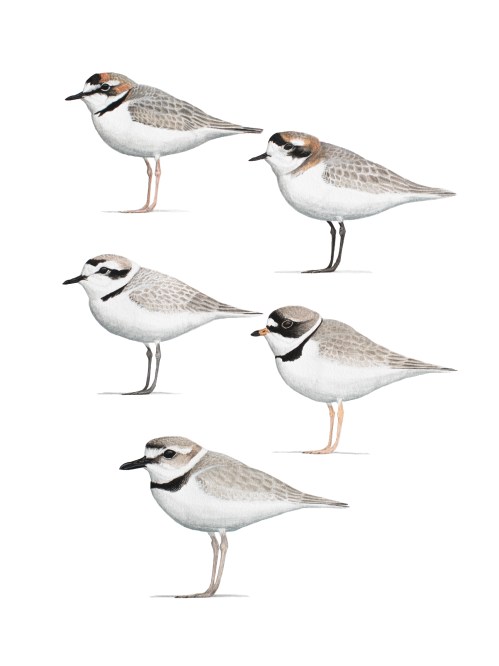
My friend Dan asked me to paint a shorebird plate for an auction at a conference that he will be attending in Peru in November. I chose to highlight the genus Charadrius for the plate, choosing five species from the new world. From the top, I’ve illustrated the Collared Plover (Charadrius collaris), Puna Plover (C. alticola), Snowy Plover (C. nivosus), Semipalmated Plover (C. semipalmatus), and Wilson’s Plover (C. wilsonia).

I learned a great deal from this painting. I am seeing a bit of growth in my painting over the past year, and this piece in particular represents a move forward. I’ll be painting many more plates that highlight species or subspecies groups.