A studio for bird study

Tag: photography

Northern Shrike Nest in Western Alaska

by Bryce W. Robinson

IMG_7056-2

I’ve been on the ground in Alaska with my friend Neil for a week now, and the hunt for Gyrfalcon nests has been all consuming. We haven’t had much luck on the Gyrfalcon front, most nest sites are occupied by Rough-legged Hawk, Golden Eagle, and Common Raven.

Although we’ve had little success with finding Gyrfalcon nests, we have found many other natural treasures. We’ve already seen our fill of Grizzly Bears, and even caught a brief but close look at a Gray Wolf. It seems that every day in the Alaska bush turns up a number of great experiences. One that tops the list for this past week was when I found a Northern Shrike nest in a small tree along a creekside.
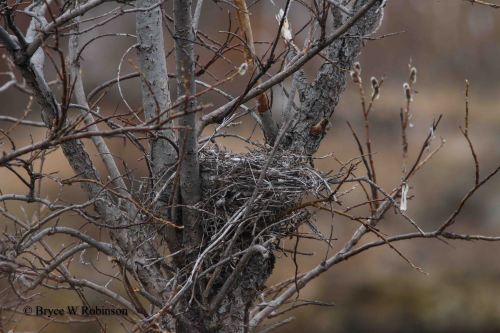
NSHR Nest

The mother held tight in the nest until we were within twenty feet. She then fled, and as we were checking the nest and counting eggs, she came back to her nest. Her responsible behavior and fidelity to her clutch provided me with some great opportunities to photograph her. I appreciate the tenacity of these small passerines. They are truly a vicious song bird. You can see she has some blood on her beak. NSHR

I’ve spent some time at Loggerhead Shrike nests in the desert southwest while doing nesting bird surveys, but I’ve never seen a Northern Shrike nest until now. I’ll tell you, the nests of excubitor are not at all unlike ludovicianus. This nest, like the Loggerhead, was in the middle of the small tree, cones shaped and made of many twigs. The cup was rather deep, and lined with many feathers to insulate eggs and young from the severe weather of the Alaskan tundra. This was a great moment in my first hand education in ornithology, so I had to share.

NSHR Nest wm-0900s


The Gyrfalcon Project is on the Ground in Alaska

by Bryce W. Robinson

Adult female Gyrfalcon- Falco rusticolus

I’m in Alaska to start the first field season of The Peregrine Fund’s Gyrfalcon Project. I landed only three days ago, and hit the search for nests right away. At this point, the earliest nesting Gyrfalcons will have hatching eggs any day. For my research, I need to find them before they hatch.

Gyrfalcon Eyrie

Already I’ve located two occupied territories, with one nest well into incubation. With the help of my friend and field assistant Neil, I made my first entry into an eyrie yesterday to assess nest age, and gather other important data. While I was in the nest, Neil took advantage of the disturbance and documented two very responsible adult Gyrfalcons as they circled and watched my intrusion.

Adult Female Gyrfalcon- Falco rusticolus

After we finished our tasks of data collection, we left the nest. When we reached a distance of approximately 500 meters from the nest cliff, we turned around and took a look at the nest. We were happy to see the female had already returned to the nest to resume incubation. While I was in the nest, I was able to see that one egg had pipped, meaning that in a couple of days there will be some newly hatched Gyrfalcons.

Stay tuned as the summer progresses. There will be numerous reports over the course of the season. Soon there will be nestlings, and I’ll be there to photograph them. You can find out more about this work on ornithologi’s Gyrfalcon Project page, and be sure to check out the Peregrine Fund’s website and consider supporting my work, and raptor conservation as a whole. Here’s to a successful summer, with loads of Gyrfalcon’s!


Western Scrub Jay with Bill Deformity

by Bryce W. Robinson

IMG_7332

My friend Mitch Tall sent me this image today of a Western Scrub Jay that he photographed in Salt Lake City, Utah. He wanted to know if I had any insight into what was wrong with this bald bird. I don’t have a lot of knowledge when it comes to bird maladies, however, I quickly noticed the elongated growth in the bill. Some birds have a disorder where their bills grow continuously throughout their lives. My friend Ron Dudley has documented several birds with related issues (See photos here). I’d be confident stating that stress related to the deformity is why the Scrub Jay is lacking feathers on its head. Still, I wonder if something such as mange is to blame, compounded by the health issues caused by the bill deformity. 

IMG_7326

I’d love to hear some ideas from those who have more knowledge on this issue than I. In the meantime, I’ll be researching some possibilities in hopes of having an answer for Mitch. Thanks again for sharing these Mitch, and kudos on the great photography.


Peculiar Plumage of the Harlan’s Hawk

by Bryce W. Robinson

IMG_3925

I found this interesting Harlan’s Hawk today in Hagerman, Idaho. It’s overall plumage left me thinking about Harlan’s ID. I’ve heard many people describe the “distinguishing” characteristics of the Harlan’s Hawk, but I’m always left confused as most of the Harlan’s I’ve seen don’t quite fit the mold they describe. I only know of a handful of people that can properly articulate why a bird is a Harlan’s, or not. In fact, I don’t include myself in that small list. I can recognize the subspecies, but putting that recognition into words is challenging. I believe this is due to the extreme variation in these hawks.

IMG_3886

The white lores and flecking against a dark background on this bird are the only part of the body plumage that tips the filter for Harlan’s. It is not the deep black that everyone describes for the subspecies, nor is it highly contrasting. To be clear, this bird is very dark, but I’ve seen many Calurus that are highly melanistic, with deep dark brown bodies, even with light markings on the breast not unlike this bird. Many of the Harlan’s in Alaska and the Yukon Territory that I saw this past summer were soft brown, not at all high contrasting in plumage. This variability causes some confusion. So what makes a Harlan’s? As with all bird Identification, the ability to recognize a bird comes with study, exposure, and the overall impression of the bird. I have always compared bird identification to facial recognition, where multiple factors contribute to a recognizable image, without any cognizant processing. I leave the breakdown of what specific factors contribute to Harlan’s identification to the true experts, like J. Liguori.

IMG_3930

At times, there are single clinching factors that seal the deal in bird ID. For the Harlan’s, it is the iconic tail, the one mysterious trait that causes we the birder so much awe and admiration. But, I’ve seen Harlan’s with red, banded tails. Most of the birds I saw in the north last summer had extensive red in the tail. The Harlan’s tail can often be misleading. This fact, coupled with the variation in body plumage leads to the point of considering every bird as a whole.

The bizarre tail of this bird is fascinating. The central feathers are half ghostly silver, and half solid dark. The others are irregularly banded and spotted against a background of soft reddish tones reminiscent of its specific designation. After encountering this bird, I’m left with one question: Are any two Harlan’s alike?